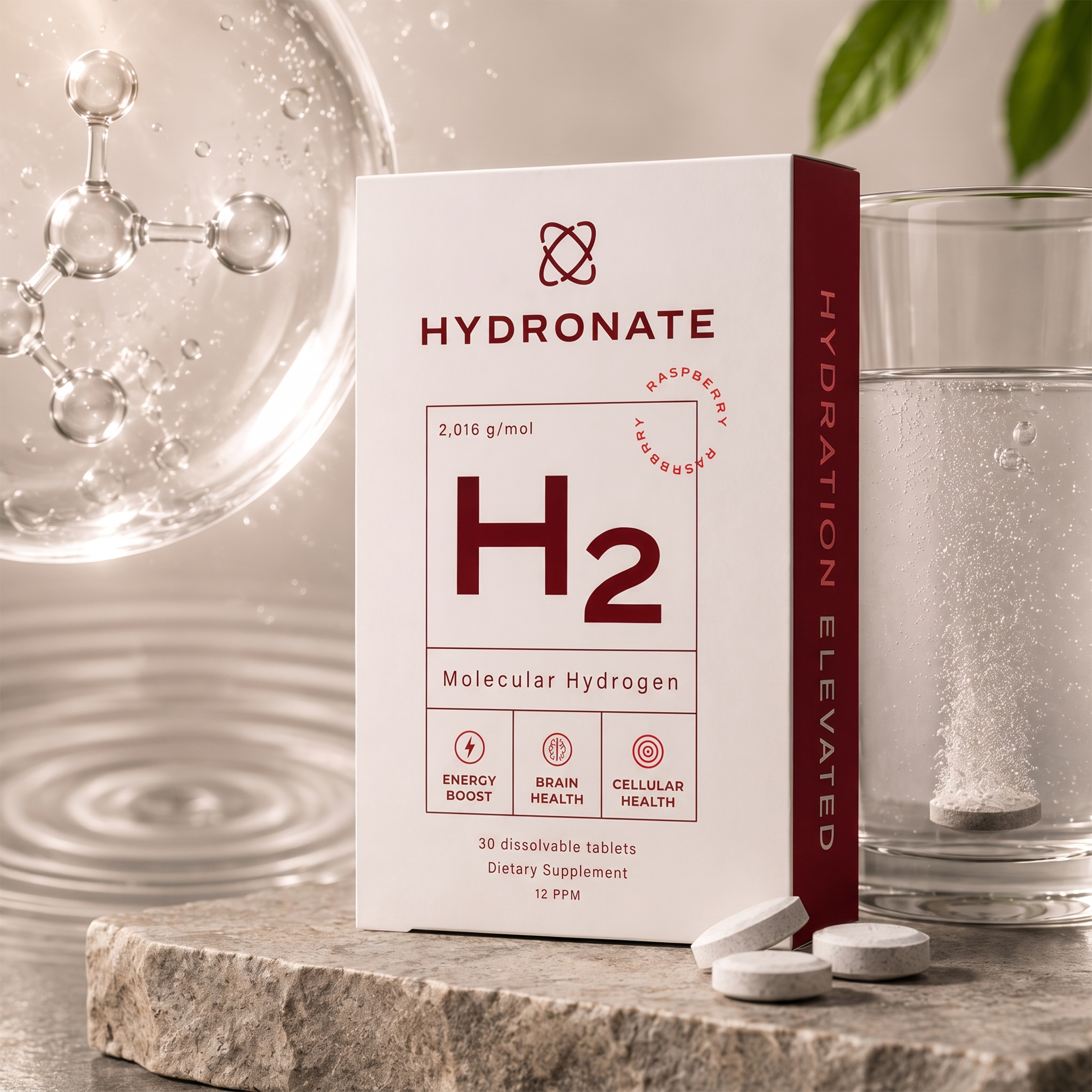
Limited time offer · applicable from this page only
Home>Health & Digestion>Gut Health Support by Hydronate

Gastroenterologist: I Found The Reason Why Your Constipation Won't Go Away — And Why Nothing You've Tried Has Helped
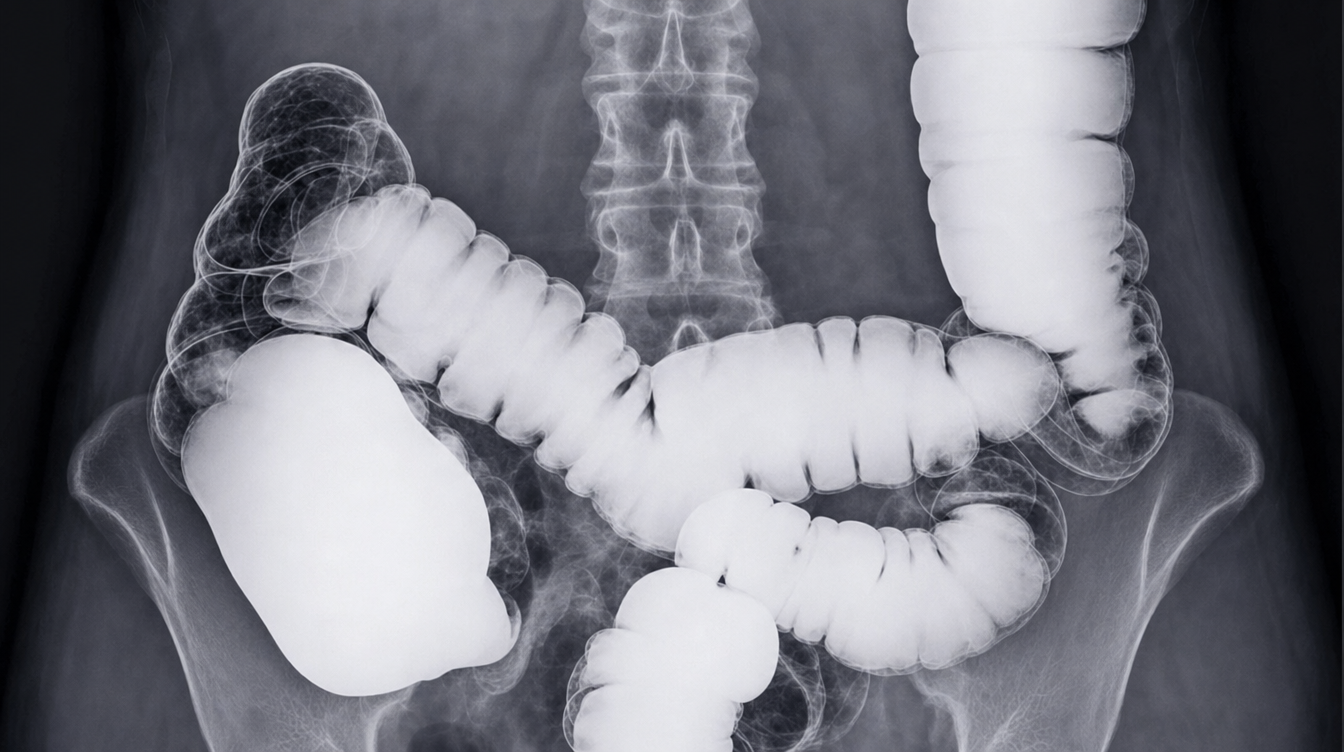
Contrast X-ray of a large intestine showing the full loaded length of the colon.

For thirty-one years I told patients the same four things. More fiber. More water. More walking. A laxative when it gets bad.

Then I couldn't fix it in myself either — and I finally understood why. Their colons were never the problem. They were waiting for a signal that had stopped arriving.

★★★★★4.9 · 80,000+ verified reviews

Written from Charlotte, North Carolina · August 2026

I'm going to tell you what I wish somebody had told me in 2017, and it will take about eleven minutes.

Everything in here is checkable. I've put the references at the bottom, and where the research doesn't support something, I say so — because after thirty-one years in this specialty, the thing I trust least is a page with no limits on it.

We All Kept Failing For The Same Reason

What broke it open for me wasn't a journal. It was reading my own patients' words back to me — in forums, in review sections, in the comments under every gut product on the internet.

Different ages. Different diets. Different products. And all of them using the exact same words.

Not similar words. The same ones.

Thousands of people. Same five sentences.

Things that fail randomly don't fail in a pattern. A pattern means there's one mechanism underneath — and everybody's been treating something else.

A collage of forum posts from people with chronic constipation, all describing the same failures.
Different subreddits, different years, different ages. The same five sentences.

And every one of those threads has the same shelf sitting behind it — the four or five things everybody is told to try, in the same order, with the same result.

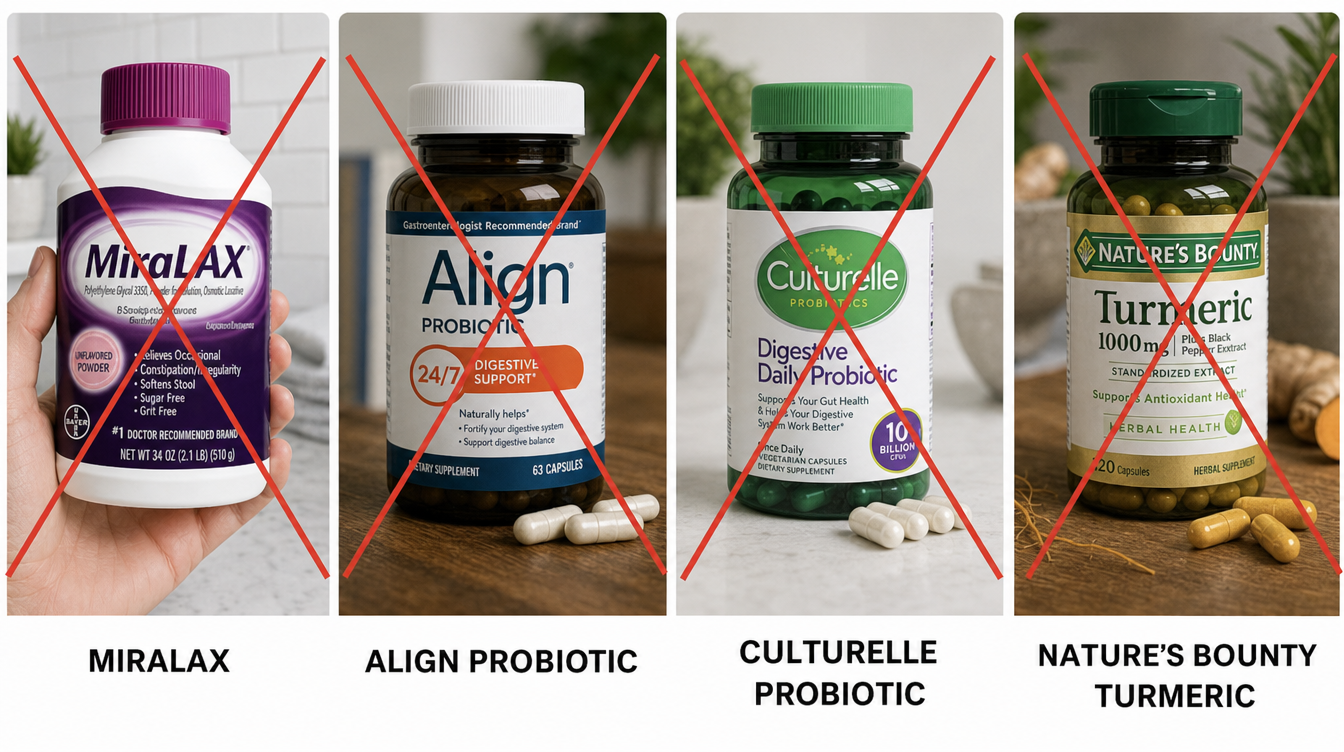
Four common constipation products crossed out: an osmotic laxative powder, two probiotics and a turmeric supplement.
My own bathroom cupboard, more or less — and the shelf I sent patients to for three decades. Each one helped for about a fortnight.

It Wasn't My Fault. It Was Biology — And Nobody Explained How It Works.

Your colon does not decide when to move. It waits to be told.

It waits for a chemical signal. Specifically for short-chain fatty acids — butyrate above all — produced by particular species of bacteria living in your large intestine.

Butyrate isn't waste. It's the primary fuel your colon cells burn. It maintains the tight junctions holding your lining together. And it's directly involved in the signalling that drives propulsive movement.

When that signal is strong, things move.

When it's thin, your colon just sits there. Nothing moves. You feel heavy, bloated, and never quite finished — even after twenty minutes of trying.

Most people think constipation is a motility problem — the muscle is slow.

For a great many people it is closer to a signalling problem — the muscle is fine, and the message telling it to work has gone quiet.

And here is the part that made me angry, once I understood it.

The bacteria that produce that signal — Bifidobacteria and Akkermansia among them — are some of the first populations to thin out, and they get thinned by very ordinary things:

Your colon isn't broken. Your fermenters are depleted — and no amount of fiber fixes a signalling system that has too few bacteria left to send the signal.

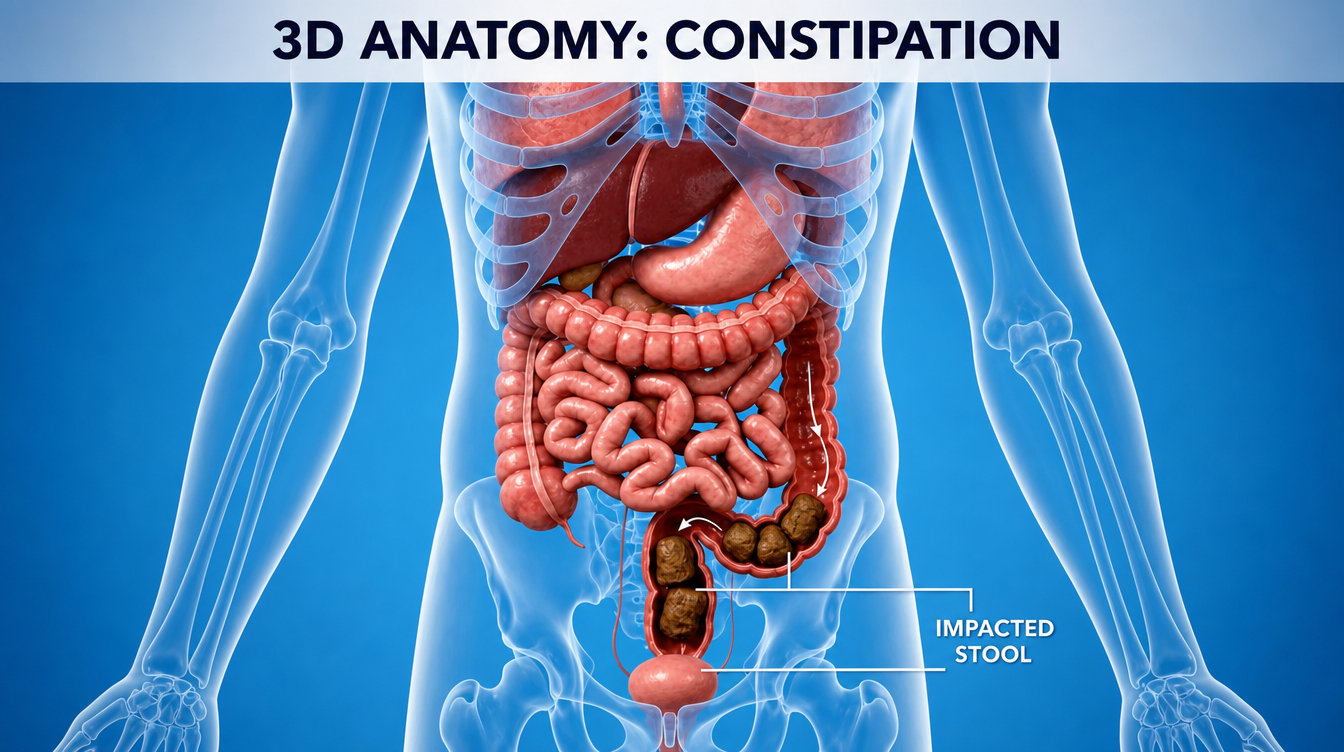
3D anatomical illustration of the abdomen showing the colon with impacted stool labelled.
The machinery is intact. What goes quiet is the instruction telling it to work.

Why Laxatives Make It Worse — And Why Nobody Puts It That Bluntly

This is the part that frustrates the clinicians who actually understand the mechanism.

An osmotic laxative works by holding water in your colon. It creates pressure until something has to move. A stimulant laxative acts directly on nerve and muscle to force a contraction.

So yes. They work. For a day. Then you need them again.

It is a mechanical answer to a bacterial problem — and it does nothing whatsoever about why the signal went quiet in the first place.

There is also a real and growing body of research on what regular laxative use does to the composition of the gut microbiota itself. I'm not going to quote you a dramatic percentage, because the honest state of that literature doesn't support one — and pages that invent numbers here are the reason this whole category is hard to trust.

But "forces movement, alters the bacterial environment, addresses no cause" is a fair summary. Which is why the box never leaves the bathroom cupboard.

A grid of forum posts from long-term laxative users describing dependency.
Twelve years. Dose increased three times. "Normal." These are other people's words, not medical claims — but the pattern in them is the reason I stopped treating the box as a solution.

Before anything else — the one genuine warning on this page

Constipation that is new, rapidly worsening, or comes with severe pain, vomiting, a visibly swollen abdomen, blood, or unexplained weight loss is not what this article is about. Some of it is surgical.

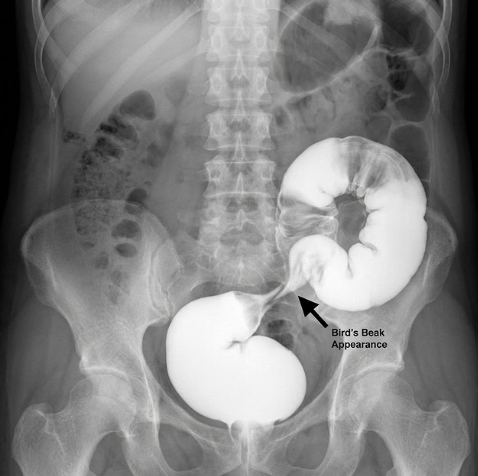
The film below is sigmoid volvulus — a twisted loop of bowel, identified by the "bird's beak" taper the arrow marks. It's diagnosed in a hospital and nothing sold online is relevant to it.

If any of that describes you, close this page and see a doctor today. Everything else here is about the slow, chronic, years-long kind.

Abdominal X-ray showing a hugely dilated loop of bowel with a tapered bird's beak appearance, indicating sigmoid volvulus.
Sigmoid volvulus. Included so you can tell the difference. Illustrative radiograph.

The Test That Takes Five Days — And Almost Nobody Is Offered

Here's the thing I'm angriest about, and it takes five days and one X-ray.

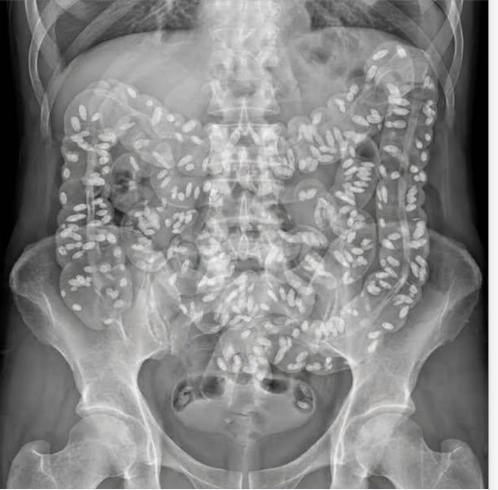
It's called a radiopaque marker transit study. You swallow a capsule of small plastic markers that show up white on film. Five days later, one abdominal X-ray.

Normal colon: nearly all the markers are gone.

Slow transit: they're still sitting there, scattered through the whole colon, five days later.

Abdominal X-ray from a colonic transit study showing dozens of white radiopaque markers still distributed throughout the colon days after ingestion.
A marker transit study. Every white capsule shape is a marker that should already have been gone. Illustrative radiograph.

For years my patients apologised to me for this, as though it were a flaw in their character. It takes five days and one film to become a measurement instead.

That film is the reason I stopped recommending things that "support regularity" and started asking what the actual missing input was.

Then I Read The Thing That Reframed All Of It

When your bacteria ferment the fiber you can't digest, butyrate isn't the only thing they release.

They also release hydrogen gas. And that second output is the one nobody ever mentions.

This isn't a fringe idea — it's a standard clinical test

Hydrogen breath testing is the routine workup for lactose intolerance and small-intestinal bacterial overgrowth. It works by measuring the hydrogen your colonic bacteria ferment out of carbohydrate, which you then breathe out. The gas is already part of your physiology. It has been all along.

What varies is how much you still make

Hydrogen output depends entirely on which species are still living there. The same depletion that thins your butyrate thins this too. Feed a depleted community more fiber and you don't reliably get more of either output — you get more gas.

And the lining is oxidatively exposed

Your intestinal wall replaces itself every few days, sits in direct contact with everything you swallow, and does that work in one of the most oxidatively demanding environments in your body. Oxidative stress in the gut is one of the better-documented findings in gastrointestinal research.

Hydrogen is a selective antioxidant — the 2007 finding that started the field

A team publishing in Nature Medicine showed molecular hydrogen preferentially neutralizes the most destructive radicals while leaving alone the ordinary reactive signalling your body runs on.[2] That selectivity is why it behaves unlike the blunt high-dose antioxidants that disappointed for thirty years.

The lining replaces itself every few days, in one of the most oxidatively demanding environments in the body.

So the chain I'd been missing looked like this:

  1. Your fermenters produce two outputs — butyrate and hydrogen
  2. Depletion cuts both, and adding substrate to a depleted community mostly adds gas
  3. The lining doing the work sits in a heavily oxidative environment
  4. And hydrogen is small enough and selective enough to reach it — if you can deliver it without waiting on the bacteria

This wasn't about forcing movement. It was about restoring an input.

Then I Tried To Buy It. Most Versions Don't Deliver Enough To Matter.

I ordered everything I could find. Hydrogen water in pouches. A countertop hydrogen-water machine that cost more than my washing machine. Three different brands of tablet.

Spent a little over $400. Noticed nothing.

So I did what I should have done first, and read the actual specifications.

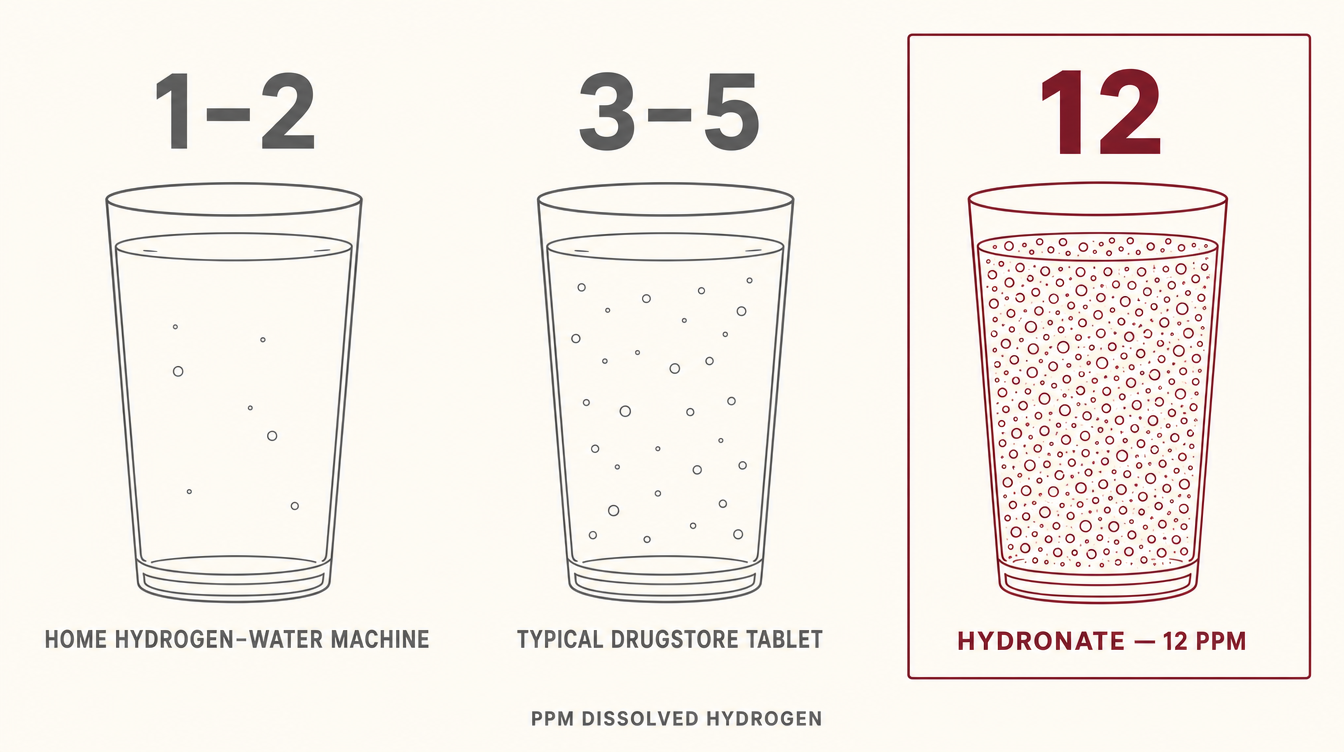
Concentration is the entire game — and almost nothing on the market reaches the level the research uses.

Three glasses of water compared by dissolved hydrogen: 1-2 PPM from a home machine, 3-5 PPM from a typical drugstore tablet, 12 PPM from Hydronate.

Hydrogen is a gas. It escapes. A weak tablet in an open glass is expensive water — you get a faint antioxidant gesture and nothing that reaches a gut lining.

The dose matters. The concentration matters. The fact that it's dissolved and drunk within two minutes matters.

That's the specification I ended up on, and it's why I'm writing about this particular one rather than hydrogen in general.

Hydronate box beside a glass of water with a tablet dissolving.

And the second reason it made sense for a gut like mine:

See The 12 PPM Version >>>

From $0.65 a tablet · free US shipping · 90-day money-back guarantee

What Actually Happened, Day By Day

I kept notes, because I don't trust anecdote — including my own. I also took it myself for a full month before I said a word about it to a patient.

And what didn't happen, because you deserve the honest version

I am not regular like clockwork. Some weeks are still better than others. Weather, travel and stress all still show up in my gut, and one glass of water a morning did not repeal that.

What changed is that my stomach stopped running my week.

Image slot — the "week 4" lifestyle shot

Reference visual: Elvera used a warm lifestyle photo here. Swap in the equivalent: documentary-style photograph, a woman in her mid-fifties in a fitted top, standing in her own kitchen mid-morning, relaxed, coffee in hand, laughing at something off-frame. Natural window light, muted warm palette, no product visible, no styling. The point is ease, not before-and-after. Landscape 3:2.

Fiber, Probiotics And This Are Not The Same Category

 Fiber & probioticsHydronate
What it acts onThe bacterial populationThe molecule that population makes
Needs fermentation to workYes — that is the mechanismNo — arrives already dissolved
Adds fermentable loadYes, so it can add gasNone
SizeBulk agent / live organisms2 daltons — crosses the lining unaided
Forces a resultLaxatives doNo — nothing to taper off
Use togetherYes — different jobs, most people keep both

Fiber is the substrate. Probiotics are the organisms. Hydrogen is the output. Only one of the three arrives already made.

Exactly What Happens When You Order

Don't stop anything you're already taking to do this. It sits alongside your fiber, your probiotic and your prescriptions, and if you're managing a diagnosed digestive condition, tell your doctor you're adding it.

What Other People Say

★★★★★

"I tried. For years. Metamucil made me more bloated. Psyllium made me more bloated. My doctor kept saying fiber takes time to adjust, and I kept adjusting for six months and it kept making me miserable. What I like about this is there's nothing to ferment. First supplement in a decade that didn't make the problem worse before it got better."

KH
Karen H.
52 · Minneapolis, MN · Verified buyer

★★★★★

"Almost returned it after five days because nothing happened. When you've tried as many things as I have you stop trusting timelines. Around day 18 something shifted — ate a normal dinner and woke up feeling light. Not empty. Light. Third box now. I just had to get past week one."

AM
Angela M.
46 · Nashville, TN · Verified buyer

★★★★★

"Every other gut supplement I tried gave me gas — sometimes worse than the problem I was fixing. My wife had banned me from fiber supplements. This produces none, because there's nothing fermenting. That's the whole point, and it's why I've stuck with it for three months when I couldn't last two weeks on anything else."

James L.
56 · Columbus, OH · Verified buyer

★★★★☆

"Being straight with you — the bloating improved a lot by week three and my afternoons are genuinely better. I was also hoping for more regularity improvement and that's been slower. Week seven, better than it was, not where I want it. Finishing the 90 days. Setting honest expectations for anyone who needs both."

Steven R.
55 · Austin, TX · Verified buyer

Individual experiences. Not typical results, and not a substitute for medical care.

You Have Two Choices Right Now

The first is to keep going. More fiber into a system whose output was the missing piece. A new probiotic every time the two weeks run out. The box in the cupboard for when it gets bad. The risky-foods list getting one line longer every year, and the same conversation at your next appointment.

The second is ninety days on the input your fermentation was supposed to be producing. Two minutes a morning. One tablet, one glass of plain water, 12 PPM — alongside the fiber and the walking, not instead of them.

If nothing moves, you're covered. The only thing you're genuinely risking is the two minutes.

Check Availability & Start My 90 Days >>>

From $0.65 a tablet · free US shipping · 90-day money-back guarantee

12PPM dissolved H₂
2k+studies on H₂
Free US shipping
90day guarantee

Asked & Answered

Is this a laxative?

No. No senna, no magnesium citrate, no stimulant, no osmotic agent — nothing that forces a result and nothing your body adapts to, so there's no dependency and nothing to taper. It works on the oxidative environment of the gut lining, not on forcing motility.

Will it make me more bloated?

It shouldn't, and the reason is mechanical: there's nothing in the tablet to ferment. Bloating from fiber and prebiotics comes from bacteria producing gas out of the substrate you added. Here the hydrogen is already dissolved in the water, so no fermentation happens and no additional gas is generated.

I've already tried fiber, probiotics and enzymes. Why would this be different?

Because it isn't the same category. Fiber is substrate. Probiotics are organisms you hope will establish. Enzymes break down food. All three act on the machinery that produces the molecule — this supplies the molecule itself, already dissolved, at a measured 12 PPM.

Can I take it with my probiotic, fiber or medication?

Yes to the fiber and the probiotic — they do different jobs and most people keep both. Don't stop any prescribed medication, and if you're managing a diagnosed digestive condition, tell your doctor you're adding it.

Isn't this just water?

Plain water contains no measurable dissolved hydrogen. The tablet puts H₂ into it at 12 PPM. The water is the delivery vehicle — hydrogen is the active molecule.

How fast will I notice anything?

Almost nobody reports anything in week one. The heaviness after meals is usually first, around week two. The broader change tends to land in weeks six to twelve — which is why the guarantee is ninety days.

Any side effects?

Molecular hydrogen is well tolerated in the published literature, with no serious adverse events reported at the doses used in human studies. It isn't a stimulant, laxative or sedative, and there's nothing to withdraw from. If you're pregnant, nursing, taking medication or managing a medical condition, check with your doctor first.

One More Thing

The thirty-one years is the part I'd take back.

Not the advice — the fiber and the water and the walking are all reasonable, and I would give them again. What I'd take back is how many people I sent away with them and nothing else. How many times I said "give it time" to somebody who had already given it six years. How many transit studies I didn't order.

If you have been counting days for longer than a year, the thing you are missing is probably not more discipline.

Hydronate Gut Health Support tablets.
from $0.65$1.63per tablet · one a day · up to 60% off from this page · free US shipping
Check Availability & Start My 90 Days >>>

90-day money-back guarantee · skip, pause or cancel anytime

NOTE: the discount on this page is applied automatically at checkout and isn't available in stores or through Amazon.

P.S. — If you take one thing from all of this, take the fourth beat: fermentation produces two outputs, and the one nobody ever mentions is the one a standard clinical breath test already measures. Your gut has been making it all along. Some of us just make far less of it than we used to.

P.P.S. — Don't judge it in week one. I felt nothing for five days, and I'm the one who went looking for it. Almost everybody who quits, quits there.

P.P.P.S. — Keep the fiber. Keep the walking. This works alongside them and the honest version of the research says so. If you're going to change one thing, change two.

90Day money-back guarantee
Fast free shipping
🔒Secure checkout
USMade in USA · third-party tested

References

[1] Suares NC, Ford AC. Prevalence of, and risk factors for, chronic idiopathic constipation in the community: systematic review and meta-analysis. American Journal of Gastroenterology. 2011;106(9):1582–1591.

[2] Ohsawa I, Ishikawa M, Takahashi K, et al. Hydrogen acts as a therapeutic antioxidant by selectively reducing cytotoxic oxygen radicals. Nature Medicine. 2007;13(6):688–694.

[3] Radiopaque marker transit studies and hydrogen breath testing are standard clinical investigations; see current gastroenterology practice guidance for protocol and interpretation.

[4] Molecular weights per PubChem: molecular hydrogen 2.016 g/mol; ascorbic acid 176.12 g/mol; curcumin 368.38 g/mol.

[5] Concentration comparisons per Hydronate tablet specification and published output ranges for consumer hydrogen-water devices.

THIS IS AN ADVERTISEMENT AND NOT AN ACTUAL NEWS ARTICLE, BLOG, OR CONSUMER PROTECTION UPDATE.

These statements have not been evaluated by the Food and Drug Administration. This product is not intended to diagnose, treat, cure, or prevent any disease. The information provided on this page is for informational purposes only and is not a substitute for advice from your physician or other healthcare professional. You should not use this information for diagnosis or treatment of any health problem or for prescription of any medication or other treatment. Consult a healthcare professional before starting any diet, exercise, or supplementation program, before taking any medication, or if you have or suspect you might have a health problem. Testimonials reflect individual experiences and are not typical results.

Contact · Privacy Policy · Terms of Sale · Refund Policy

Check Availability — 90-Day Guarantee >>>