
20-Year Nephrology Nurse Reveals the Daily Habit That Made Her eGFR Rise From 43 to 59
If your eGFR keeps slipping, your ankles keep swelling, or the word dialysis has started following you around — read this before your next appointment.
Especially if kidney teas, supplement stacks, and bottled hydrogen water have already let you down.
Here are the five reasons why.


Doctors are trained to be careful with their words. Nurses spend twelve-hour shifts at the bedside, and there are some things we just can't stay quiet about. After 20 years in nephrology, and after watching my own kidneys begin to slip, this is one of them.
My name is Susan Hartley. I've spent two decades on renal floors. I've sat beside people the hour they were told “Stage 3.” I've prepped an arm for a first dialysis session and watched the light go out of someone who used to garden, travel, and chase grandchildren around the yard.
“I always assumed I'd be the one holding the clipboard. Never the one sitting in the chair.”

Then It Happened to Me.
At my own physical, my nephrologist turned the monitor toward me. I already knew the room, the chart, the voice they use. What I wasn't ready for was seeing my own name at the top of the screen.
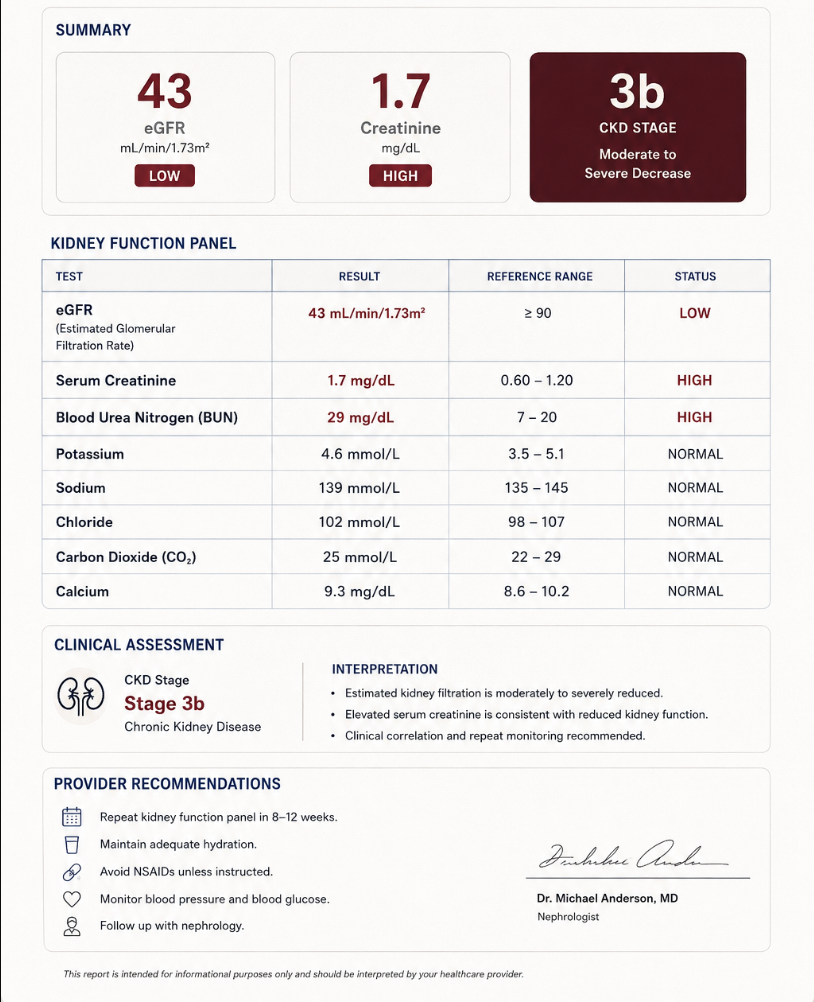
Most patients hear noise in that moment. I heard the whole timeline. The word “dialysis” stopped being something that happened to other people. It became a date on my own calendar.
So I Did Everything Right. Everything.
Nobody had to explain the rules to me, I'd been enforcing them for twenty years. So I became the perfect, compliant patient.

And every three months, the number slid a little further. Never up. Always down. My blood pressure was controlled. My diet was textbook. My kidneys were declining anyway, and no one could tell me why doing everything right wasn't stopping it.
“For the first time in my career, I felt the thing I'd watched cross so many patients' faces: helpless.”
One Night, Around 2 A.M., I Started Reading.
My ankles were too swollen to sleep, propped up on a stack of pillows. So I did the thing I tell my own patients not to do at 2 a.m., I opened the clinical databases.
What I found wasn't a supplement ad. It was a body of peer-reviewed research, much of it out of Japan, on something almost too simple to believe: plain water enriched with molecular hydrogen. No new medication. No procedure. No complicated protocol.
In one eight-week trial, markers of oxidative stress in kidney patients dropped meaningfully. Others reported changes in the very kind of cellular wear that quietly grinds kidney filters down. I read it three times. Then I asked the obvious question: why had I never heard of this in twenty years on the floor?
Why Your Doctor Never Mentioned This
I don't believe in grand conspiracies. I believe systems quietly promote what pays for the system, and that quietly decides what your doctor is ever prompted to mention.
Dialysis is recurring revenue for life. A chair, three times a week, billed indefinitely, that is what the system is built around.
Branded prescriptions renew every month. Billing codes, bulk contracts, and reps who bring them to the office. Neither is wrong, they're simply profitable, so they get the conferences and the “standard of care” label.
A tablet in a glass of water is a few cents a day. You can't patent it and no rep pitches it, yet over 1,300 peer-reviewed studies circle the same idea. It just didn't fit the business model.
Which one do you think the system is built to talk about? And something in me said: you need to try this.
Here Are My Five Learnings
Getting my eGFR moving in the right direction wasn't luck, and it wasn't one single thing. Looking back, here is what I learned, about my own kidneys, about the research, and about why the tablet I now take every morning is Hydronate.
The Number Everyone Watches Isn't the Whole Story.
eGFR tracks how fast you filter, not the oxidative wear grinding the filters down. Your kidneys hold roughly a million microscopic filters called nephrons, and unstable free radicals from high blood pressure, high blood sugar, and the ordinary wear of ageing corrode the filters themselves. Once I understood that, the slow slide finally made sense.
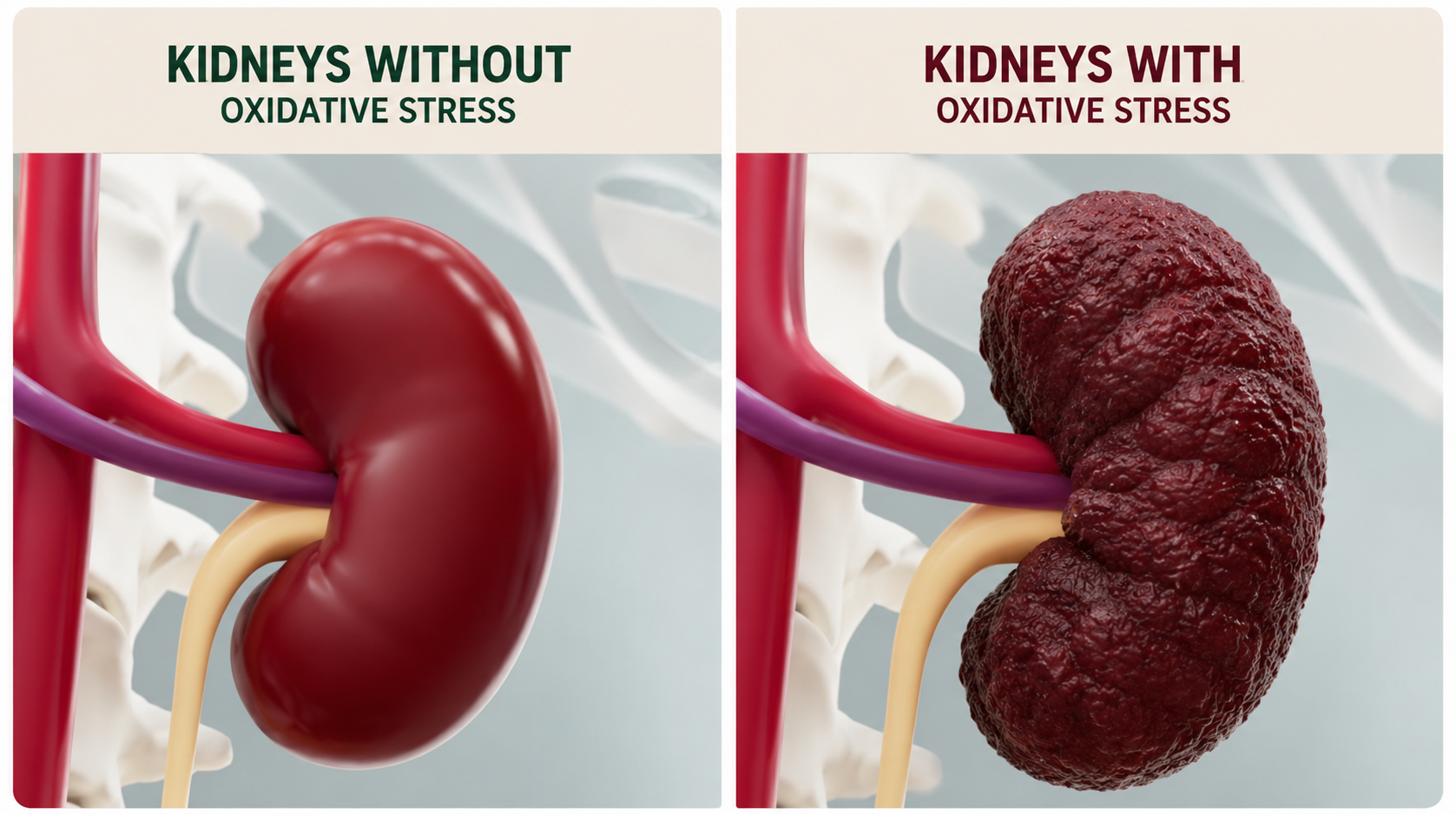
Your kidneys are like the air filters in your home. Ordinary waste is dust, they're built to catch it. Oxidative stress is an acid mist that corrodes the filter itself. My blood-pressure pill, my diuretic, my low-sodium diet all reduced the load, none of them touched the corrosion.
Doing Everything “Right” Reduces the Load, Not the Damage.
My ACE inhibitor, my low-sodium diet, my blood-pressure log, they eased the burden on my kidneys, but nothing was touching the corrosion. That is why the number kept sliding. Molecular hydrogen was the first thing I read about that spoke to the wear itself: H₂ is the smallest molecule that exists, small enough to slip inside the cell where bulky antioxidants like vitamin C can't reach, and research suggests it's selective, targeting the most destructive radicals while sparing the ones your body needs.

Illustration of the proposed mechanism, molecular hydrogen acting as a selective antioxidant. Not a depiction of guaranteed results.
“I'd spent twenty years managing symptoms. This was the first thing I'd read that spoke to the wear itself.”
Dose Is Everything, So I Tested It on Myself.
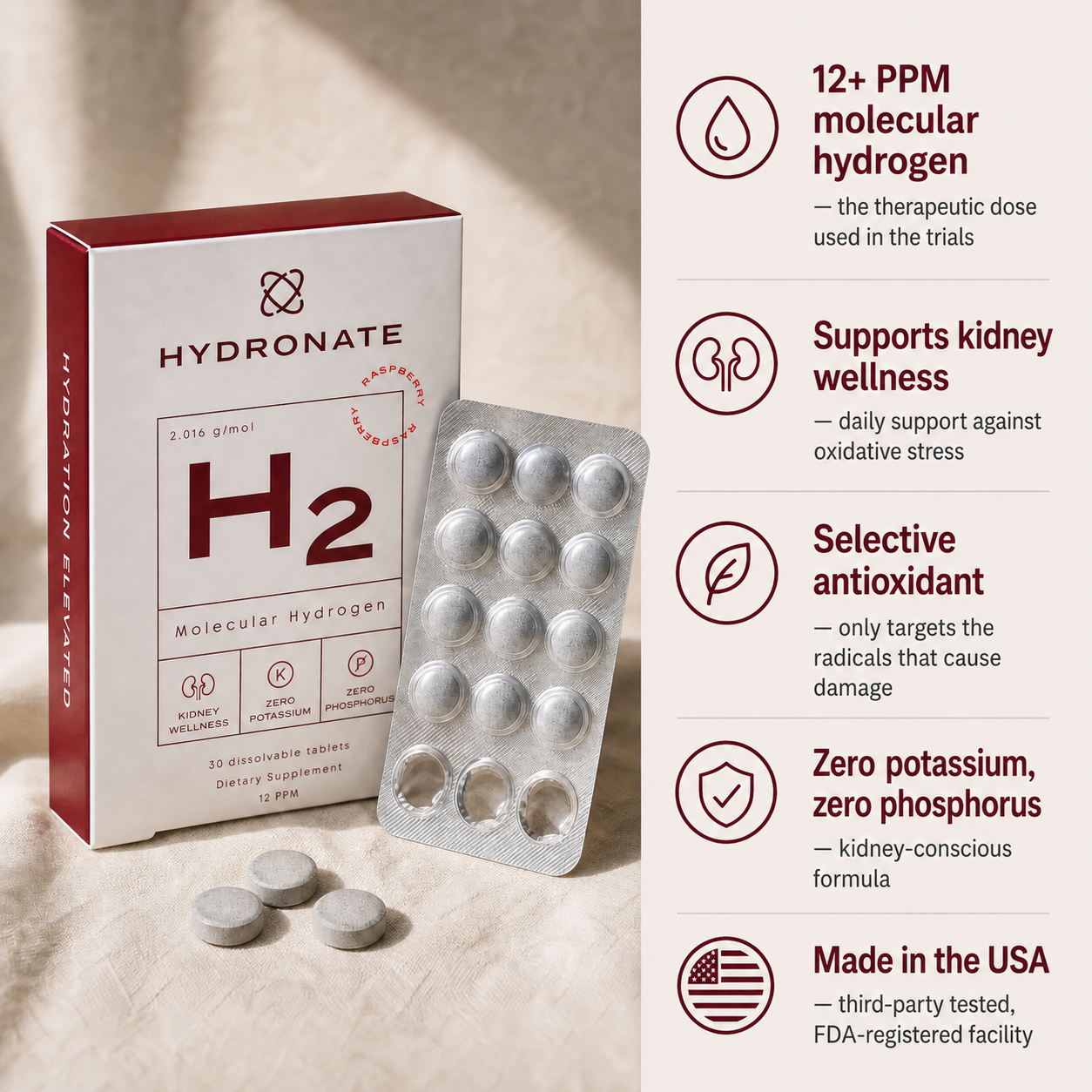
I'm a nurse. I don't run on faith, I run on trials, even when the only subject I can enrol is myself. I found a dissolvable tablet at a real 12+ PPM, third-party tested: drop one into a glass of water and drink it while it's still fizzing. One tablet, one glass, every morning. At first I felt nothing. Then things changed, slowly, then all at once.
My energy came back. I made it through a full hospital shift without needing to sit down every hour.
The swelling in my ankles went down. I could see my ankle bones for the first time in a year.
Quarterly labs. My nephrologist went quiet, scrolled back through my history, and asked: “What are you doing differently?” eGFR up from 43 to 52.
eGFR 59. Creatinine 1.7 down to 1.0. The swelling gone. Sleeping through the night. And the fear of dialysis, for the first time in two years, loosening its grip.

One nurse's personal lab history, shared with permission. A single individual's experience, not a clinical result, not a promise. Individual results vary; molecular hydrogen is a wellness support, not a treatment for kidney disease.
Zero Potassium and Zero Phosphorus Is Non-Negotiable.
Those are the first two numbers a kidney patient watches. Hydronate is magnesium-based, with nothing on the label working against the panel you're trying to protect, which is exactly why I was comfortable adding it alongside my prescribed medication.
Consistency Beats Intensity.
One tablet, one glass of water, every morning, given a real 90 days and a before-and-after blood draw. That is the whole routine. When I lined my five learnings up, the only tablet that passed all five was Hydronate.
What Nephrologists & Researchers Are Saying
I'm not the only clinician paying attention. Here's what a few of the doctors and scientists studying molecular hydrogen have said about what they're seeing.
“In the patients I've followed, the ones supporting oxidative-stress balance alongside standard care tend to hold their filtration numbers more steadily than I'd expect. It's not a cure — it's the piece the checklist leaves out.”

“Molecular hydrogen behaves like a selective antioxidant, reaching oxidative damage where conventional antioxidants can't. In dialysis and renal-stress studies we've seen inflammatory markers move in the right direction.”

“The randomised data on H₂ and oxidative stress is more compelling than most people expect. For patients already doing everything right, it's a reasonable, low-risk thing to add and then measure.”

Quotes illustrate researchers' published views on molecular hydrogen and oxidative stress; they are not endorsements of Hydronate as a treatment. Molecular hydrogen is a wellness support, not a treatment for kidney disease. These statements have not been evaluated by the FDA.
Start your upgrade today
Over 80,000 customer purchases. Join the people who have made Hydronate part of their daily routine. Subscribe today and save up to 60% off.
Certified
the USA
Backed
Tested
Hydronate
Kidney Support
90X More Potent Than
Bottled Hydrogen Water


Drop 1 tablet in 8–12 oz of water, let it dissolve, then drink it within a few minutes.
Zero potassium, zero phosphorus. Take 1–3 tablets a day and give it a full 90 days before you judge it.
When To Take It
Spread 1–3 Tablets Across The Day

Morning Ritual
Start the day hydrated, with antioxidant support already in place.
Best time
After waking up, before breakfast

Afternoon Top-Up
Keeps steady support going through the back half of your day.
Best time
20–30 mins before lunch

Evening Wind-Down
Supports overnight recovery while your body rests and repairs.
Best time
1–2 hours before bed
I Shared What I Found. Here's What Came Back.
Six weeks in and way less bloated, my ankles are finally visible again. I drink it the second it starts fizzing, like the instructions say. Easiest thing I've ever added to a routine.

✓ Verified
Two weeks in and the energy difference is the first thing I noticed. Didn't expect a fizzy glass of water to do anything, honestly. Waiting on my next labs to see the real proof, but mornings already feel different.

✓ Verified
For anyone drowning in a cabinet full of supplements, one tablet in a glass of water is such a relief. Mine came in four days and yes, the certificate of analysis is real. That's what sold me over the cheap tablets online.

✓ Verified
Illustrative examples. Testimonials may not represent typical results; individual results vary.
After 45, Just Monitoring Your Kidney Numbers Isn't Much of a Plan.
Here's what I watched happen to patient after patient. They'd get labs every few months, hear "we'll keep an eye on it," and go home. Monitoring feels like doing something. It isn't. A number on a chart doesn't slow the decline, it just documents it.
Watches the number fall without touching the oxidative wear driving it down. By the time the trend is undeniable, filters you can't grow back are already gone. Waiting is a decision, and after 45 it rarely breaks your way.
Keeps the labs and adds the one thing they don't address: daily support against the oxidative stress corroding the filters. Zero potassium, zero phosphorus, so it sits alongside your prescriptions, not against them. You're finally doing something the number can respond to.
Monitoring tells you where you are. It was never going to tell you what to do about it. One tablet, one glass of water, a real 90 days, and a before-and-after blood draw, that's a plan you can actually measure.
Imagine Three Months From Now
You wake up with real energy, not the dragging kind you've learned to accept. The swelling in your ankles has eased. Your shoes fit. Your rings slide on and off.
You walk into your nephrologist's office, and for the first time in a while, the conversation isn't about how much further you've slipped. You stop googling “how long can you live with Stage 3.” You make plans with family without wondering whether you'll have the energy to keep them.
I can't promise you my numbers. Nobody honest can. What I can tell you is that it's testable, and it starts with one tablet in a glass of water.

You Have Two Choices Right Now
Change nothing, and nothing changes. Next appointment, the number slips again. You keep doing everything “right,” while quietly knowing nothing is addressing the wear itself. I watched that path for 20 years, the people who said “I'll think about it” until there wasn't much left to protect.
Lock in your baseline labs, start one tablet a day, and let your next blood draw do the talking. Ninety days from now, you'll have your own before-and-after, the same way I got mine. That's the whole point: I don't want your faith. I want your bloodwork.
A real hydrogen tablet loses potency sitting on a shelf, that's chemistry, not marketing. So Hydronate is made in small, fresh runs and third-party tested before each one ships. When a batch is gone, it's gone until the next run.
Here's Exactly What to Do Next
Choose your supply and check out. Free US shipping; orders ship within 24 hours while the batch lasts.
Before it arrives, book your baseline labs. Ask for eGFR and creatinine so your “before” number is locked in on paper.
One tablet a day for 90 days. Then retest, and let the bloodwork do the talking. Keep taking your prescribed medications exactly as written, this sits alongside them, not instead of them.
[1] Ohsawa et al. Molecular hydrogen acts as a selective antioxidant, neutralising the most destructive free radical while sparing the ones the body needs. Nature Medicine. 2007;13(6):688–694.
[2] Dissolved hydrogen delivered to haemodialysis patients reduced markers of oxidative stress and inflammation. Nephrology Dialysis Transplantation. 2010.
[3] In a double-blind trial in adults with type 2 diabetes, hydrogen-rich water lowered oxidative-damage markers; a follow-up analysis reported a rise in eGFR.
These studies describe molecular hydrogen's effect on oxidative-stress markers. They are not evidence that Hydronate treats, reverses, or cures kidney disease.
Comments
142 comments
Can anyone actually vouch for this? I've been burned by kidney “miracle” stuff before and I'm tired of hoping.

I felt that fatigue too. I won't promise a miracle, I'll promise it's testable. Get your eGFR now, take one tablet a day, retest in 90 days. Let your own bloodwork vouch for it, not me.

I'm on lisinopril and a diuretic. Nervous about adding anything with a mineral in it, is this going to interfere with my meds?
Keep taking both exactly as written, this doesn't replace either one. It's a small magnesium dose with zero potassium and zero phosphorus, which is usually the part people on kidney meds worry about. Still, tell your prescriber you're adding it and ask them to glance at your magnesium at your next draw.

Sending this to my brother who's Stage 3 now. I just wish we'd found something like this before my wife's numbers got as far as they did.
It's Time to Put This to the Test.
Will you be next, or look back six months from now wishing you'd tested it when you had the chance?
