Five Reasons Coffee Won’t Fix Your Brain Fog
If coffee keeps letting you down by mid-afternoon, here’s what’s really going on — and the simple shift that helps.


If you feel sharp in the morning but foggy and drained by mid-afternoon — no matter how much coffee you drink — the problem may not be a lack of stimulation. It may be a lack of recovery.
Coffee piles stimulation on top of an already-tired system. The lift fades, the fog comes back, and you reach for another cup. It helps you ignore the problem — not fix it.
Hydronate supports the recovery underneath your focus — so clarity holds through the afternoon. No spike, no crash, no extra caffeine. Just steadier, cleaner thinking you settle into.

You’re not lazy. You’re not losing your edge. Your brain may just be under-recovered.
If coffee keeps letting you down by mid-afternoon, here’s what’s really going on — and the simple shift that helps.
Most people assume that if coffee makes them feel more alert, it must be helping their focus too. But being awake and being mentally clear are not the same thing.

That’s because coffee works by increasing stimulation. It does little for a brain that’s overworked, under-recovered, and worn down by stress, poor sleep, and nonstop input. Coffee might make you feel more functional — but functional and clear are two very different things.
When your brain feels slow, the instinct is to force output: more coffee, stronger nootropics, focus hacks, tighter routines, more discipline. The assumption is always the same —
“If I can just push harder, I’ll feel normal again.”
But what if the problem isn’t that your brain needs to be pushed harder — but that it’s carrying more stress, fatigue, and recovery debt than you realise?

This is how coffee quietly becomes a trap. You feel foggy, so you reach for a cup. You feel better for a while, so you assume it’s working. Then the dip comes back — so you reach for another.

You’re not really solving the problem — you’re managing it in short bursts. For a lot of people, coffee becomes less of a performance tool and more of a coping mechanism for a brain that never fully feels recovered.
Most people think brain fog is a focus problem. It often isn’t. Sometimes it’s what happens when your brain has been asked to absorb too much, recover too little, and keep performing anyway.

Coffee doesn’t help your body recover from that load. It just makes it easier to keep going — while the load keeps building.
If you’ve already tried more coffee, nootropics, productivity hacks, better routines, and more discipline — and your brain still doesn’t feel clear — then maybe you don’t need more stimulation. Maybe your brain needs better support recovering from the stress it’s already under.

That’s exactly why some high performers are now looking beyond caffeine — toward a different kind of support entirely.
Across all five, the same thing keeps surfacing: a brain carrying more stress than it has recovered from. Researchers have a name for a big part of that load.
Think of it as everyday wear on your cells. The busier and more stressed life gets, the more “exhaust” your body produces inside — and your system has to clear it. When it builds up faster than you can recover, your brain is usually the first place you feel it.

If oxidative stress is the load dragging your focus down, the answer isn’t more stimulation — it’s helping your body clear it. That’s exactly what Hydronate is built to do.
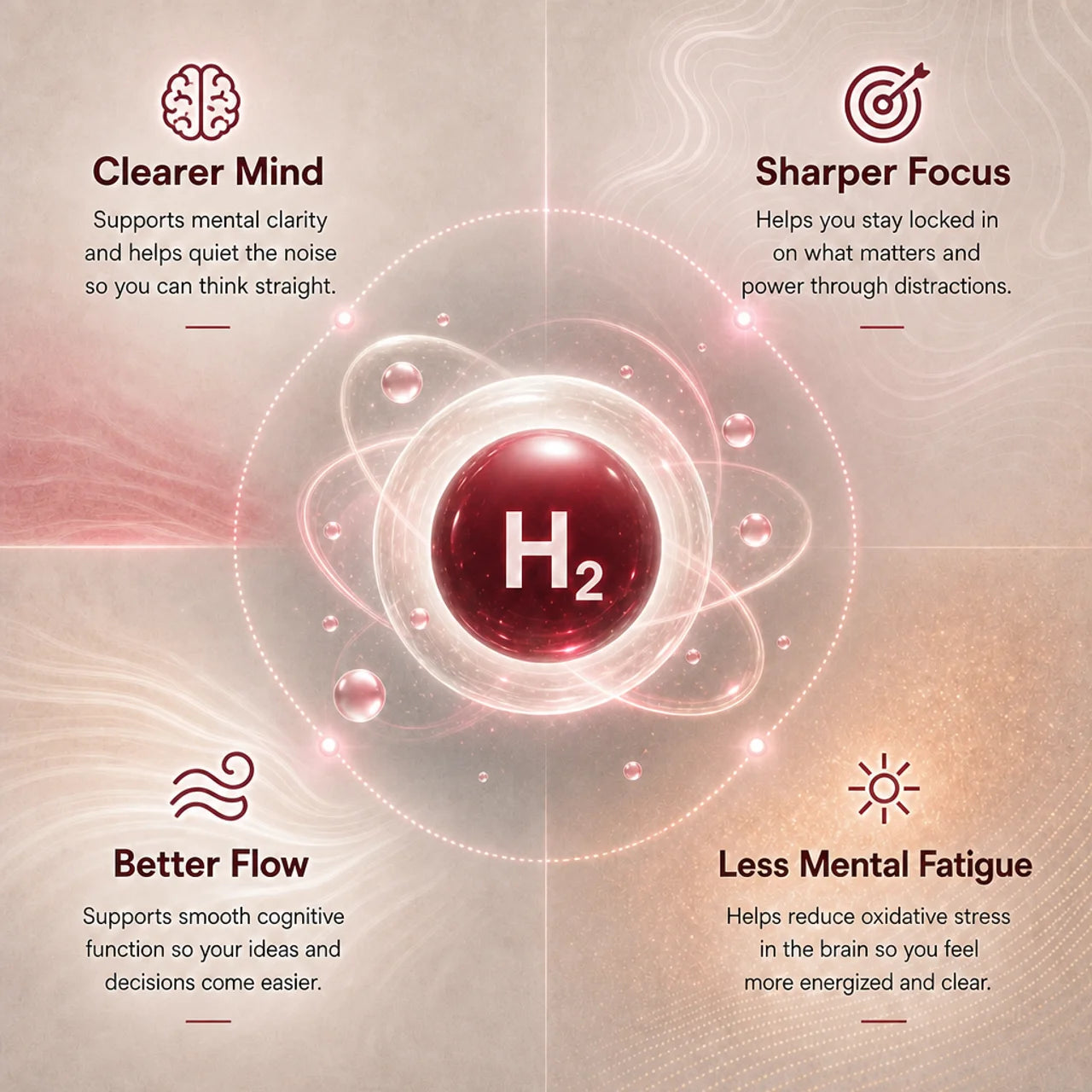
Drop one tablet into water and it releases 12+ PPM molecular hydrogen (H₂) — small enough to reach where bigger antioxidants can’t, and selective enough to clear the most damaging free radicals while leaving the useful ones alone. The result is support for the recovery underneath your focus, not another jolt.
Steady support without the spike-and-crash.
Built around molecular hydrogen.
Clarity that holds past the morning.
Drop, fizz, drink. No stack.
If you’ve tried vitamin C, greens powders or a nootropic stack and felt almost nothing — you’re not alone. Most antioxidants share the same blind spots. Molecular hydrogen works differently.
It isn’t caffeine, so don’t judge it like caffeine. Give it a real run.
Drop, fizz, drink. Many feel a quiet shift — a little clearer, a little lighter.
Subtle clarityEnergy, clarity, caffeine cravings. Some feel clearer early; others need more time.
Building the habitIs the afternoon crash softer? Is my brain less heavy? Am I reaching for less coffee?
Steadier focusSharper? More recovered? Less dependent on coffee? A real evaluation window, not hype.
Make the callHydronate’s claim categories were reviewed by an independent panel of PhD-level researchers under the FTC’s competent-and-reliable-scientific-evidence standard. The molecular-hydrogen claims rest on multiple randomised, double-blind human trials.

Lead reviewer on the molecular-hydrogen antioxidant literature and the substantiation panel for Hydronate’s claim categories.

Lead investigator on multiple H₂ supplementation trials and co-author of the FTC-standard substantiation review.

Co-author of the 24-week metabolic-syndrome RCT — one of the foundational human trials on hydrogen-tablet supplementation.
“I stopped reaching for the third coffee just to get through the afternoon.”
“I stopped reaching for the second and third cup just to get through work.”
“The best way I can describe it: my brain felt less heavy by the afternoon.”
“More steady through long workdays. Not wired — just clearer.”
Have one we haven’t covered? Email support@hydronate.com — we read every message and reply within 24 hours.
“Their support team answered a really specific question about taking it alongside my morning coffee in under an hour. Felt like talking to someone who actually knew the product.”
Yes. You can continue drinking coffee alongside Hydronate. The core benefit is that Hydronate helps support better recovery and antioxidant balance, so your body may feel clearer and your coffee may feel like it works better again. You do not have to cut coffee out.
No. Hydronate has no caffeine or stimulants, so it should not keep you wired like coffee or energy drinks can. If you are sensitive to new supplements, start with it earlier in the day.
Hydronate is not meant to hit like caffeine. Results can take anywhere from 2 to 4 weeks, depending on how much oxidative stress has built up in your body. Hydronate helps fight oxidative stress and support recovery, so the effects can build gradually with consistent use.
Some people notice a clearer, lighter feeling quickly. For others, it takes 2 to 4 weeks of daily use to feel the difference. The key is consistency, especially if your body has been running on stress, caffeine, and poor recovery for a while.
You can take Hydronate in the morning, afternoon, or whenever you usually feel foggy or reach for another coffee. Drop 1-2 tablets into water, let it dissolve, and drink it fresh.
For best results, yes. Hydronate works best as a daily recovery ritual. Taking it consistently helps your body fight oxidative stress and feel clearer over time.
Electrolytes and hydration powders work on the surface. They add minerals and fluid to help you rehydrate. Molecular hydrogen works deeper. Hydronate releases hydrogen gas into your water, a tiny antioxidant molecule small enough to reach your cells, where it helps neutralize the free radicals that drive oxidative stress. That oxidative stress, not a lack of electrolytes, is often what's behind brain fog, fatigue, and slow recovery. Better hydration is just a bonus of drinking more water. Hydrogen is what actually helps your body work the way it's supposed to, with no caffeine or stimulants.
Hydronate is designed for daily use. For best effects, take it 2 to 3 times a day depending on your routine and needs. If you are pregnant, breastfeeding, taking medication, or managing a medical condition, check with your doctor before adding it to your routine.
Stop asking how to push your brain harder. Start asking how to support it better. For a growing number of professionals, that shift is becoming one of the simplest daily habits in their routine.
Try Hydronate today