Take Hydronate every day for thirty days. Drop a tablet in a glass of water, drink it down, do that part of the ritual every morning. If at the end of thirty days you don't feel a difference — sleep, mornings, the small things you've been bracing for — email us at support@hydronate.com and we'll refund the order in full. You don't need to send the empty boxes back. You don't need to fill out a form. You don't need to give a reason.
Reviewed by medical experts · Built on clinical evidence
The aches you've
stopped mentioning.
Finally relieve joint pain and morning stiffness — without more painkillers, injections, or supplements that never reach the source.

★★★★★
"Walking the dog twice a day again. Three months in. I'd accepted that was gone."
Linda B., 58 · Verified customer
The knee that talks back on the stairs. The lower back you've been managing for years. The shoulder you don't reach with anymore. A clinically studied molecule is doing quiet work on the cellular damage that keeps that pain switched on. You'll notice it in the small things first.
- Wake up without the morning stiffness you've gotten used to
- Walk the dog, bend down, reach up — without bracing first
- Sleep through the night instead of waking at 3am sore
- Get through the day with steadier energy, not borrowed energy
30-day money-back guarantee · Free US shipping over $55
There's a molecule smaller than every cellular barrier in your body. That's
where this starts.
★★★★★
"Walking the dog twice a day again. Three months in. I'd accepted that was gone."
Linda B., 58 . Verified customer
Customer reviews
25,956+ · 4.8/5
Medical review
4 independent experts
Manufacturing
Made in USA · cGMP
Guarantee
30-day money back

The Science Behind Hydronate
Meet Dr. Tyler LeBaron.
The hydrogen researcher whose work anchors everything
you're about to read.
Dr. LeBaron
Hydrogen Researcher · CARSE Reviewer
Dr. LeBaron is the founder of the Molecular Hydrogen Institute and one of the most
published researchers in the field. He's the lead author of the most-cited 24-week human
trial on hydrogen water and oxidative stress — and one of four medical experts who
independently reviewed Hydronate's clinical evidence to FTC standards before this product
ever went on sale.
"For two decades I've watched people try painkiller after painkiller,
supplement after supplement, and stay stuck in the same cycle. The reason
isn't the medication. The reason is that the damage driving the pain is
happening at a level most treatments never reach."
— Dr. Tyler LeBaron, lead author, 24-week clinical trial on oxidative
stress & joint inflammation
Painkillers mask the signal. Injections pause the flare. Supplements rarely reach the cell where the damage is actually happening. None of them are wrong — they just work in places that aren't the source. To understand why the pain keeps coming back, you first have to understand what's driving it at the cellular level. That's what Dr. LeBaron's research has spent two decades uncovering.
Affiliation
Founder · Molecular Hydrogen Institute
Review panel
CARSE Reviewer · FTC-standard evidence panel
Research
Lead author · 24-week clinical trial on oxidative stress & joint inflammation
Published in
Canadian Journal of Physiology, Medical Gas Research, and others
The Three Tools You’ve Already Tried
Why most pain solutions stop short.
You weren’t wrong to try them. The problem isn’t what you tried — it’s where those solutions can reach, and where they can’t.

Painkillers
They quiet the signal. They don't quiet the source.
Ibuprofen, naproxen, acetaminophen — they dull the pain signal traveling through your bloodstream, which is real, useful relief. But they don't change the reason that signal keeps getting sent. The moment the dose wears off, the body sends it again.
⚠ Long-term daily use is hard on the stomach,
kidneys, and liver. Most people already know this.
kidneys, and liver. Most people already know this.

Injections
A pause button, not an off switch.
Cortisone shots and similar treatments can calm a flare-up fast — that's why doctors reach for them. But they were designed for short-term relief, not long-term correction. The relief fades, the inflammation returns, and most physicians cap how often you can have them for a reason.
⚠ Useful in the right moment. Not built to be a
daily strategy.
daily strategy.

Supplements
The right idea. The wrong delivery.
Turmeric, fish oil, glucosamine, every "anti-inflammatory" capsule on the shelf — most of them target the right system. The catch is bioavailability. Only a small percentage of what you swallow actually reaches the cells where the damage is happening. Most of it never gets there.
⚠ Not useless. Just rarely concentrated enough to move the needle.
So if painkillers can’t reach the source, injections aren’t built for daily use, and most supplements don’t make it to the cell — what is actually happening in your body that none of these are addressing?
That’s the question Dr. LeBaron’s research starts answering next.
The Part That Frustrates Most People
“Just learn to live with it” isn’t an answer.
If you’ve heard some version of this, you’re not alone. And you’re not imagining the gap.

You walk out of the appointment with another prescription, or another stretch routine, or another vague “we’ll keep an eye on it.” Maybe it takes the edge off for a few days. Maybe it doesn’t. Either way, nothing actually changes. You’ve started to wonder whether you’re being dramatic, or whether you should just accept that this is how getting older feels.
Most physicians aren’t dismissive. They’re working with the tools they were trained to use — tools that target the symptom you can measure on a scan or dull with a drug. Cellular oxidative stress, the system underneath all of it, isn’t something most medical training covers in depth. It’s a research field, not a clinical one. That’s the gap.
★★★★★
"My doctor told me arthritis just gets worse and that I should pace myself. I'd accepted that. Three months in, I'm walking the dog twice a day again. I'm not saying it's magic, but I'm gardening. That's enough."
Verified customer
★★★★★
"I'd basically given up on the morning stiffness. Forty-five minutes before I felt human, every day. I thought that was the deal now. It isn't, apparently."
Verified customer
★★★★★
"I kept getting told it was 'just inflammation' like that explained anything. Nobody told me what was actually causing it or what to do about it. I figured it out myself, late."
Verified customer
The answer is chronic inflammation. And the reason it keeps driving your pain isn't a mystery — it's a cycle. Once you see how it works, why every short-term fix stays short-term finally makes sense.
The Real Reason The Pain Won’t Stop
Inflammation isn’t the disease. It’s the response.
Once you see the cycle, the rest of the page makes sense.
The version your doctor never quite explains.
Inflammation isn’t a problem in itself. It’s how your body responds to something — an injury, a toxin, a stressor. It triggers swelling, heat, immune activity, and it begins repairs. Then it shuts off. That’s acute inflammation, and it’s working exactly the way it’s supposed to.
Chronic inflammation is what happens when that signal never shuts off. The damage signal stays on. The immune response stays active. And the body starts to wear down from a process that was meant to be temporary.
Acute inflammation
Signal on — repairs triggered
Signal off — job done, resolved
Working as designed
Chronic inflammation
Signal on — repairs triggered
Signal stays on — damage accumulates
The cycle that drives joint pain
What happens when the signal doesn’t shut off.
When inflammation stays switched on, your immune system keeps releasing molecules called cytokines. Cytokines are signaling proteins — they’re how immune cells talk to each other. In small bursts, they’re useful. In a steady stream, they trigger the production of free radicals: unstable molecules that are missing an electron.
Missing electrons make molecules unstable. They take one from the nearest available source — cell membranes, joint tissue, mitochondrial DNA. That stealing process is called oxidative stress. And it’s where the actual damage happens.
The loop most treatments never address.
The cytokines trigger free radicals. The free radicals damage the cells. The damage keeps the inflammation signal switched on, which triggers more cytokines. Repeat.
That’s the cycle. And it’s what most pain treatments aren’t built to interrupt.
Your body has its own answer for this. The catch is whether it can keep up.
The body’s defense against free radicals is antioxidants — molecules that can donate an electron, neutralize the unstable molecule, and stop the chain reaction before it does damage. Your body produces some of its own (glutathione, catalase, superoxide dismutase), and you get more from food.
This system worked well for most of human history, when diets were dense in fiber, plants, and the foods that feed it. The modern version — processed food, low fiber, environmental load, less recovery, more stress — produces more free radicals than the body’s antioxidant system was built to neutralize.
So the cycle wins. The damage accumulates. And the inflammation signal stays on.
“The damage keeps the signal switched on, which triggers more damage. That’s the cycle most treatments aren’t built to interrupt.”
Which raises the actual question. If the body’s own antioxidants can’t keep up, and most antioxidant supplements barely reach the cell — what can reach the cell, neutralize the damage, and let the cycle finally quiet down?
There’s one molecule small enough to do it. It’s also the one Dr. LeBaron has spent his career studying.
The Molecule Section 5 Was Pointing At
Molecular hydrogen. The smallest molecule in the universe.
Small enough to reach every cell. Selective enough to leave the good ones alone.

Hydrogen — H₂ — is the simplest, smallest molecule that exists.
Hydronate's tablets specifically have been the subject of 19 clinical studies, 6 pre-clinical studies, and 4 case studies.
Hydrogen acts as a therapeutic antioxidant by selectively reducing cytotoxic oxygen radicals
"...hydrogen can be used as an effective antioxidant therapy; owing to its ability to rapidly diffuse across membranes, it can reach and react with cytotoxic ROS and consequently protect against oxidative damage in nuclear DNA, lipids, and proteins."
KEY FINDINGTRIAL RESULT
Week 24
PRIMARY OUTCOME
Significant reduction in oxidative stress markers across 68% of participants — including measurable improvement in joint inflammation indicators
CITATIONS
2,300+
PEER-REVIEWED STUDIES
1,000+
HUMAN CLINICAL TRIALS
19
01 — Reaches the cell
The size advantage.

Most antioxidants — vitamin C, vitamin E, glutathione, the standard supplement-shelf options — are too large to slip easily through cell membranes. They circulate, they help where they can reach, and a lot of what you swallow never makes it to the cells where the damage is happening. Hydrogen has the opposite problem, which is to say no problem at all. It's smaller than every cellular barrier in the body. It diffuses through cell walls, through the blood-brain barrier, into the mitochondria — the places oxidative stress actually starts.
02 — Targets only the harmful free radicals
Not all free radicals are bad. Hydrogen knows the difference.

The body actually needs some free radicals. Your immune system uses them to fight pathogens. Your muscles produce them during exercise as part of how they adapt and grow stronger. The problem with most antioxidants is that they don't distinguish — they neutralize the harmful ones and the useful ones together, which is why high-dose antioxidant supplementation has shown mixed results in clinical trials.
Hydrogen is selective. It reacts primarily with the most destructive free radicals — particularly hydroxyl radicals and peroxynitrite — and leaves the helpful ones in place. That selectivity is the single most important thing about it as a therapeutic.
03 — Activates your body's own antioxidant production
The point isn't to add antioxidants. It's to wake yours up.

This is the part most people don't know. When hydrogen reaches the cell, it activates a pathway called Nrf2 — the master switch that tells your body to produce its own antioxidants: glutathione, catalase, superoxide dismutase. The same antioxidants we mentioned in the previous section. The ones your body was making on its own until the system got overwhelmed.
You're not adding antioxidants from outside and hoping enough survives digestion. You're giving the body the signal to make its own again.
Dr. Tyler LeBaron — Molecular Hydrogen Institute
"When I first encountered the hydrogen research, my instinct was to rule it out. The claims were too broad. The mechanism seemed implausible for a molecule that simple. I spent two years looking for the methodological flaw — bad controls, underpowered samples, conflicts of interest in the authorship. I didn't find one. What I found instead was a body of evidence that kept replicating across independent labs, different populations, and different conditions. At some point the more intellectually honest position was to follow the data."
24
weeks — his landmark trial
68%
of participants — reduced joint stiffness
4
independent experts — same conclusion
— Dr. Tyler LeBaron · Lead researcher · Molecular Hydrogen Institute
Small enough to reach every cell. Selective enough to leave the useful free radicals alone. And it activates your body's own antioxidant system you already had before the load got too heavy.
The practical question is next: how do you actually get hydrogen into your body, at a concentration that matters, every day, without making it a chore?
The Practical Part
One tablet. A glass of water. 60 seconds.
That’s the whole ritual.

Hydrogen released · Lung weight
12.4mg/L
IHSA-certified gas chromatography
Hydronate is a magnesium-based tablet that dissolves in a regular glass of water and produces molecular hydrogen — the same molecule the last 6 sections have been about. You drop it in. It fizzes for about 60 seconds. You drink it. That’s it.
We didn’t build it to be more complicated than that. The molecule is doing the work. The tablet is just the delivery system that gets it into your body, in a high enough concentration, every day, without turning into a chore.
Each tablet, when dissolved in plain water, produces 7.79 mg/L of dissolved hydrogen. In the stomach acid environment where it’s actually absorbed, that figure rises to 12.4 mg/L. Both numbers were verified by IHSA-certified gas chromatography. For context, most hydrogen tablets on the market produce a small fraction of that concentration, and most never publish their lab numbers at all.
Hydronate — Molecular Hydrogen Tablets
The smallest molecule in the universe, made into a daily ritual.
- One tablet, dropped into 8–12 oz of water
- 7.79 mg/L in plain water · 12.4 mg/L in stomach acid (IHSA-certified)
- Available in unflavored or raspberry
- Made in the USA, cGMP-certified, NSF and Informed Sport certified
Three steps. About sixty seconds, start to finish. Once a day. Here’s exactly how it works.
The Daily Ritual
Drop it. Mix it. Drink it.
Once a day. About sixty seconds, start to finish.

01 — DROP
One tablet. 8–12 oz of water.
Use a regular glass of room-temperature or cool water. Plain water is fine. The tablet starts dissolving the moment it hits the surface.

02 — WAIT
Let it fizz for 60 seconds.
The reaction releases molecular hydrogen into the water. You'll see fine bubbles rising as it dissolves. By the end of a minute, the tablet is fully reacted and the water is hydrogen-rich.
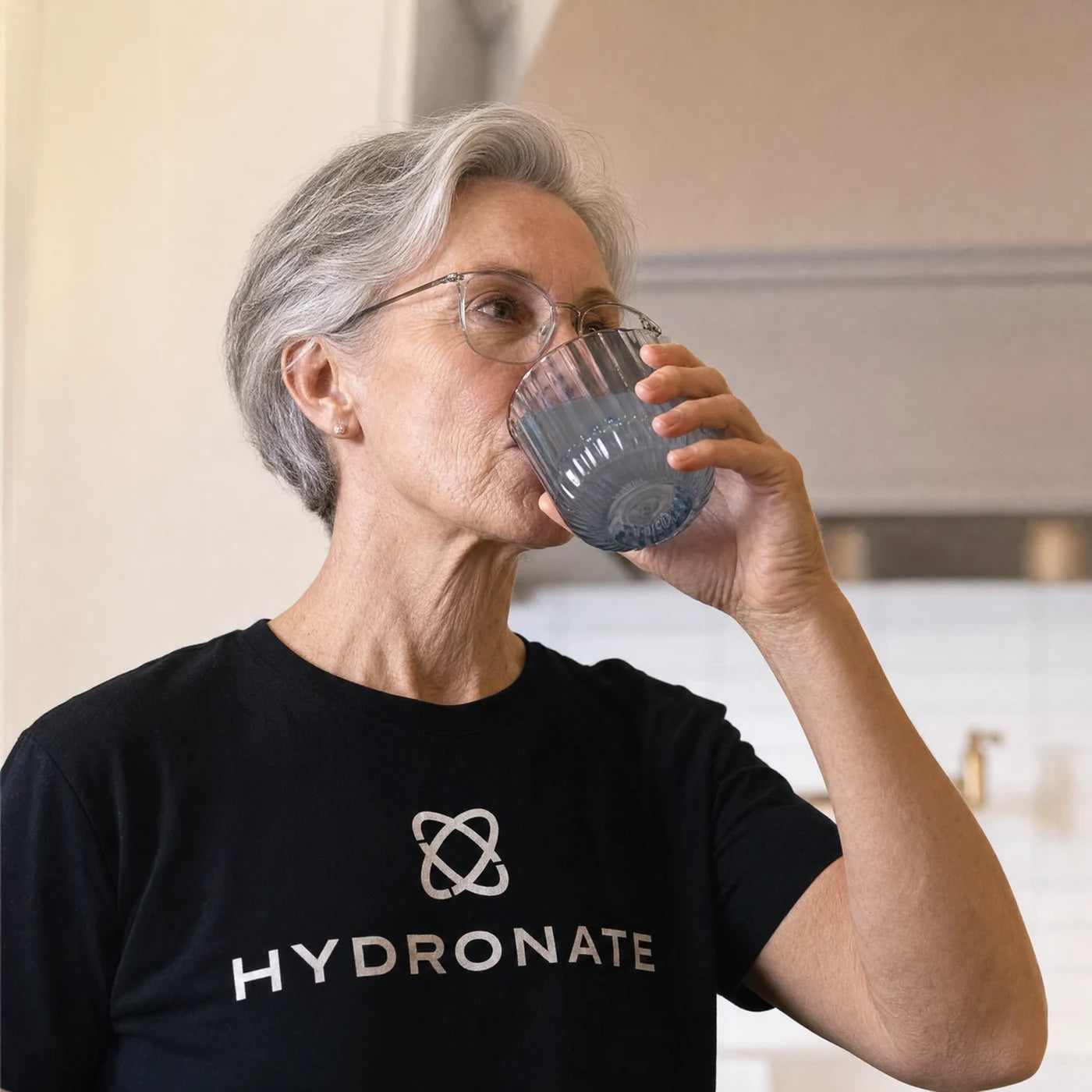
03 — DRINK
Drink the whole glass at once.
Don't sip it slowly. Drink it down while the hydrogen is still dissolved. The whole ritual, start to finish, takes about sixty seconds.
Why drink it right away?
Hydrogen is the lightest gas in the universe. Once it's dissolved in water, it doesn't stay there — it diffuses out into the air, the same way a fizzy drink goes flat after it's been sitting open. Drinking the glass while the hydrogen is still in the water is the difference between absorbing a clinically meaningful dose and absorbing a fraction of one.
It's not a strict rule, but it's the difference between the ritual working the way it was studied and the ritual working at half-strength. Drink it down.
What People Notice First
The small things start
working again.
Less inflammation at the cellular level. You’ll feel it where you’ve been bracing.

01 — Sleep
You wake up because morning came, not because something hurts.
When the cellular inflammation that's been keeping your nervous system on quiet alert finally settles, sleep changes shape. You fall asleep faster. You don't wake up at 3am sore. You stay under for the full stretch.
It's not dramatic. It's just that the things that were waking you up stop being loud enough to interrupt.
Most people notice it inside the first two weeks.
Hydrogen supports a healthy inflammatory response and helps maintain cellular redox balance — both clinically associated with better sleep quality.

02 — Movement
Your body starts feeling like yours again.
The first ten minutes of the morning stop being the careful, slow ten minutes. You bend down to pick something up without thinking about it. You climb the stairs without using the rail. You walk further than you meant to and notice it after, not during.
It isn't that you forgot you have arthritis or a bad knee. It's that the volume goes down. The joint is still there. It just isn't running the day anymore.
Walk the dog. Garden in the morning. Get on the floor with the grandkids. The things you've been quietly subtracting from your life slowly come back.
Hydrogen helps maintain healthy joint function and supports the body's response to oxidative stress — the cellular driver behind much of the stiffness people accept as aging.

03 — Energy
The energy you didn't know you were spending starts coming back.
Pain takes a percentage off the top of every day, and you don't realize how much until it gives some of that back. The mental load of managing it — adjusting how you sit, how you stand up, what you avoid, what you brace for — runs in the background even when you aren't thinking about it.
When the cellular inflammation quiets, that background process quiets with it. You're not borrowing energy from caffeine. You're not crashing at 3pm. You just have a steadier supply of it through the day.
You'll notice it the first time someone asks if something has changed and you can't quite name what.
Three changes, slowly. Then a fourth one a few weeks in: you stop noticing you’re taking it, and start noticing the days you forgot to.
Find relief30-day money-back guarantee · Free US shipping over $55
What's Behind The Tablet
Reviewed, certified, and verified — by name.
Eight things most supplements never put on the page.
Hydrogen concentration
12.4mg/L
In stomach acid. 7.79 mg/L in plain water. Verified by IHSA-certified gas chromatography.
Clinical trials
19+6+4
Nineteen clinical studies. Six pre-clinical studies. Four case studies. All on hydrogen water specifically.
Medical review panel
4
Dr. Tyler LeBaron, Dr. Sergej Ostojić, Dr. Ram B. Singh, Dr. Jan Slezak. Independent review to FTC standard.
FDA recognition
NDI #1104
New Dietary Ingredient notification acknowledged by the FDA. GRAS determination by Spherix Consulting Group.
Where it's made
USA · cGMP
Manufactured in a cGMP-certified facility in the United States. Each batch tested before it leaves the line.
Certifications
NSF · Informed Sport · Halal
The same standards used by professional athletes who can't afford a contaminated supplement on their tested list.
Patents
7
Patented manufacturing process in the US (×2), South Korea, Japan, the EU, Russia, and India. Not a generic formulation.
Every tablet does two things
1 = 1
Each tablet sold helps fund clean drinking water for communities that don't have it.
That's what's behind every tablet. Here's what 25,000 people say about what it does.
Verified customer reviews
25,956
People who started the daily ritual and kept going.
4.8 / 5 · 30-day money-back guarantee
Why Hydronate Is The Best
12 PPM Hydrogen (Highest)
IHSA-Verified · 12.4 mg/L H₂
0 Additives or Artificial Flavors
Reviewed by 4 Medical Experts
All certifications independently verified. Documentation available on request.
Find relief
Pick your supply. Start the ritual.
One tablet a day. Most people start to feel it inside the first two weeks.
Subscribe & save 20%
Skip, pause, or cancel anytime. Ships every 30 days.

01 — Starter
1 Pack · 30 Tablets
30-day supply
$27.96
$34.95
- Most people notice the first changes — sleep quality, morning stiffness — within 2–4 weeks
- Best if you want to experience the shift before committing to a longer supply
$0.93/tablet · Save $6.99
Most Popular

02 — Best Value
2 Packs · 60 Tablets
2-month supply
$55.92
$69.90
- The supply most people land on after their first month
- In the 24-week trial, participants saw peak reduction in joint stiffness by week 8–12 — this supply gets you there
- Free US shipping included
$0.93/tablet · Save $13.98

03 — Stock Up
3 Packs · 90 Tablets
3-month supply
$83.88
$104.85
- The supply serious users land on — enough to feel the full cellular effect
- Lowest per-tablet price · Free US shipping included
- Most people who start a 3-month supply don't go back to the starter
$0.93/tablet · Save $20.97
What 25,956+ Customers Say
Rated 4.8 out of 5. Across more than 25,000 reviews.
The reviews keep saying versions of the same thing. Mostly about the small wins.
★★★★★
"Gardening again. That's enough."
I'm not going to oversell this. My doctor told me arthritis just gets worse and to pace myself. I'd accepted that. Three months in I'm walking the dog twice a day, and I planted a vegetable bed last weekend. I'm not saying it's magic. I'm gardening again. That's enough.
Verified customer
★★★★★
"The first ten minutes of my morning got shorter."
Used to take me about forty-five minutes to feel human after I got out of bed. Knees, lower back, the whole tour. I started taking these about six weeks ago and didn't really clock the change until my husband said something. The first ten minutes of my morning got shorter. That's the easiest way to put it.
Verified customer
★★★★★
"Wasn't expecting much. Now I don't skip it."
Honestly bought it because my daughter wouldn't stop sending me articles. Wasn't expecting much. Now I don't skip it. The shoulder thing I'd given up complaining about is just… quieter. Sleep is also better but I think that's because of the shoulder.
Verified customer
★★★★★
"The 3pm crash stopped happening."
Working mom, two kids, run on coffee and adrenaline. The 3pm crash stopped happening within about two weeks of taking these. I don't feel wired or anything — just don't fall apart at the same point in the afternoon anymore. Caffeine alone wasn't doing this for me.
Verified customer
Questions People Actually Ask
Before you order, here's what
we get asked most.
Short answers. The longer ones live on the science page.
Most customers notice the small things — sleep, morning stiffness, steadier afternoon energy — somewhere between week two and week six. The cellular work hydrogen does is gradual. The clinical studies that anchor our evidence ran 12 to 24 weeks for a reason. If you give it the full thirty days and feel nothing, you're covered by the guarantee. No questions.
Hydronate is molecular hydrogen — a gas that's already produced in your body, in small amounts, by your gut bacteria. It's not a stimulant, a hormone, or a synthetic compound. There are no documented interactions in the published clinical literature, but as with any addition to a medication regimen, a quick check with your physician is the right move. Show them this page if useful.
No. Hydrogen isn't a stimulant. There's no caffeine, no adaptogen, no nootropic blend. The energy people describe is the absence of the slow drain that chronic inflammation causes — not added stimulation. You won't feel anything dramatic in the moment. Most people only realize it's working when they notice they didn't crash at 3pm.
Hydrogen is the lightest gas in the universe. Once dissolved in water, it diffuses out into the air over a few minutes — the same way a fizzy drink goes flat. Drinking the full glass within the first minute or two is the difference between getting the dose the studies used and getting a fraction of it.
No. The whole point of the tablet format is that it works in any glass of water. Generators have their place but they're expensive and they don't produce a higher hydrogen concentration than a tablet does — Hydronate hits 12.4 mg/L in the stomach acid environment.
No. Alkaline water is a pH claim — different category. Hydrogen-infused bottled water is closer, but most of it has lost most of its hydrogen by the time you open it. A tablet dissolved fresh produces a concentration most pre-bottled hydrogen waters never had to begin with.
Hydronate's clinical studies have not reported significant adverse events. A small minority of people report a brief, mild loosening of digestion in the first few days — same pattern as starting any magnesium-based supplement. It usually resolves on its own within a week.
Email us within 30 days, full refund, no conditions. You don't need to send the empty boxes back. You don't need to give a reason. The guarantee section right below this one covers the details.
Got a question we didn't answer? Email support@hydronate.com — a real person replies, usually same day.
The Easiest Possible Way To Try It
30 days. No conditions. You pay nothing if it doesn't work.
Keep the tablets. No boxes to return. No reason. No phone call.

Refund
Within 5 business days
Email us. No call centre, no holds.
30 Days
Money-back
Email within thirty days.
Subscription
Pause, skip, or cancel anytime
From your account. No notice period.


Hydronate · Molecular Hydrogen Tablets
4.8 ★ · from 25,000+ reviews · 30-day guarantee