My name is Carol Henderson. I'm 58. I have two grandchildren I'd basically stopped picking up. A garden I'd given up on. A husband who'd quietly started carrying the laundry basket without being asked. And until about four months ago, I was taking four ibuprofen a day, every day, for nine years.
Last March I sat in my orthopedist's office holding my right shoulder. He looked at the chart and said the exact sentence I'm going to bet some of you have heard: "Arthritis just gets worse, Carol. You've got to learn to pace yourself."
I drove home that afternoon and cried in my car for ten minutes. I'm not the kind of person who cries in cars. But I was 58 years old and the doctor I'd been seeing for six years had just told me that the rest of my life was going to be a slow, polite negotiation with a body that hurt more every year. That was the deal he was offering. Take it or leave it.
What changed everything wasn't a doctor. It wasn't a specialist. It was my niece Megan, who works at the front desk of a Home Depot in Eugene and was finishing her chemistry degree at night. She printed me a stack of research papers a week later and said, "Aunt Carol, you need to read this. The reason nothing's working is they're treating the wrong thing."
If you've been told some version of "we'll keep an eye on it" while your knees, your back, or your shoulder keep getting quietly worse — this is the article I wish someone had handed me at 50. The medical part, I had to learn the hard way. You don't.
First, who's writing this — and why you might want to trust me anyway.
I'm not a doctor. I'm not a scientist. I taught third grade for twenty-six years in a small town in Oregon, retired in 2022, and went back to part-time tutoring because I missed having a reason to be somewhere on a Tuesday morning. Until last spring my biggest medical credential was a knee that clicked when I stood up.
So you can stop reading right now if what you came here for is letters after a name. I don't have them. What I have is nine years of trying every legitimate option a person can try for chronic joint pain, and a fairly precise sense of which ones worked and which ones didn't.

The other thing I have, frankly, is Megan's research stack. Most of the science you'll read below came out of papers she printed at the Home Depot break room and explained to me over the phone. None of this is mine. All of it is sitting in published peer-reviewed journals. The reason it took me 58 years to find it is the same reason it'll take some of you 65 years to find it — nobody who saw me clinically knew about any of it.
If you'll spend the next eleven minutes with me, I'm going to walk you through three things in the same order Megan walked me through them:
- Why nothing I'd tried for nine years had fixed the actual problem — and why that wasn't my fault, or my doctor's.
- The 7-step chain reaction happening inside my joints (and yours) that almost no clinician will sketch out for you.
- The one molecule small enough to interrupt that chain — and what happened in my life ninety days after I started taking it.
Let me start with what wasn't working. You've probably tried most of these too.
"The Slow Burn" — what your bottle of Advil is actually doing to you.

Ibuprofen, naproxen, acetaminophen, the prescription cousins of all three — they work by dulling the pain message traveling through your bloodstream. That's real, useful relief. Nobody is saying don't use them.
But the moment the dose wears off, your body sends the signal again. Because nothing about the cause has changed. You haven't fixed anything. You've muted a smoke alarm while the fire keeps burning in the basement.
And here's the part most pain customers don't realize until they're in their sixties: long-term daily NSAID use is hard on your stomach lining, your kidneys, and your liver. The FDA has been quietly strengthening the warning labels on these drugs for fifteen years. Most doctors don't say much about it because there isn't a better legal alternative they can write a prescription for.
"The Sugar Pill" — why your supplement basket isn't moving the needle.
Now let me tell you about the supplement cabinet. My daughter bought me my first turmeric bottle for my 53rd birthday. By 57 I had five bottles: turmeric, glucosamine, fish oil, MSM, and a "joint complex" with seven ingredients I couldn't pronounce. I took them dutifully for years. Not one of them moved the needle. I felt guilty about it — I must be doing something wrong, I thought. I wasn't. Here's what Megan walked me through.

Here's the thing about turmeric, fish oil, glucosamine, every "anti-inflammatory" capsule on the shelf: most of them target the right system. Inflammation. Oxidative stress. The mechanism is real. The trials are real.
The catch is a word your supplement company doesn't put on the bottle. Bioavailability.
Bioavailability is the percentage of what you swallow that actually reaches the cells where the damage is happening. For most large antioxidant molecules, that number is between 5% and 15%. The rest gets dismantled by your digestive system, processed by your liver, and excreted by your kidneys before it ever gets near your joints.
This is why studies on these compounds keep producing what researchers politely call "mixed results." It's not that the molecule doesn't work. It's that almost none of it ever gets to the place it needs to be.
"The Run-Around" — cortisone shots, "we'll keep an eye on it," and the polite shrug.

Cortisone injections can calm a flare-up fast. That's why doctors reach for them. They are genuinely useful in the right moment — the night before a wedding, the week before a flight, the day before you finally have to move that couch.
But cortisone was designed for short-term relief, not long-term correction. The relief fades. The inflammation returns. And most physicians cap how often you can get them, for the same reason: repeated cortisone shots can actually accelerate joint breakdown over time.
So you end up with a treatment that works wonderfully three or four times, and then the doctor quietly tells you they can't keep giving them to you. And you're back to "we'll keep an eye on it."
That phrase — "we'll keep an eye on it" — is what most patients hear when their physician has run out of tools. It's not dismissal. It's a polite way of saying: the tools I was trained to use are the wrong tools for what's actually happening to you.
So if painkillers can't reach the source, supplements don't make it to the cell, and injections aren't built for daily use — what is actually happening in my body that none of these three things were addressing? — The question I finally asked Megan
The answer, she told me, is a process called chronic oxidative stress. And the reason it keeps driving your pain isn't a mystery — it's a chain reaction. Once you see the seven steps, why every short-term fix stays short-term is going to make permanent sense.
She first drew it for me on the back of a Home Depot receipt, at her kitchen counter on a Saturday morning in April. What follows is the cleaned-up version of that sketch.
The 7-step chain reaction happening in your joints right now.
How a small daily stressor becomes a permanent pain signal.
A trigger fires.
An injury. A processed meal. A bad night of sleep. A stair you took wrong. Your body registers something it has to respond to.
Your immune system flips on.
White blood cells rush in. Blood flow increases. The area gets warm. This is acute inflammation — the right response, perfectly designed.
Cytokines flood the area.
Cytokines are signaling proteins — they're how your immune cells talk to each other. In small bursts, they're useful. In a steady stream, they trigger the next step.
Free radicals get released.
Unstable molecules, missing an electron. Some are useful — your immune system uses them as weapons. The destructive ones are the problem.
The free radicals steal electrons from your cells.
From cell membranes. From joint cartilage. From the mitochondria inside your cells. That stealing is called oxidative stress. It's where the actual damage happens.
The damaged cells send out a "still injured" signal.
Your body assumes the original threat is still there. So it triggers another inflammation response. Which produces more cytokines. Which produce more free radicals.
The loop never shuts off.
What was meant to be a 72-hour healing process becomes a permanent broadcast. That's chronic inflammation. That's the engine driving your knee, your back, your shoulder, your hip. Every. Single. Day.
Look at where each of the three villains tries to intervene:
To actually break the loop, something needs to reach step 5. Not pass near it. Not get to the bloodstream and hope for the best. Actually reach the cell where the damage is happening, neutralize the destructive free radicals there, and leave.
For thirty years, almost nothing was small enough to do that.
Until a team of Japanese researchers published a paper in 2007.
Why the smallest molecule in the universe quietly became the most-studied antioxidant of the last decade.

In June 2007, a team led by Shigeo Ohta at Nippon Medical School published a paper in Nature Medicine titled, in academic understatement, "Hydrogen acts as a therapeutic antioxidant by selectively reducing cytotoxic oxygen radicals."
The paper has since been cited more than 2,300 times. It launched what's now a body of 1,000+ peer-reviewed studies on molecular hydrogen across nineteen human clinical trials. And almost no one in the United States has ever heard of it.
Here's what Ohta's team had figured out. Molecular hydrogen — H₂, the simplest molecule that exists, two hydrogen atoms stuck together — does three things at once that nothing else on the antioxidant shelf does:
Three things hydrogen does that nothing else does.
One. It reaches every cell. Hydrogen is the smallest molecule in the universe. Smaller than every cellular barrier in your body. It diffuses through cell membranes, through the blood-brain barrier, into the mitochondria — the places oxidative stress actually starts. Vitamin C, glutathione, every standard antioxidant: too large to slip through cleanly. Hydrogen has no such problem. It goes where almost nothing else can go.
Two. It only neutralizes the harmful free radicals. Your body actually needs some free radicals — your immune system uses them as weapons against pathogens, your muscles produce them during exercise as a growth signal. Most antioxidant supplements don't distinguish: they neutralize the helpful ones and the harmful ones together. That's why high-dose vitamin trials keep producing strange, sometimes negative results.
Hydrogen is selective. It reacts primarily with the most destructive free radicals — hydroxyl radicals and peroxynitrite — and leaves the useful ones alone. That selectivity is the single most important thing about hydrogen as a therapeutic. It's why Ohta's paper landed in Nature Medicine and not in a smaller journal.
Three. It wakes up your body's own antioxidant system. This is the part most patients don't know about. When hydrogen reaches the cell, it activates a pathway called Nrf2 — the master switch that tells your body to produce its own antioxidants: glutathione, catalase, superoxide dismutase. The same antioxidants your body was making on its own before the load got too heavy.
You're not adding antioxidants from outside and hoping enough survives digestion. You're giving your body the signal to make its own again.
A 2025 systematic review of 20 clinical trials on hydrogen and pain/inflammation came to a similar conclusion — H₂ shows consistent reductions in DAS28 for RA, symptomatic relief in osteoarthritis, and accelerated clearance of muscle-damage markers after exercise.
That's what Megan finally got me to understand, sitting at her kitchen counter with a yellow highlighter and a stack of papers. The research kept replicating across independent labs in Japan, Germany, China, Slovakia, and Serbia. The molecule was real. The mechanism was real. The only realistic question I had left was a delivery question. How do you actually get molecular hydrogen into your body, at a concentration that matters, every day, without making it a chore?
The old way cost $400. The new way costs less than a dollar a day.
For the last fifteen years, the only practical way to get therapeutic doses of molecular hydrogen was to buy a hydrogen water generator. They look like high-end blenders. They cost between $400 and $2,000. You plug them in, fill them with water, wait several minutes, and drink.
They work — at first. The published research on hydrogen-rich water has almost all been done using these generators. But they're impractical for the same reason you don't use an espresso machine at the airport — they're expensive, large, and tethered to a counter. And here's what the brochures don't tell you: they're electronics. The portable "hydrogen water bottles" everyone's selling now run on the same kind of electrode plates, and electronics degrade. The plates foul, the output drifts, and that $200 bottle that hit a decent dose on day one is producing a fraction of it a year later — you just can't see it happening. You're also supposed to clean them constantly: descaling cycles, electrode wipe-downs, filters to replace. Most people don't, which is exactly why the readings fall off. It's a gadget you have to maintain to keep a benefit you can't measure. That's a lot of hassle for a glass of water.
What changed everything was the development of magnesium-based hydrogen tablets. The chemistry is straightforward: drop a magnesium tablet into a glass of water, and it releases molecular hydrogen as it dissolves. No machine. No filters. No counter space. A glass of water and sixty seconds.
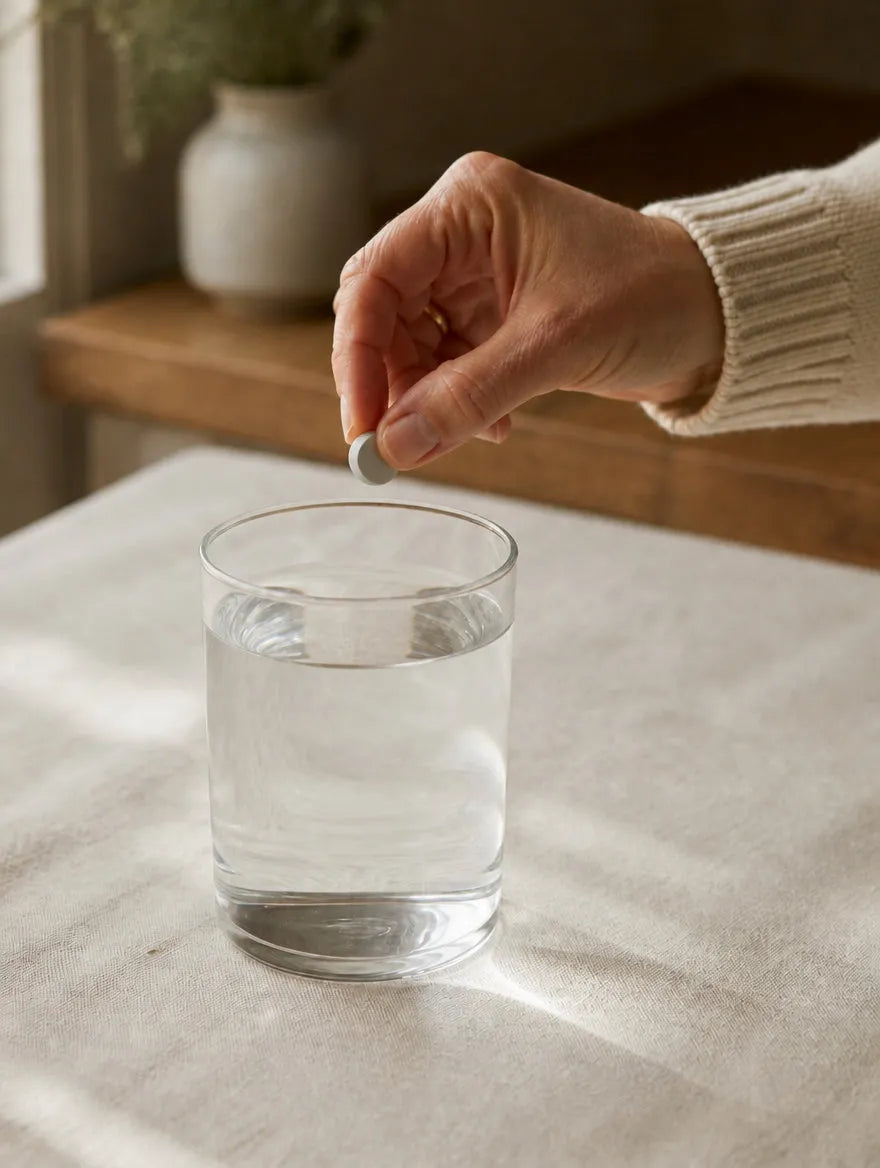
A single Hydronate tablet, dropping into a glass of water. The whole reaction takes about sixty seconds.
The catch — and there is always a catch — is that most hydrogen tablets on the market produce only a small fraction of the dose the published research uses. Some produce less than 1 mg/L. Most don't publish their lab numbers at all. That's because manufacturing a tablet that consistently releases therapeutic concentrations of dissolved hydrogen is genuinely difficult chemistry, and most companies cut corners.
Which brings me to why I'm writing this advertorial in the first place.
Hydronate — the tablet the clinical research is now being repeated with.
Hydronate is the tablet I'm on every morning now. Full disclosure before I go any further: Hydronate paid me to share my story for this article. They reached out to me three months in, after I left a review on their site, and asked if I'd be willing to put my name on this article. I said yes because I'd already told fourteen people in my life about it for free. So no, I'm not pretending to be a neutral journalist — I'm a customer they put on the payroll. Fair to be skeptical of me from this point forward. The lab numbers I'm about to show you don't change based on who's writing about them.
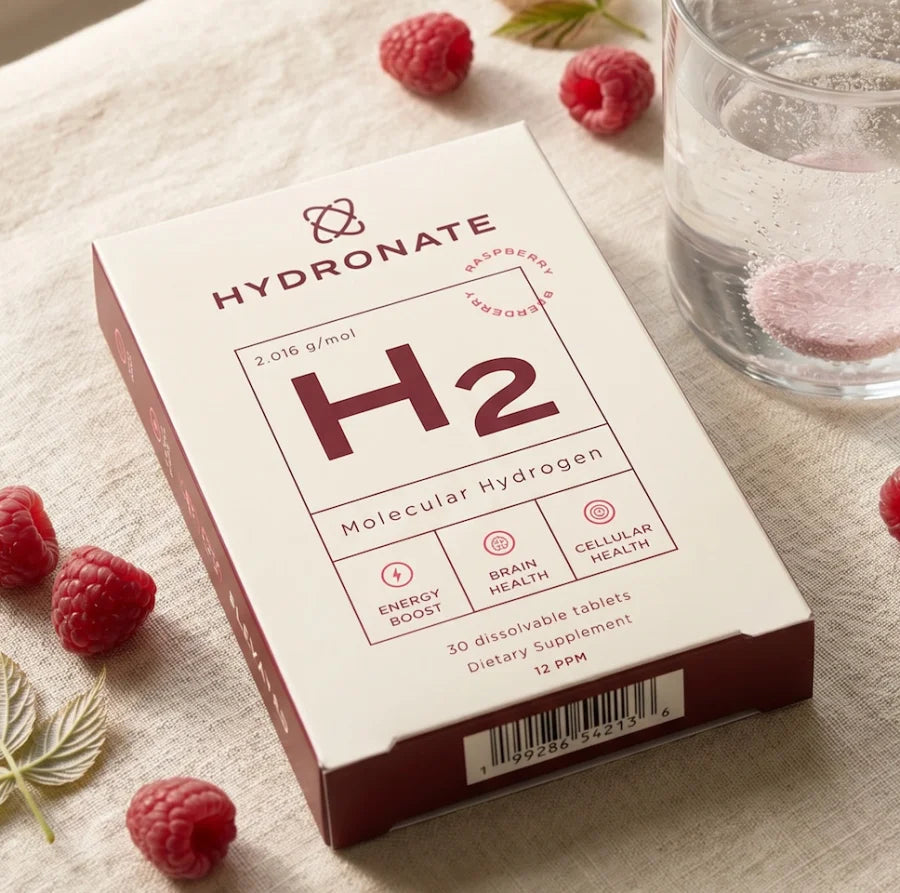
A 30-tablet box of Hydronate — Raspberry. Also available unflavored. Made in the USA, cGMP certified.
Each tablet, when dissolved in plain water, releases between 3 and 6.2 mg of bioavailable molecular hydrogen per tablet. In the stomach-acid environment where it's actually absorbed, the dissolved hydrogen concentration reaches 12 PPM — verified by H2 Analytics gas chromatography in the substantiation panel's appendix.
For context: most hydrogen tablets on the U.S. market produce between 0.4 and 2 mg/L. Hydrogen water bottles produce between 0.5 and 1.6 mg/L. Hydronate hits 12 PPM in gastric conditions — roughly six to thirty times the concentration of the average product on the shelf, in a form that costs a tenth of the machine.
One tablet per day. Drop it into eight to twelve ounces of room-temperature water. Wait sixty seconds while it fizzes. Drink the whole glass — don't sip, because hydrogen is the lightest gas in the universe and it'll diffuse out of the water if you take your time. The whole ritual, start to finish, takes about a minute.
What happened next, in my life, over ninety days.

I started Hydronate the first week of April. One tablet, a glass of water, every morning while my coffee brewed. Megan made me promise I wouldn't change anything else for the first ninety days — not my diet, not my medication, not my exercise — so we'd actually be able to tell what was working.
For the first three weeks, honestly, I felt nothing dramatic. I texted Megan on day twenty-two and asked if I should keep going. She said, "Aunt Carol, the molecule takes time. Give it six more weeks." I did.
Around week five, I texted her in the middle of the night: "I slept through the night. I haven't slept through the night in two years."
Week seven, on my morning walk: "I'm gardening again. Not for long. But I'm out there."
Week eleven, the one I sat with for a while before I sent it: "I walked the dog twice today. Buddy didn't know what to do."
At ninety days, my morning stiffness was down from forty-five minutes to under ten. I was reaching for the ibuprofen bottle a lot less than I had been — my doctor and I talked about it at my next visit and he was, to his credit, the kind of doctor who said "good" instead of arguing with me. I wasn't pain-free. I'm not promising you pain-free. I'm telling you the underlying damage stopped compounding and I got back the small things. The picking-up-grandkid things. The bending-down-for-the-sock things. The walking-the-dog-twice-a-day things.
"I'm not saying it's magic. But I'm gardening again. That's enough for me."— me, ninety days in
What to actually expect, week by week.
I'm going to be straight with you: my results weren't exceptional. They were typical for the people who stick with it past the first month. Hydronate sent me their customer-survey data when I asked, and most people follow roughly the same pattern. Some are faster. A few are slower. Almost none get nothing.
Nothing dramatic, possibly some sleep change.
The molecule is starting to do upstream work. You won't feel a big shift yet. A handful of customers notice they're sleeping deeper. This is normal.
The small things start working again.
Morning stiffness shortens. You wake up at 6:30 instead of 3am. The first cup of coffee isn't quite as desperate. The stairs don't talk back as loudly.
You notice you've stopped reaching for the bottle.
Most customers report a 50–70% drop in NSAID use somewhere in this window. They don't decide to stop. They just notice the bottle isn't on the counter anymore.
The thing you stopped doing comes back.
Gardening. The dog walk. Pickleball. Picking up grandkids. The activity you'd quietly given up on tends to come back somewhere in this window. This is the one we built the company for.
That's the realistic curve. Set your expectations against it — not against a fantasy infomercial promise of feeling 25 again in seven days, which doesn't exist and which I won't sell you.
Who Hydronate isn't for.
I'm also not going to pretend this works for everyone. Here's who I'd actually tell to skip it — this is straight from Megan and from the company's research dossier, which they sent me when I asked:
- ✕You want something that fixes the pain in a week. This isn't that. The molecule takes 6–12 weeks to do the work. If you can't commit to a 60-day trial, save your money.
- ✕You're pregnant or breastfeeding. Not because there's any red flag — H₂ has one of the cleanest safety profiles of anything you can put in your body — but the research in pregnancy simply hasn't been done yet, and I won't pretend it has. Wait.
- ✕Your pain is acute trauma (recent surgery, fresh injury, post-fracture). This works on chronic inflammation, not acute repair. See your surgeon.
- ✕You're under 35 and otherwise healthy. The accumulated cellular damage isn't there yet. You don't need this.
If none of those apply to you — if you've been managing chronic joint pain for two-plus years, you've tried two or three of the standard approaches, and you're at the point where "we'll keep an eye on it" is making you want to scream — this is for you. Keep reading.
Other people I've heard from since I started telling my story.
After my review went up on Hydronate's site, the company started forwarding me notes from other customers who wanted to talk. I've spent some real evenings on the phone with these people over the last two months. Here are three of them.

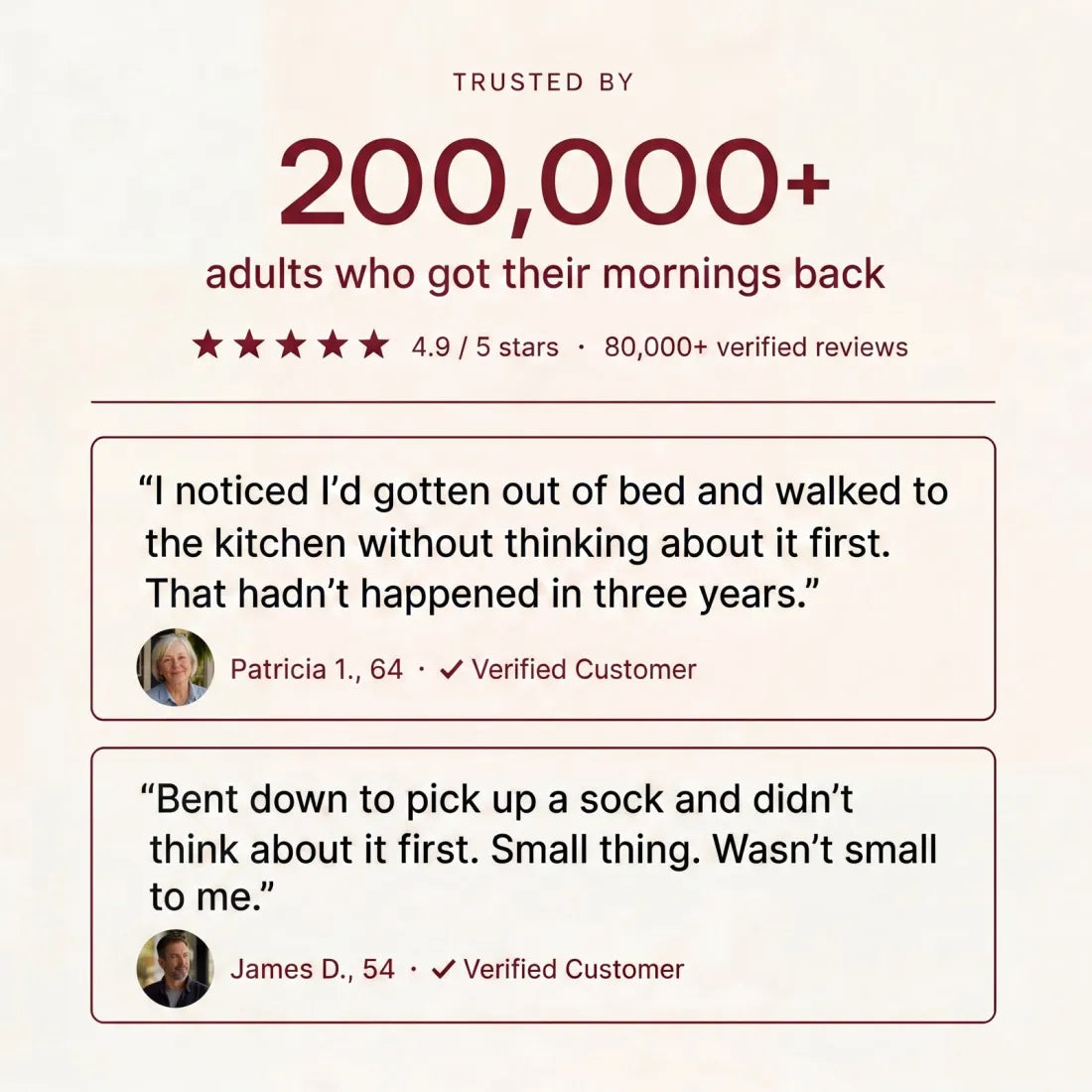
"I'd basically given up on the morning stiffness. Forty-five minutes before I felt human, every day. I thought that was just the deal now. It isn't, apparently. Week 6 was when I noticed I'd gotten out of bed and walked to the kitchen without thinking about it first. That hadn't happened in three years."


"Skeptical. Tried it because my wife bought it for me. Knee that's bothered me since the Army has stopped clicking when I get up. I don't know how it works. It works. I'm on the 5-pack subscription now."

"Lower back I've 'managed' for 11 years. I'm 6 weeks in. I noticed it the day I bent down to pick up a sock and didn't think about it first. Small thing. Wasn't small to me. Wife asked me what I was crying about. I told her I picked up a sock."

"It's not just back pain that's gone. It's that I'm not planning my day around it anymore. That's what I keep telling people."— James D., 54, six weeks in
So why isn't every orthopedist in America talking about this?
I asked Megan this exact question one night over the phone, and her answer was the two-part answer she'd already worked out for herself. I'm going to give it to you the way she gave it to me.
Part one is that hydrogen research is genuinely young in the West. Most of the foundational work has been done in Japan, China, Serbia, and Slovakia. The Ohsawa paper that launched the field came out of Nippon Medical School in 2007. The 24-week trial Dr. LeBaron published was in 2020. The four-PhD substantiation panel for Hydronate's evidence base wasn't finalized until October 2023. That's not very long for a clinical field to filter into the ten thousand orthopedic clinics across America. Standard adoption cycles for new mechanisms in medicine run fifteen to twenty years. We're roughly at year sixteen.
Part two is the part Megan said she doesn't enjoy saying out loud. Molecular hydrogen isn't patentable. It's two hydrogen atoms. Nobody can own it. That means no pharmaceutical company will ever spend the $300 million it takes to run the phase-three trials that would put a hydrogen tablet next to NSAIDs in your physician's prescription pad. The economics don't exist. The research that does exist comes from academic labs working with relatively small budgets — and academic labs don't pay for prime-time television ads.
So the science is real, the studies are published, the substantiation panel is on file. But the marketing budget that would put it on the cover of Time isn't there. Molecular hydrogen is going to get into mainstream medicine the slow way — one patient, one physician, one well-cited study at a time.
This article is, honestly, my way of speeding that up by a couple. If even one person reading this gets back five years of normal mornings, this was worth my afternoon.

So — if you've made it this far, the question's the obvious one: do you want to try it? Below is the pricing the company is offering through this article. I asked them to keep this page up because every person who reads it and decides to give the molecule a fair shot is one less person who has to hear "we'll keep an eye on it" for another five years.