"Nine Years of Bone-Grinding Knee Pain... and the 2-Minute Morning Habit That Finally Reached It?"
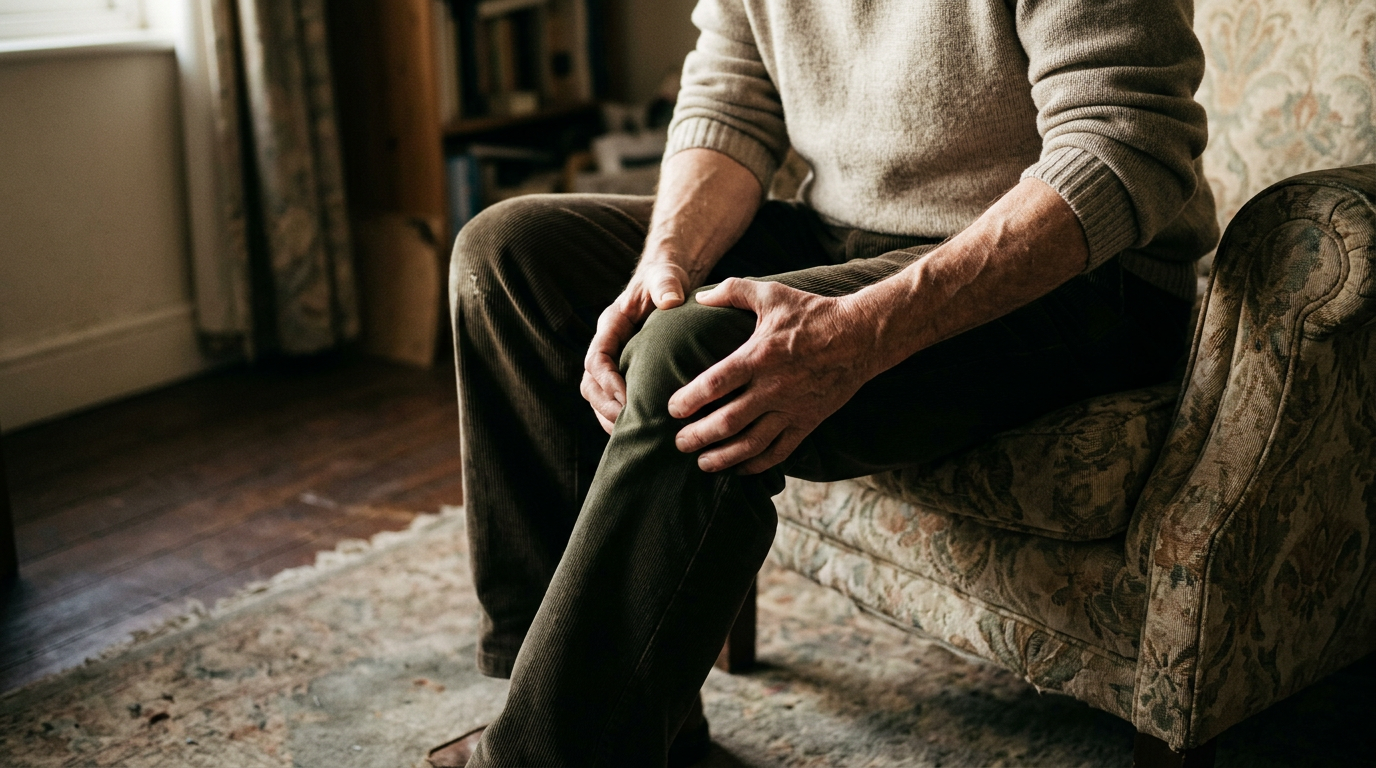
I'm about to annoy every orthopedic clinic, supplement company, and pharmacy chain that ever took my money.
Because what I'm about to tell you cost me nine years and thousands of dollars to figure out... and it turns out the answer was sitting in over two thousand research papers the whole time.
But nobody ever mentioned it to me. Not once.
I carried mail for thirty-one years. Eight, nine miles a day, six days a week, in a city with real winters. I wrecked both knees somewhere in the middle of that and I never once thought of it as an injury. It was just the job.
The bill came later. It came quietly, the way these things do... not as pain exactly, but as a set of small negotiations I started making with myself without noticing.
I'd take the ramp instead of the four steps. I'd park on the flat side of the lot. I'd stand up from the couch during a commercial so nobody had to watch me do it slowly.
Then one Sunday my grandson asked me to come look at something in the yard, and I had to put both hands on the arms of the chair and push, and I heard myself make a noise.
Sixty-seven years old and I made a noise getting out of a chair.
That was the day it stopped being a negotiation and became a problem.
Nine Years of Chasing It Around the Outside of My Body
I want to be honest about this part, because I think most people reading this have the same list... and I think the list is the whole clue.
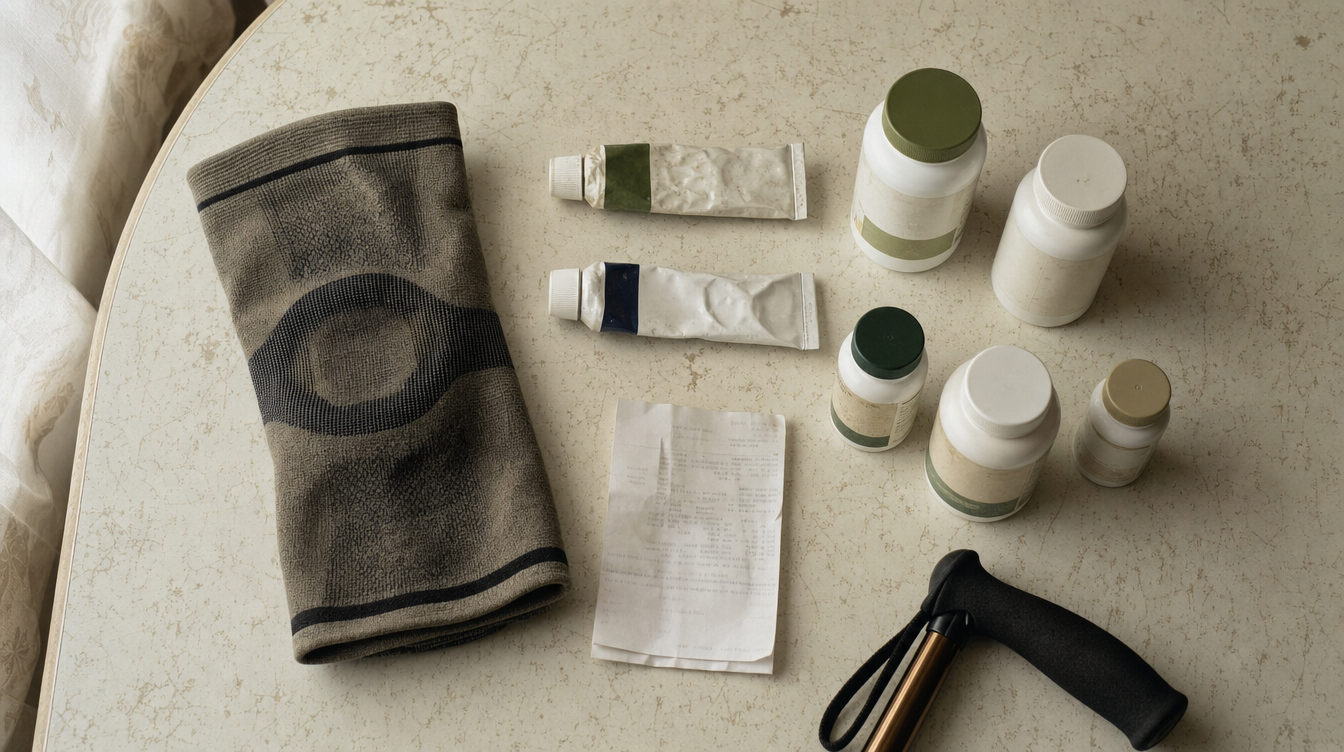
Creams and gels. Menthol, capsaicin, the expensive one behind the pharmacy counter. They worked, in the sense that a cold burn on my skin was a more interesting sensation than a deep ache underneath it. Twenty minutes, maybe forty.
Braces and sleeves. Genuinely useful — I still wear one on long days. But a brace changes how load moves through a joint. It doesn't change the joint. Take it off and you're exactly where you started, only warmer.
The supplements everybody recommends. Glucosamine, chondroitin, MSM, collagen, turmeric, fish oil, the one my neighbour swore by. I gave most of them the full three months. Some helped a little. Most did nothing I could point to.
Two cortisone injections. The first one was close to a miracle for about five weeks. The second one did less. The doctor was straight with me about why we weren't going to keep doing that.
Nine years. Thousands of dollars. And every single thing on that list has one property in common, which took me an embarrassingly long time to notice:
None of them were ever trying to reach the same place.
The List I Stopped Saying Out Loud
Somewhere around year six I stopped mentioning any of it, because I could hear how it sounded. It sounds like getting old. So you keep it to yourself, and you keep the tally privately.
See how many of these you know by heart:
- Getting up out of a chair hurts — the thing you plan for now
- Twenty-plus minutes of morning stiffness before you move normally
- Stairs going down hurting more than stairs going up
- A dry grinding or crackling deep in the bend
- Swelling that shows up in the evening after an ordinary day
- Aching that beats the weather report by a full day
- Waking up when you roll over
- Kneeling being quietly off the list of things you do
I used to read that as eight signs of wear.
I now think it's one process, showing up in eight places... and it happens a layer deeper than anything I'd been rubbing on my skin.
The Real Root Cause Nobody Explained to Me
Here is the thing that reframed nine years for me, and it isn't complicated.
Cartilage is strange tissue. It has no blood supply of its own. No vessels running through it. No direct delivery route. It's fed by fluid and by pressure — by the squeeze and release of ordinary movement.
Which means the cells inside it, the chondrocytes, live in a slow, low-oxygen, badly-plumbed neighbourhood... and they are responsible for maintaining the surface you walk on for eighty years.
Those cells generate waste, the way all cells do. Reactive oxygen species. Free radicals.
In a young joint that's managed. As we age — and after the kind of decades I put my knees through — the balance tips. More reactive load. Less capacity to mop it up.
Researchers call the tipped state oxidative stress, and in joint tissue it isn't a vague wellness word. It's measurable. And it sits upstream of the things that actually hurt: it drives the inflammatory signalling in the joint lining, and it pushes the enzymes that break cartilage down faster than it can be rebuilt.
So here's the distinction that matters, and no orthopedist ever drew it for me:
Pain relief works on the signal. Braces work on the load. Oxidative stress is the environment the cells are living in.
Nothing on my nine-year list was aimed at the environment.
Why Most of What I Swallowed Was Too Big to Matter
Getting a molecule into the inside of a cell is a size question before it's anything else. And when I finally looked up the numbers, the nine years made sense in about a minute.
Molecular weight is measured in daltons. Curcumin — the active compound everybody points at in turmeric — is about 368. Glucosamine is 179. Vitamin C is 176.
Molecular hydrogen is 2.
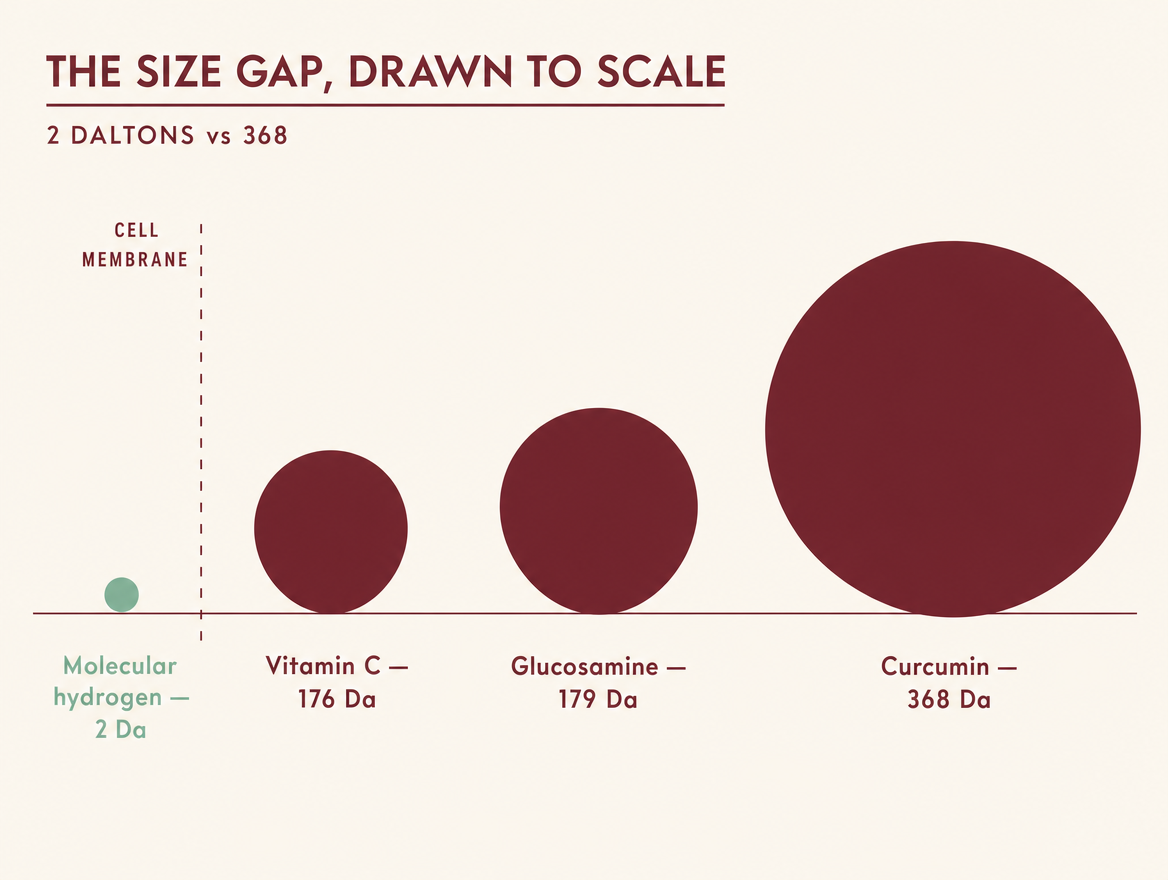
That is the whole reason I use hydrogen specifically, and I'd rather say it in plain language than dress it up: it is small enough to go where the problem is.
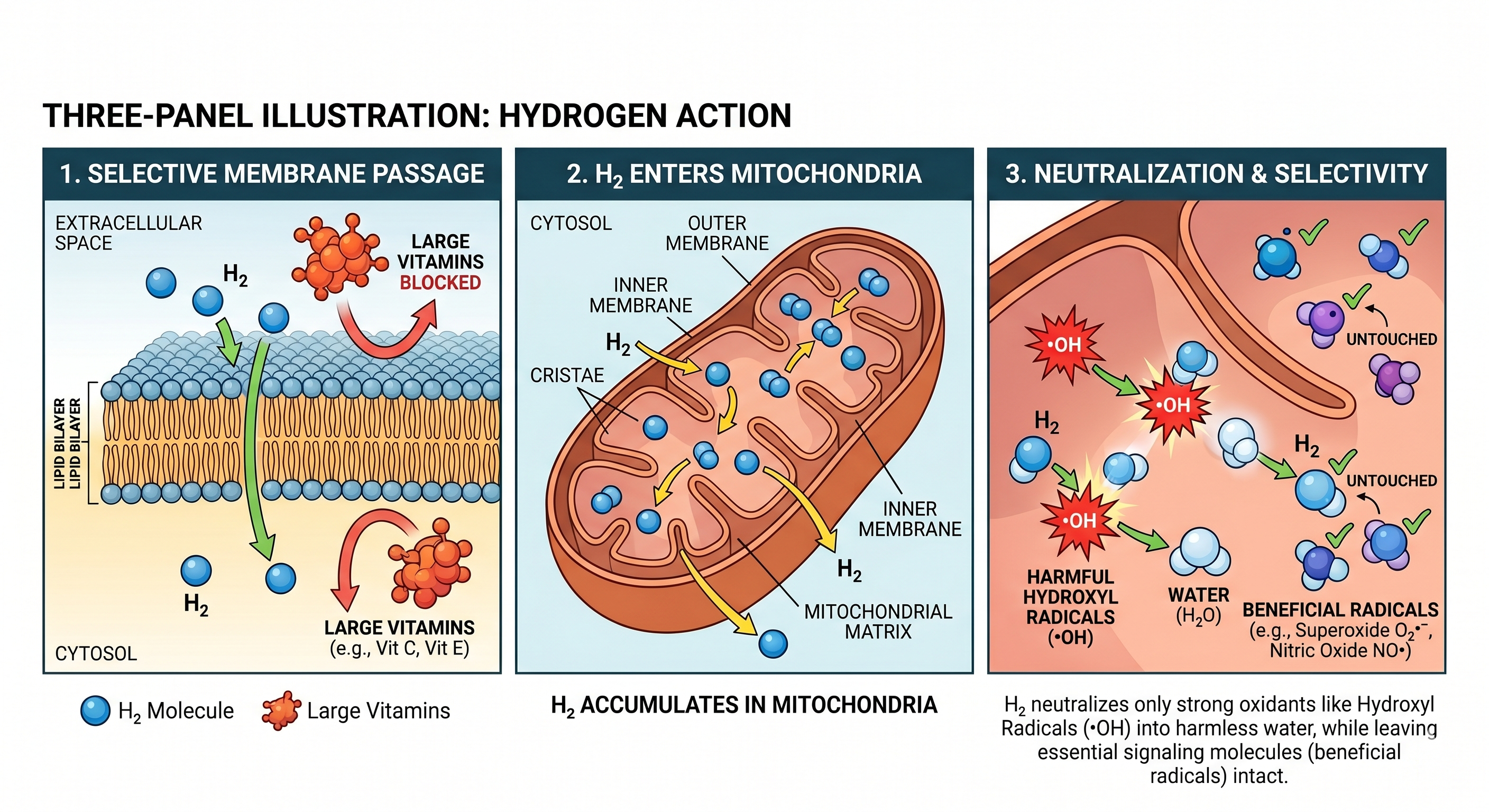
It's the smallest molecule in existence. Neutral, non-polar. It diffuses straight through cell membranes instead of waiting for a transporter to carry it. It gets into the cell interior, and into the mitochondria.
Nothing else in my kitchen cupboard could make that claim.
And there's a second property that took me longer to appreciate.
Hydrogen is a selective antioxidant. That was the finding that started the entire field — a 2007 paper in Nature Medicine showing H₂ preferentially neutralises the most destructive radicals while leaving alone the ordinary reactive signalling your body actually uses to run itself.
Which matters more than it sounds. Blunt high-dose antioxidants have a long history of interfering with things you didn't want interfered with... including the adaptations you get from exercise.
I Read the Research. Including the Parts That Don't Help Sell Anything
I'm not a scientist. I'm a man who delivered mail. But I can read an abstract, and I did a lot of reading before I put anything in a glass.
The animal work is the clearest. In a rat model of osteoarthritis, hydrogen-rich water protected articular cartilage — and the researchers traced the mechanism specifically to suppressed oxidative stress, reduced matrix breakdown, and less cell death in the cartilage. That's the exact chain I just described, measured rather than argued.
In people, the most relevant trial took elderly patients with knee osteoarthritis, put everyone on the same twelve-week home exercise programme, and gave one group molecular hydrogen on top of it. Pain, stiffness and function were scored on WOMAC — the standard arthritis index — alongside inflammatory markers, a chair-stand test and a timed get-up-and-go.
And a 2025 review swept PubMed, EMBASE and the Cochrane Library and pulled together 45 eligible studies across musculoskeletal conditions — 25 preclinical, 20 clinical. Its summary of the animal data was consistent: reductions in reactive oxygen species and inflammatory cytokines, improved cell viability. Its summary of the human data was more modest: symptomatic relief reported in osteoarthritis, with delivery methods varying so widely between studies that direct comparison is difficult.
Now here's the honest reading of all that — and it's the reason I trust it more, not less.
The mechanism is well supported. The human trials are real but early. The ones that used inhaled hydrogen saw benefits that faded once treatment stopped, which tells you this is a daily thing, not a course of treatment you finish. And in that trial, hydrogen was added on top of exercise, not instead of it.
It worked with movement.
That matched my experience so exactly that I'll put it plainly: if you're not going to move, don't bother.
So Why Hasn't Your Doctor Mentioned Any of This?
I asked that with some heat, actually. Sitting in my kitchen with nine years of receipts in a drawer.
The dull answer is the true one.
Hydrogen is the first element on the periodic table. Nobody owns it. There is no patent on a molecule of hydrogen — which means there is no sales force, no rep visiting orthopedic clinics, no budget to run the large expensive trials that move something onto a treatment guideline.
The research exists. Over two thousand papers on molecular hydrogen across medicine now, with the joint-specific work arriving relatively recently. But there is no commercial engine carrying any of it to your appointment.
That's an economics story. Not an evidence story.
"But isn't it just water?"
Plain water has no measurable dissolved hydrogen. What the tablet does is put H₂ into it — at 12 PPM. The water is the delivery vehicle, not the active ingredient.
"Aren't antioxidants a dead end?"
Blunt high-dose antioxidants largely were, partly because they interfere with useful signalling. H₂'s documented selectivity is the specific reason it behaves differently.
"Why haven't I heard of it?"
No patent. No rep. No guideline entry. And to be clear — that is not a reason to change anything you've been prescribed.
What I Actually Do Every Morning Now
It's almost annoyingly simple, and I think that's why it took me so long to take it seriously.
One tablet of Hydronate goes into a glass of plain water. It fizzes — properly fizzes, like an effervescent tablet should — and in about two minutes the water is hydrogen-rich. Then I drink it. All of it, reasonably quickly, because hydrogen is a gas and it doesn't hang around in an open glass forever.
That's the entire ritual. Two minutes, before coffee, before the phone, standing at my own kitchen counter.
Then I do the ten minutes of knee work my physio gave me years ago and I'd been skipping. Because, as I said, the research is clear that this belongs next to movement — not instead of it.
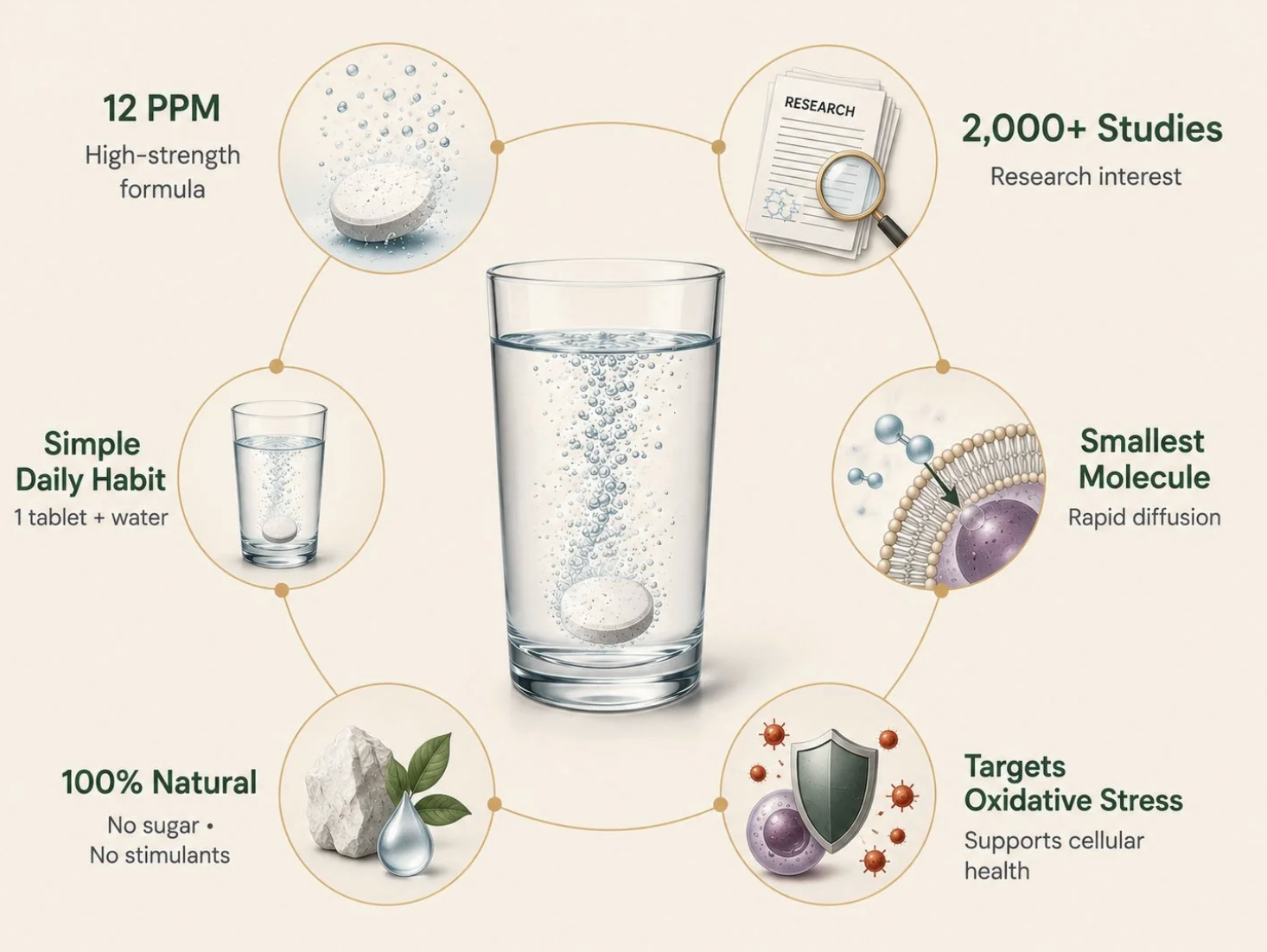
Two things made me choose these specifically.
The concentration. 12 PPM, which is among the strongest available and roughly ten times what home hydrogen-water machines typically produce.
The delivery. A tablet and a glass. Not a $2,000 appliance I'd have used enthusiastically for a month and then resented.
 Check Availability & Start My 30 Days >>>
From $0.59 a tablet · free shipping · 30-day money-back guarantee
Thirty Days, Honestly Reported
I kept notes, because after nine years of things that didn't work I no longer trust my own memory about whether something is helping.
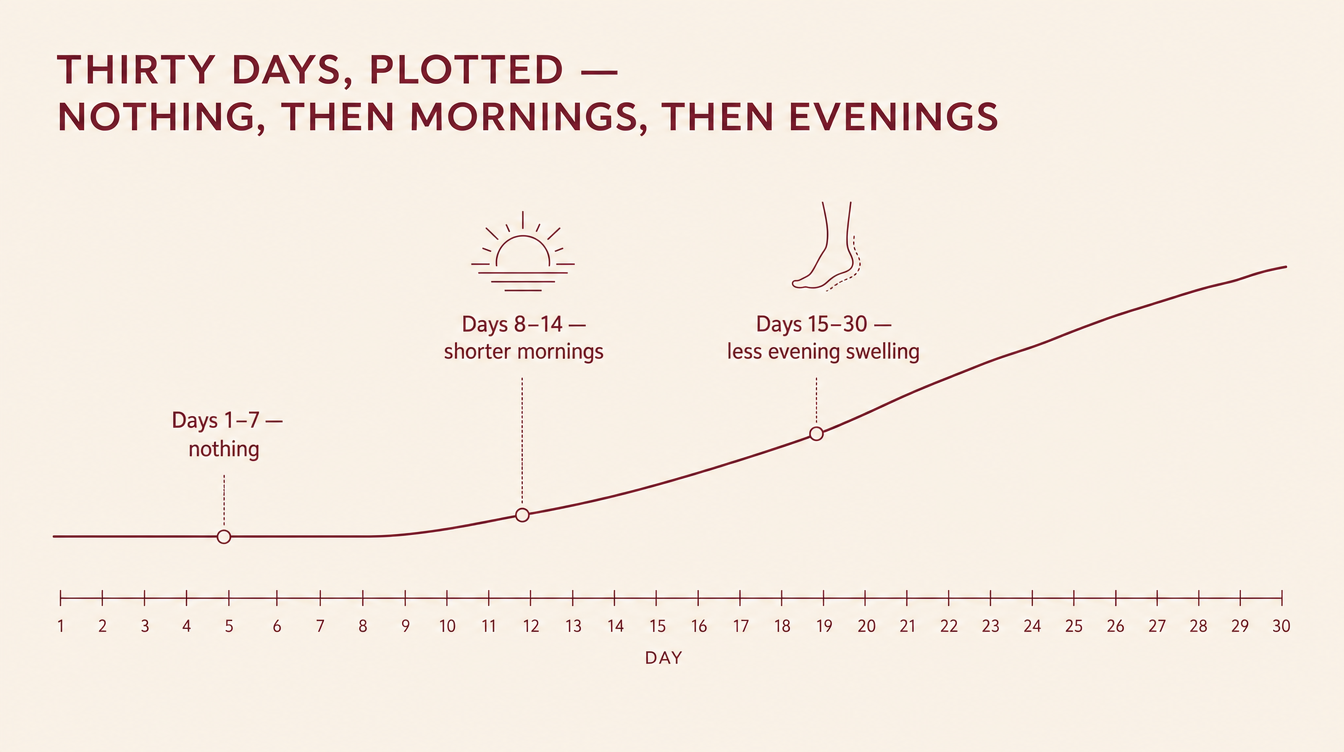
Week one: nothing. I want that on the record. If you're expecting a first-glass moment, you'll be disappointed and you'll quit.
Around day ten: the mornings. Not gone — shorter. The twenty-minute loosening became something closer to ten, and I noticed it because I got to the kettle before I'd thought about my knees at all.
Week three: the evenings. The swelling after a big day in the garden was less than I'd have predicted for that much kneeling and squatting. And I had done kneeling and squatting, which is its own headline.
Day thirty: I got out of a chair in front of my daughter without making the noise. She didn't notice. That was the whole point.
And what didn't change, because you deserve that too:
The grinding is still there when I bend deep. Weather still tells me things. I did not grow new cartilage in a month, and I'd be suspicious of anyone telling you they did.
What changed is the day-to-day cost of having these knees.
Don't Take My Word for It
I'm one man with one set of knees. Here's what other people have written:
Gary, 64: "Twenty-eight years on concrete floors as a machinist. I've bought every cream on the shelf. First seven days on this: absolutely nothing, and I nearly stopped. Somewhere in the second week the mornings got shorter — that's the honest version, shorter, not gone. I'm three months in now and I do the stairs down without holding the rail. Not a miracle. A real difference."
Terrence, 61: "Reading about pushing up out of a chair with both hands was like being described to myself. I'd been doing it for years and calling it nothing. Six weeks of the morning glass and the physio exercises I'd been ignoring. I stand up normally now. My wife noticed before I said anything."
Alan, 68: "Retired chemical engineer, so the size argument is the only part of this I found genuinely persuasive — 2 daltons versus 368 is not a marketing claim, it's the periodic table. Cartilage has no blood supply; whatever helps it has to diffuse. Ten weeks in. Evening swelling after yard work is noticeably down."
Diane, 62: "I'd given up bulbs entirely — two hundred of them used to go in every October and I just stopped. This spring I planted, on my knees, and got up off the ground on my own. I still ache when the weather turns. I don't care. I got the garden back."
Ray, 70: "Four months. Morning stiffness: much better. Swelling: better. The grinding when I squat all the way down: exactly the same as day one. I told the company that and they didn't argue with me. That's more or less why I've reordered twice."
You Have Two Paths From Here
Path #1: Keep doing what you're doing.
Keep planning how to get out of chairs. Keep taking the ramp. Keep buying the next cream, the next brace, the next bottle of something too big to reach the place it needs to reach. Keep waiting twenty minutes every morning for your own legs to come back online. Keep letting the list of things you don't do anymore get a little longer every year.
Path #2: Give thirty days to something aimed at the actual layer.
Two minutes a morning. One tablet, one glass of plain water, 12 PPM of the smallest molecule there is. Plus whatever movement you can manage, because that's how it was studied and that's how it works.
Thirty days is the window where I noticed anything at all. It's also covered by the guarantee either way — so the only thing you're actually risking is the two minutes.
My knees waited nine years for someone to explain this to me.
Yours don't have to.
 Check Availability & Start My 30 Days >>>
From $0.59 a tablet · free shipping · 30-day money-back guarantee · cancel anytime
P.S. If you take one thing from nine years of my mistakes: the size of the molecule is the argument. 2 daltons versus 368. Everything I tried before was too big, too slow, or aimed at my skin.
P.P.S. Don't judge it in week one. I felt nothing for seven days. If I'd quit there — and I nearly did — I'd still be planning how to get out of chairs.
P.P.P.S. Do the exercises. The research pairs hydrogen with movement, and so should you. Ten minutes is enough to count.
What This Article Is Not
It's a paid advertorial. Hydronate paid for this page and I use their product. Read everything above with that in your hand.
It isn't medical advice, and it isn't a treatment. Molecular hydrogen is not a cure for osteoarthritis and it will not rebuild a joint. If your knee is mechanically damaged, no glass of water fixes that.
The human evidence is early. The strongest mechanistic work is in animal models. The clinical trials in knee osteoarthritis are small, use different delivery methods, and in at least one case saw benefits fade after treatment stopped.
It worked alongside movement, not instead of it.
Don't stop anything you've been prescribed. Not a pain medication, not an anti-inflammatory, nothing. Talk to your physician — particularly before adding anything if you're managing another condition.
My thirty days are one man's thirty days. Individual results vary, and the reviews on this page are individual experiences, not typical outcomes.
References
Ohsawa I, Ishikawa M, Takahashi K, et al. Hydrogen acts as a therapeutic antioxidant by selectively reducing cytotoxic oxygen radicals. Nature Medicine. 2007;13(6):688–694.
Cheng S, Peng L, Xu B, Chen W, Chen Y, Gu Y. Protective effects of hydrogen-rich water against cartilage damage in a rat model of osteoarthritis by inhibiting oxidative stress, matrix catabolism, and apoptosis. Medical Science Monitor. 2020;26:e920211.
https://www.ncbi.nlm.nih.gov/pmc/articles/PMC11821916/
Wang C, Yan M, Li Y, et al. Hydrogen-oxygen mixture inhalation as an adjunctive treatment to home-based exercise in older patients with knee osteoarthritis: an open-label, blinded-endpoint, randomized controlled trial. Frontiers in Pharmacology. 2025;16:1505922.
Molecular hydrogen therapy in musculoskeletal conditions: an evidence-based review and critical analysis. 2025. Systematic search of PubMed, EMBASE and the Cochrane Library to April 2025; 45 eligible studies (25 preclinical, 20 clinical).
Molecular weights per PubChem: molecular hydrogen 2.016 g/mol; curcumin 368.38 g/mol; glucosamine 179.17 g/mol; ascorbic acid 176.12 g/mol.
This is an advertisement and not an actual news article, blog, or consumer protection update.
These statements have not been evaluated by the Food and Drug Administration. This product is not intended to diagnose, treat, cure, or prevent any disease. The information provided on this site is for informational purposes only and is not intended as a substitute for advice from your physician or other health care professional. You should not use the information on this site for diagnosis or treatment of any health problem or for prescription of any medication or other treatment. You should consult with a healthcare professional before starting any diet, exercise or supplementation program, before taking any medication, or if you have or suspect you might have a health problem. Testimonials reflect individual experiences and are not typical results.