The cholesterol gap: why Japan is twenty years ahead of America on heart disease.
Same disease, same drug class, a third of the mortality. The reason isn't sushi. Since 2007, Japanese cardiology has been treating a different culprit than American cardiology — and the molecule at the center of their model has finally crossed the Pacific.
 By Dr. Jim Kowalski, Contributing Editor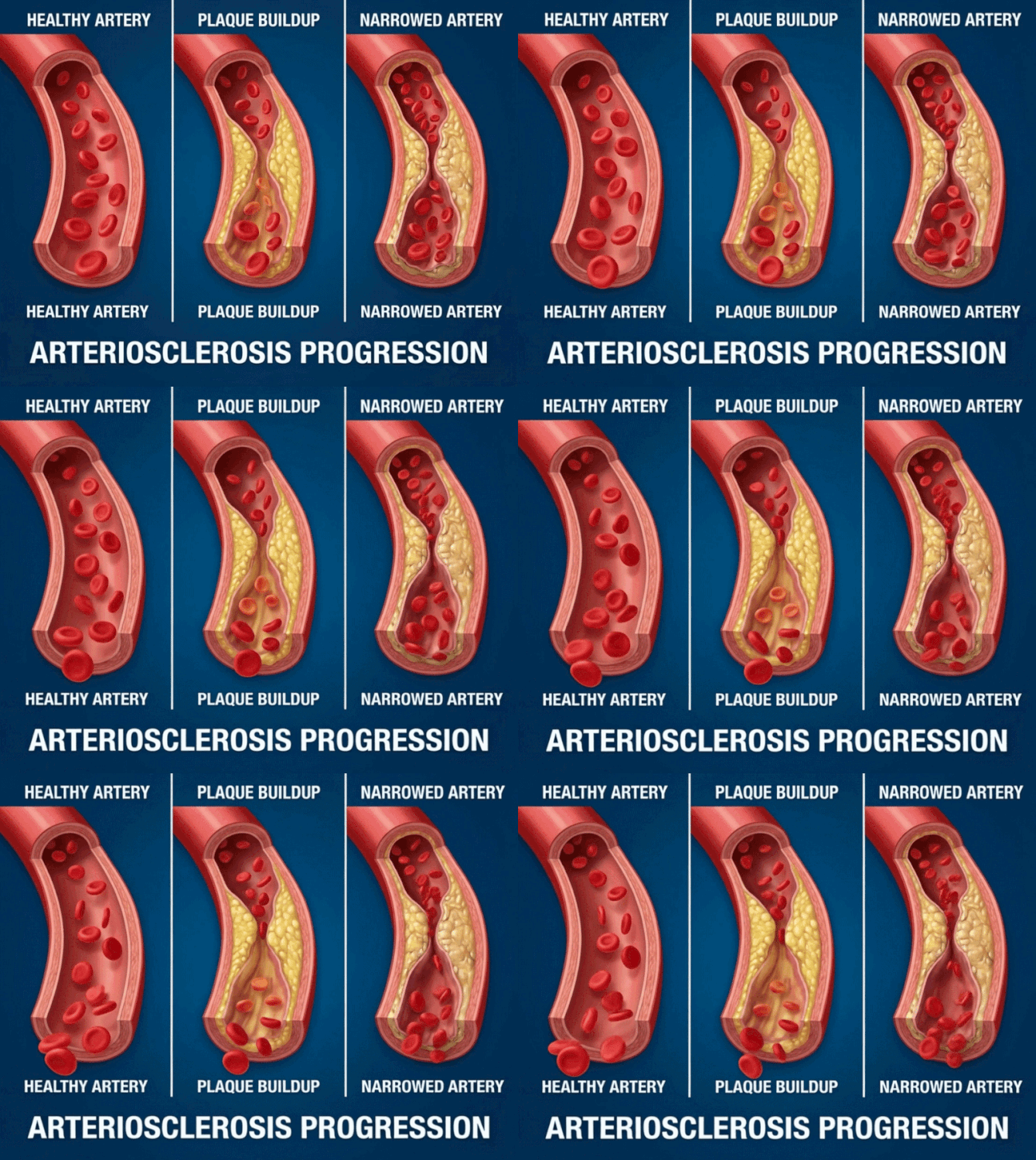
I came across this story in a magazine in my cardiologist's waiting room. The article was four pages long, three months old, tucked between a piece on Tokyo restaurants and an ad for luggage. The headline asked something I'd somehow never thought to ask: why does Japan have a third of America's cardiovascular mortality rate, when both countries take the same drugs?
I photographed all four pages before the nurse called me back. The story isn't really about me. It's about what Japanese medicine has been quietly doing about cholesterol since 2007 — and why almost no one on this side of the Pacific has heard about it.
The disparitySame disease. Same drugs. One-third the mortality.
If heart disease is the leading killer in both the United States and Japan, and both countries treat it primarily by lowering LDL cholesterol with the same drug class, why does Japan have roughly one-third the cardiovascular mortality we do?
Diet and genes explain less than you'd think. Japanese-Americans who eat broadly American diets pick up American cardiovascular risk within a generation. Whatever is protecting hearts in Japan travels with the country, not the body.
The honest answer is harder. Somewhere around June 2007, Japanese cardiology and American cardiology stopped treating the same disease.


That research-output gap is not random. The two countries are asking different questions about the same disease. The American question, since the late 1980s, has been: how do we get the LDL number down? The Japanese question, since 2007, has been: how do we stop the oxidation that turns LDL into plaque? These are not the same question — and they lead to different drugs and, eventually, different mortality curves.
Tokyo · June 2007The paper that started the split.
The lead author was Shigeo Ohta at Nippon Medical School. The journal was Nature Medicine. The title, in unusually plain English: "Hydrogen acts as a therapeutic antioxidant by selectively reducing cytotoxic oxygen radicals."
What Ohta and his team showed was something the antioxidant field hadn't believed possible. Molecular hydrogen — H₂, the smallest molecule that exists — selectively neutralized the hydroxyl radical, the most destructive species your body produces, while leaving alone the radicals your body uses for signaling.
The paper has been cited more than four thousand times. By any objective measure, this is mainstream science.

A different theoryLDL isn't the problem. Oxidized LDL is.
Japanese cardiology, by and large, does not believe LDL is the thing that builds plaque. They believe LDL is the cargo. The thing that builds plaque is what happens to that cargo on the way through your bloodstream.
Specifically: ordinary LDL becomes oxidized LDL when a free radical damages its outer protein. The immune system stops recognizing it. Macrophages engulf the damaged particles, swell into "foam cells," and embed themselves in the artery wall. Repeat for two decades — and you have plaque.
Under this model, lowering LDL is necessary but not sufficient. You also have to stop the oxidation. Statins do the first thing brilliantly. They do not, by themselves, do the second.

The moleculeWhy hydrogen — and why nothing else does what it does.
Arterial oxidation happens inside the mitochondria of the cells lining your artery wall. That setting is famously hard to reach. Vitamin C is too large and charged. Vitamin E gets into membranes but not deep enough. Glutathione cannot cross the cell membrane intact.
Molecular hydrogen does three things nothing else does at once:

It's the smallest molecule that exists. It diffuses through cell membranes, mitochondrial membranes, the blood-brain barrier — places nothing else goes without active transport.
It's selective. It reacts preferentially with the hydroxyl radical — the one tearing up your LDL — and largely ignores the radicals your body uses on purpose.
It leaves only water behind. No metabolite, no residue, no organ burden. The molecule does its work and exits through normal water turnover.
From paper to practiceIn Japan, this is hospital medicine.
The fact that surprises Americans first: hydrogen therapy in Japan isn't sold in health-food stores — it's sold in hospitals. In November 2016 Japan's Ministry of Health authorized hydrogen inhalation as an Advanced Medical Treatment for post-cardiac-arrest brain protection. More than ninety registered Japanese clinical trials are currently underway.

Eighteen years, in milestonesHow the Japanese research program built itself.
Ohta et al. publish in Nature Medicine. H₂ shown to selectively neutralize hydroxyl and peroxynitrite radicals. The field begins.
Ichihara review covers 321 original articles across 170 disease models. The Japanese clinical literature now exceeds the English-language literature.
Japan's Ministry of Health designates hydrogen inhalation an Advanced Medical Treatment — the first formal regulatory endorsement of H₂ for a cardiovascular indication anywhere.
For the first time, a daily, dosed form of H₂ — matching hospital inhalation concentrations — becomes available outside Japan as an over-the-counter consumer product.
The American silence2,000 studies in Tokyo. Zero guideline updates here.
The common assumption — that pharma is hiding something — does not survive contact with the evidence. There is no suppression campaign. There doesn't need to be.
What there is, instead, is a pipeline. Discovery → patent → $200M clinical trials → FDA approval → guidelines → pharmaceutical sales reps → your doctor. Pull any one step and the chain breaks. The step that does not exist for hydrogen is step two: you cannot patent it. It's the first element on the periodic table. Nobody has the financial incentive to spend $200 million proving what the Japanese state has already, in effect, paid to prove.
Japan, with a system that doesn't depend on private patent revenue to fund its drug pipeline, simply did the obvious thing. The American system could not.
The molecule, on your counterThe first Japanese-grade dose outside Japan.
Until recently there was no practical way for an American to take H₂ at a clinically meaningful dose at home. Hospital inhalation devices are large and require certified operators. Bottled hydrogen water loses most of its dissolved H₂ within hours.
What changed is the delivery. A new generation of effervescent tablets, when dropped into a glass of water, releases a measured dose of molecular hydrogen at concentrations matching Japanese inhalation protocols. The molecule is the same one Ohta described in 2007. The access is new.

Hydronate Molecular Hydrogen Tablets
- The same H₂ molecule studied in the 2007 Ohta paper and 2,000+ studies since
- Targets oxidized LDL — the upstream driver of plaque the Japanese model identifies
- One tablet, one glass of water, every morning. No pills, no prescription
- No known side effects, no interactions, leaves only water behind
- Subscribe & save 20% + free shipping · 30-day money-back guarantee
Each tablet sold helps fund clean-water access for communities in need.

What this article is notThe honest qualifications.
This is an advertorial — paid editorial produced on behalf of Hydronate. The reporting is real and the citations are real, but you should read it with that financial relationship in mind.
Molecular hydrogen has not been evaluated by the FDA for the treatment of any specific disease. Don't discontinue a statin or any prescription on the strength of an article. Talk to your physician — bring the citations below if you want. Japan figured something out in 2007. What you do with that is your decision.
