Same test. Same age. Different arteries.
I saw my own angiogram beside a healthy one. I have practised internal medicine for seventeen years, and I did not have a word for what I was looking at. Korean medicine does.
 By Dr. Daniel Rhee, MD · Internal Medicine
The point of this story is not that I am a doctor. The point is that being one did not help me.
What matters is a Tuesday morning eighteen months ago, spent on the wrong side of a cardiology reading room while a colleague scrolled through the results of a routine angiogram I had agreed to after a mildly elevated calcium score on a prior scan. My cholesterol had been "normal" for years. I had the printouts. I had read them myself. I wasn't expecting anything alarming — I mostly wanted to rule something out and get on with my week.
He pulled up my scan first: a coronary vessel with a visible narrowed section, the dye thinning noticeably at one point along its length. Then, almost as an aside, he pulled up a reference image from a study he'd been reviewing that week — a healthy vessel from a man the same age as me, same general build, no cardiac history.
Side by side, they did not look like they belonged to the same decade of life, let alone the same age.
So I asked him the question I have answered for other people several hundred times. It came out of my mouth in exactly the words my own patients use: my cholesterol has been fine for years. How is this possible?

미병 · mibyeongNot yet sick. No longer well.
There is a word for what I turned out to be. It is not an English word, and I want to be honest that I did not learn it in medical school. I learned it eighteen months ago, reading Korean-language material with a dictionary open, because I had run out of English vocabulary for my own scan.
American medicine is binary. You have a diagnosis or you don't. There is a code for disease and a code for a well visit, and there is nothing between them that anyone gets paid to act on. So when your labs come back inside the reference range and your arteries are quietly accumulating damage, the system has no name for you. It files you under fine and books you for next year.
no longer well
American billing recognises the two ends of this scale. It has no line item for the middle, which is where most people spend their forties and fifties.
The idea is old, and it is not originally Korean. The phrase 治未病 — treat what is not yet ill — comes from the Huangdi Neijing, the foundational text of East Asian medicine, and it circulates through Japanese mibyō and Chinese wèibìng as well.[9]
What Korea did with it is the part that interested me. 한의학 — Korean medicine — kept mibyeong as a working category rather than a philosophical flourish, and Korean researchers have spent years trying to make it measurable: prevalence surveys in the general adult population, and validated questionnaires intended to identify the state before a disease is codable.[8] Whatever you make of that project, it is a serious attempt to put a name and an instrument on a stage of life that my own training simply skipped.
I had apparently been standing in that middle band for most of a decade. Nobody told me — including me — because in the language my training was conducted in, there was nothing to tell.
To be exact about what this is
Mibyeong is a clinical concept, not a diagnosis you can be given in the United States, and not a billing code. Naming it changes nothing a scan shows. What it changed for me was which question I asked next — and, eventually, which test I ordered.
The vocabularyFour words this piece runs on.
Not yet sick, no longer well. The state between health and diagnosed disease — a working category in Korean medicine, and a gap in mine.
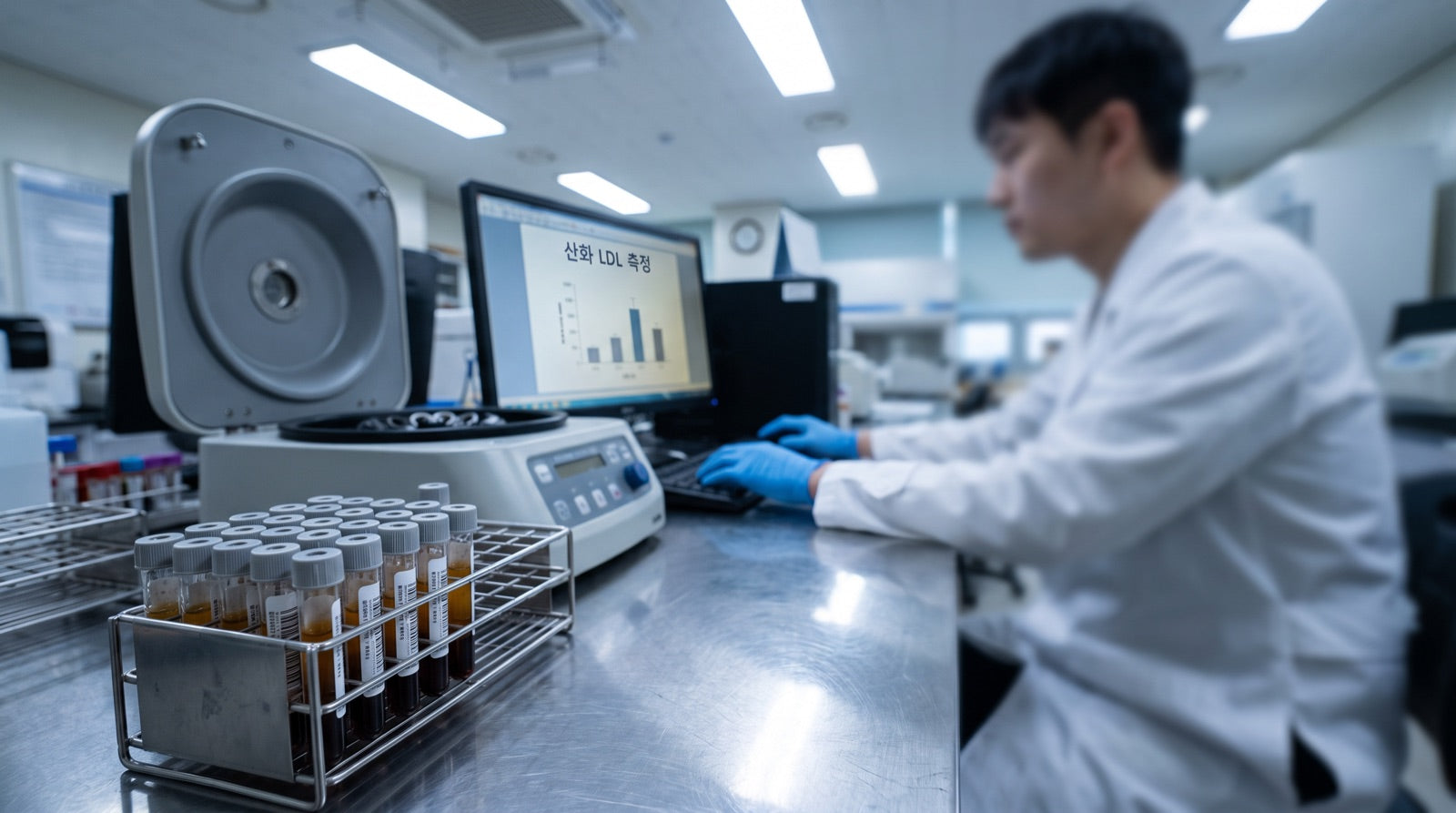
Oxidized LDL. Not how much LDL you have, but whether it has been chemically altered into the form that ends up in the artery wall. Orderable in the U.S. Almost never ordered.
Comprehensive health screening. In Korea, an ordinary scheduled purchase that often includes imaging. In America, something that happens after an event.
Hydrogen. Two daltons — the smallest molecule there is, and the subject of a twenty-year East Asian research literature most American physicians, myself included, have never read.
산화 · sanhwa — oxidationQuantity is not condition.
My colleague's answer is the reason I am writing this at all, because it changed how I read every lab result that has crossed my desk since — mine and everyone else's.
A standard cholesterol panel measures how much LDL is circulating in your blood. It does not measure whether that LDL has been oxidized — chemically altered by free radical activity in a way that makes it far more likely to be picked up by immune cells and deposited into the artery wall, where it becomes the plaque an angiogram actually visualizes. Two people can carry identical total LDL numbers and very different amounts of oxidative damage to that LDL. The angiogram shows the accumulated result of that process, sometimes across decades. The standard panel was never designed to catch it in progress.
I need to be careful here, because I knew this. I knew it the way you know something you were taught once in a lecture hall and never had a reason to act on. I could have drawn the cascade on a napkin. In seventeen years of practice I had never once ordered the test.

종합검진 · jonghap geomjinIn Korea, the default is to look.
The second thing I found, reading about the country my parents emigrated from, was structural rather than molecular. South Korea runs population-wide health screening through its single-payer insurer, on a regular cycle, as a matter of course. Layered on top of that, 종합검진 — a comprehensive screening package, frequently including imaging — is an ordinary scheduled purchase for a middle-class adult. You book it the way you book a dental cleaning.
I am not going to romanticise this. More screening also produces more overdiagnosis, and Korea has had that argument in public and at volume — most famously over a thyroid-cancer detection surge driven substantially by ultrasound screening rather than by any change in disease.[10] Screening everyone for everything is not a free lunch and Korean clinicians know it better than I do.
But the default posture is different, and the default posture is what decides who gets found early. In my system, most people never have their arteries visualized until something has already gone wrong. I am a physician, and I was fifty-three before anyone looked at mine — and only then because a calcium score came back mildly off.

If this sounds familiarThe list I now run through.
If any part of this sounds like your own situation
→ Your cholesterol panel has come back "normal" for years, and you have treated that as the full picture
→ You have never had an angiogram or a calcium scan, and don't know what your arteries look like independent of your labs
→ You have a family history of cardiac events despite normal-looking cholesterol in relatives
→ Nobody has ever said the phrase "oxidized LDL" to you as something distinct from total LDL
→ You would rather understand the mechanism creating the plaque than monitor the number that partially predicts it
None of this means your labs are wrong or meaningless. I still order them every day. It means they are answering a narrower question than "how healthy are my arteries right now."
수소 · suso — hydrogenWhat addresses the oxidation, rather than the quantity.
After that appointment I went looking — with a physician's access to the literature and a patient's motivation, which is a combination I had never had before — for anything that specifically addresses LDL oxidation rather than LDL quantity.
That search led me into molecular hydrogen research, most of it originating in Japan and Korea, examining hydrogen's selective antioxidant activity: its capacity to neutralize the specific free radicals responsible for oxidizing LDL without disrupting the body's normal oxidative signaling.[1] It is the smallest molecule that exists — small enough to reach circulating LDL particles directly, and addressing a different mechanism than a statin does.

Seoul, and before that TokyoThe literature isn't new. It just isn't in English-language guidelines.
Credit where it belongs: the origin is Japanese. A 2007 paper in Nature Medicine from a Tokyo group established that hydrogen acts as a selective antioxidant, neutralizing the most destructive radicals while leaving the useful signaling species intact.[1] What followed was largely a Korean and Japanese clinical trail, running for the better part of two decades while I sat in American conference rooms being shown slides about statin adherence.

The trials I found most persuasive were the ones that went at the particle rather than the number. A randomized, double-blind, placebo-controlled crossover trial reported modified LDL falling 15.5% and small dense LDL 5.7%.[3] A later study in the Journal of Lipid Research found lower total and LDL cholesterol, improved HDL function, and reduced oxidative damage measured in the LDL fraction directly.[4] A 2021 trial in angina patients traced its effect to LOX-1 — the receptor through which oxidized LDL does its damage.[5]
And in 2020, Seoul National University published a randomized, double-blind, placebo-controlled trial in Scientific Reports: antioxidant potential rose more in the hydrogen group among older participants, and immune-cell RNA sequencing showed distinct transcription in inflammatory-response and NF-κB networks.[6]
What those trials did and did not measure
They measured oxidation markers, lipid fractions and gene expression. They did not measure heart attacks, and they did not measure plaque on a scan. I am not going to blur that line, because blurring it is how this material gets dismissed. It is a mechanism literature, and a reasonably deep one. It is not an outcomes literature, and no cardiovascular outcome trial of hydrogen exists.
Original articles on molecular hydrogen catalogued in a single 2015 review in Medical Gas Research[2] — with more since, across Korea, Japan and China. Mentions in American cholesterol guidelines: none.
The American silence321 studies. Zero mentions in the guidelines.
It isn't a drug, and it can't be patented — hydrogen is the first element on the periodic table. No patent means no company funds the large outcome trials that get a molecule into a guideline, into a conference slide, and into your doctor's conversation. Not suppressed. Just outside the pipeline that decides what gets discussed.
I know how that argument sounds, so let me put it the way it actually applies to me: if this were worth knowing, a doctor would have mentioned it. I am that doctor. I never did, for seventeen years, and not because I had weighed the evidence and rejected it. I had simply never encountered it, because nothing in the system that educates me had any reason to bring it up.
There is a second silence underneath the first, and it is the one that actually cost me. Oxidized LDL is not a standard American test. It exists. You can order it — I can order it. It is not part of the routine workup, so nobody offers it, and you cannot ask for something you have never heard named.

I want to be precise about what that means and what it does not. This is not a claim that anything reverses existing plaque, or replaces a cardiologist's guidance on managing a narrowed artery. It is a mechanism that may help address the oxidative process contributing to plaque formation in the first place — a different question from the one my statin, or anyone's, is designed to answer.
The practical partGetting a dose you can actually verify.
The practical question became how to get a meaningfully concentrated, verified dose of molecular hydrogen. I had already read enough about the $100–150 electrolysis bottles — devices that reportedly fail, leak, or produce contaminated output well below their advertised concentration — to be wary of that format entirely. A dose you cannot verify is not a dose, it is a hope.
What I found instead was Hydronate: a dissolvable tablet rather than a device. Nothing to charge or break, third-party tested for dissolved hydrogen output at the point of consumption, manufactured in a cGMP-certified U.S. facility, and separately tested for heavy metals and microbial contamination. It runs about $0.59 per tablet.

What changedNot my care. My question.
I started taking it daily, alongside the cardiac monitoring plan my cardiologist and I had already agreed on. I did not stop my statin, and nothing about my existing care changed. If you take away one thing from a page that is, transparently, an advertisement, let it be that sentence.
What changed is smaller than a treatment and larger than a supplement. It is a sentence. I have said "your cholesterol is normal" more times than I can count, in a tone that meant we're done here. I don't say it that way any more. I say what the panel measures, and then I say what it doesn't, and the appointment runs four minutes longer.
I am a physician, but I am not your physician, and nothing here is medical advice. If you have any concern about your cardiovascular health, that conversation belongs in an examination room — not at the bottom of an ad.
What I would suggest, as one specific and askable thing: ask whether an oxidized LDL panel — 산화 LDL — or imaging such as a calcium score is appropriate for your particular risk profile. You may well be told no, with good reason. But you will have asked a question that most people never get to, because most people are never told the question exists.

And you don't have to wait for that appointment to start addressing the oxidative piece in the meantime.
Hydronate H2 — Molecular Hydrogen Tablets
"My panel has been 'fine' for twenty years. Nobody ever told me the number and the artery were two different questions." (illustrative reader account; results vary)
- 2 daltons — the smallest molecule there is, small enough to reach circulating LDL particles directly
- 선택적 항산화 — selective: targets the destructive radicals, leaves normal oxidative signaling alone
- A tablet, not a device — nothing to charge, leak or replace
- Third-party tested for dissolved hydrogen output at the point of consumption
- cGMP-certified U.S. facility · separately tested for heavy metals and microbial contamination
- About $0.59 per tablet · one glass of water a morning
30-day money-back guarantee · free shipping · cancel anytime

