Japan has a twenty-year head start on your heart disease.
And your doctor doesn't even know the race started. Same disease, same drug class, three times the deaths — and the molecule that explains the gap has been sitting in Japanese journals American cardiology doesn't read since 2007.
 By Dr. Alex Larowe, Contributing Editor
I started looking into this because my own LDL wouldn't move far enough on a statin, and a Japanese colleague asked me a question I couldn't answer: if we take the same drugs, why does America bury nearly three times as many people from heart disease as Japan does?
I assumed I'd find the usual answers — diet, genes, healthcare. None of them survived an afternoon of reading. What I found instead was a twenty-year head start, a single 2007 paper, and a molecule American cardiology has somehow never put in a guideline.
The disparitySame disease. Same drugs. Three times the deaths.
Here are the numbers, and they aren't close. Atherosclerotic cardiovascular disease is the leading killer in both countries. Both treat it primarily by lowering LDL cholesterol with the same drug class — statins. Same disease, same mechanism, same medicine. The outcomes are not the same.

America's cardiovascular mortality rate is nearly three times Japan's. Not a rounding error — a chasm. And the explanations everyone reaches for don't hold up under an afternoon of reading.
Japanese-Americans who eat broadly American diets pick up American cardiovascular risk within a single generation. The protection travels with the country, not the cuisine.
The same generational shift disproves it. If genes explained the gap, Japanese-Americans would keep their protection regardless of where they live. They don't.
Both countries have advanced systems with widespread statin availability. That isn't the variable either.
Something else is happening in Japan that isn't happening in America. And it started, very specifically, in June 2007.
Tokyo · June 2007The paper that started the split.
The lead author was Shigeo Ohta at Nippon Medical School. The journal was Nature Medicine. The title, in unusually plain English: "Hydrogen acts as a therapeutic antioxidant by selectively reducing cytotoxic oxygen radicals."
What Ohta and his team showed was something the antioxidant field hadn't believed possible. Molecular hydrogen — H₂, the smallest molecule that exists — selectively neutralized the hydroxyl radical, the most destructive species your body produces, while leaving alone the radicals your body uses for signaling.
The paper has been cited more than four thousand times and launched an entire field of research — in Japan. Since 2007, over two thousand peer-reviewed studies have followed, the bulk of the foundational work coming out of Japanese, Korean, and Chinese institutions. By any objective measure, this is mainstream science.

The four-stage cascadeYour statin wins stage one. Stages two through four run unchecked.
Plaque doesn't appear all at once. It builds through a cascade: healthy LDL becomes oxidized LDL, oxidized LDL is engulfed by immune cells that swell into "foam cells," and foam cells embed in the artery wall as plaque. Four stages, two decades.
Your statin addresses stage one — it lowers the number of LDL particles available to oxidize. It does this brilliantly. But the LDL that remains after the statin does its work is still being attacked by free radicals. Still oxidizing. Still building plaque. Stages two, three and four continue unchecked.
American cardiology intervenes at stage one. Japanese cardiology intervenes at stage two — the oxidation itself, where the damage actually begins.

The moleculeWhy hydrogen — and why nothing else does what it does.
Arterial oxidation happens inside the mitochondria of the cells lining your artery wall. That setting is famously hard to reach. Vitamin C is too large and charged. Vitamin E gets into membranes but not deep enough. Glutathione cannot cross the cell membrane intact.
Molecular hydrogen does three things nothing else does at once:

It's the smallest molecule that exists. It diffuses through cell membranes, mitochondrial membranes, the blood-brain barrier — places nothing else goes without active transport.
It's selective. It reacts preferentially with the hydroxyl radical — the one tearing up your LDL — and largely ignores the radicals your body uses on purpose.
It leaves only water behind. No metabolite, no residue, no organ burden. The molecule does its work and exits through normal water turnover.
Small enough to reach the exact site where oxidation happens, it converts the radicals to water and the LDL stays intact. No oxidation. No foam cells. No plaque.
Stage one and stage two. The number and the mechanism. That — in one sentence — is the twenty-year head start.
From paper to practiceIn Japan, this is hospital medicine.
The fact that surprises Americans first: hydrogen therapy in Japan isn't sold in health-food stores — it's sold in hospitals. In November 2016 Japan's Ministry of Health authorized hydrogen inhalation as an Advanced Medical Treatment for post-cardiac-arrest brain protection. Not alternative medicine. Not supplement-store speculation. Government-authorized therapy in clinical settings — with more than ninety registered Japanese trials underway.
What the cardiovascular research covers
The H₂ literature has examined LDL oxidation, arterial inflammation, foam-cell formation, blood pressure, and cholesterol markers — the full length of the plaque cascade, not just the LDL number at the start of it.

Nineteen years, in milestonesHow the Japanese research program built itself.
Ohta et al. publish in Nature Medicine. H₂ shown to selectively neutralize hydroxyl and peroxynitrite radicals. The field begins.
Ichihara review covers 321 original articles across 170 disease models. The Japanese clinical literature now exceeds the English-language literature.
Japan's Ministry of Health designates hydrogen inhalation an Advanced Medical Treatment — the first formal regulatory endorsement of H₂ for a cardiovascular indication anywhere.
For the first time, a daily, dosed form of H₂ — matching hospital inhalation concentrations — becomes available outside Japan as an over-the-counter consumer product.
The American silence2,000 studies in Tokyo. Zero guideline updates here.
The common assumption — that pharma is hiding something — does not survive contact with the evidence. There is no suppression campaign. There doesn't need to be. The reason isn't scientific. It's economic.
What there is, instead, is a pipeline. Discovery → patent → $200M clinical trials → FDA approval → guidelines → pharmaceutical sales reps → your doctor. Pull any one step and the chain breaks. The step that does not exist for hydrogen is step two: you cannot patent it. H₂ is the first element on the periodic table and the most abundant element in the universe — no company can own exclusive rights to it. No patent means no funding, means no trials, means no guidelines, means no drug reps, means your doctor never hears about it.
Japan's research system doesn't need a patent holder to fund science — government grants, academic institutions, a culture that advances research on evidence rather than profit potential. So it simply did the obvious thing. The American system could not.
The dose that mattersWhy most hydrogen products were never going to work.
Until recently there was no practical way for an American to take H₂ at a clinically meaningful dose at home. Hospital inhalation devices are large and require certified operators. Bottled hydrogen water loses most of its dissolved H₂ within hours. And the tablets that did appear mostly missed the one number that decides everything.
The Japanese clinical results were achieved at concentrations of 10–12+ PPM. Most American hydrogen products deliver 2–4 PPM — a fraction of the studied dose. Concentration isn't a footnote here; it's the difference between matching the research and gesturing at it.

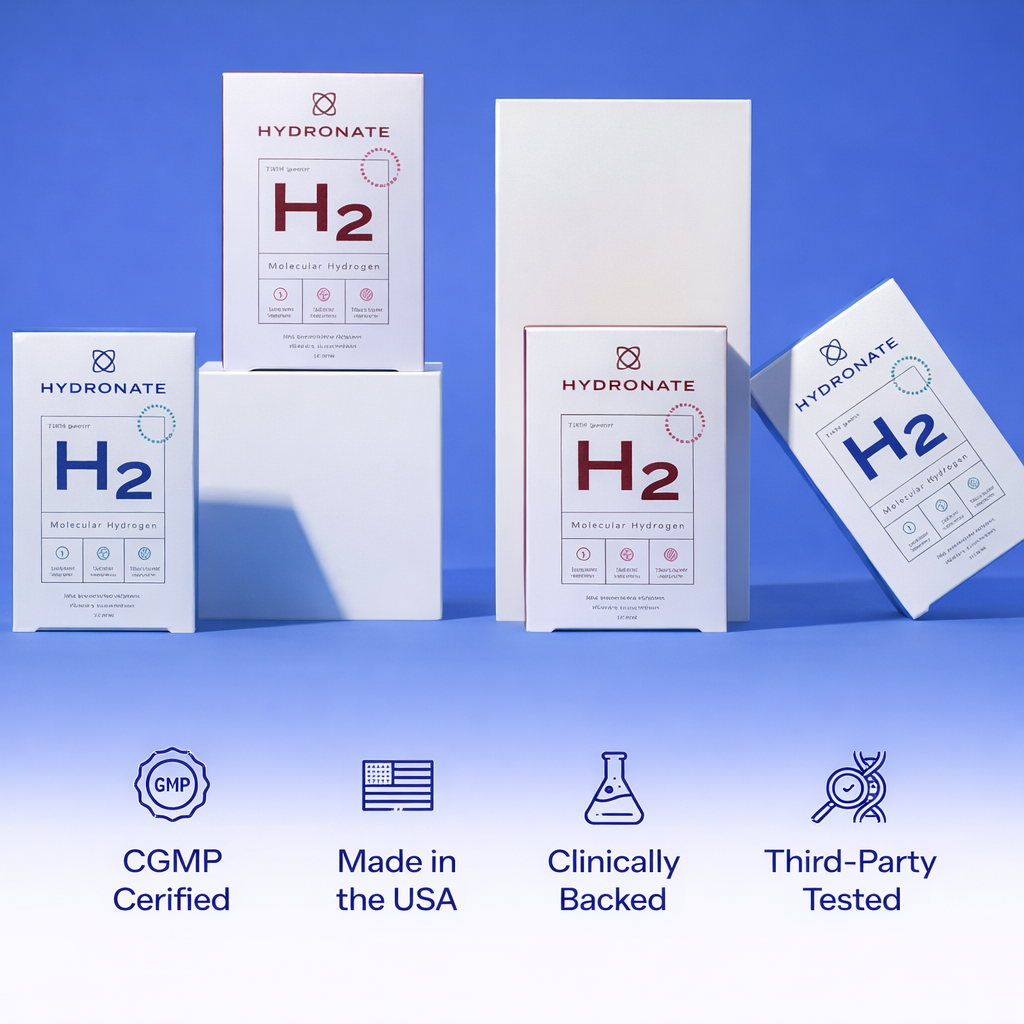
What changed is the delivery. A magnesium-based effervescent tablet, dropped into a glass of water, releases a measured dose of molecular hydrogen at 12+ PPM — the concentration the Japanese literature actually used, third-party tested. The molecule is the same one Ohta described in 2007. The dose, finally, is too.

Hydronate H2 — Molecular Hydrogen Tablets
“I've taken it for over a year. My oxidized-LDL marker was back in normal range by week eight.” — reader account, illustrative; results vary.
- 12+ PPM — matches the Japanese clinical concentration, not the 2–4 PPM most products deliver
- The same H₂ molecule from the 2007 Ohta paper and 2,000+ studies since
- Works at stage one and stage two — the number and the oxidation
- Magnesium-based effervescent tablet, third-party tested. One glass of water a morning
- No known side effects, no interactions, leaves only water behind
- $27.96 / month — about $0.93 a day · as low as $0.59 a tablet on larger supplies
90-day money-back guarantee · cancel anytime · free shipping

Raw, Unfiltered Reviews
"Japan was 20 years ahead. I stopped waiting for America to catch up."

Ken T.
"I'd never once heard that Japanese hospitals have been using molecular hydrogen for two decades while we're still arguing about it here. That single fact changed my mind. My father had his first heart attack at 58 — I'm 54 and didn't want to repeat his timeline. Started Hydronate every morning. My oxidized LDL came down into normal range by the eight-week recheck and my doctor was genuinely surprised. I'm not waiting another 20 years for this to become 'standard.'"
"Giving my kids the head start I never had"

Susan P.
"Heart disease runs hard on both sides of my family. After reading how far behind the US is on prevention, I didn't want to gamble on 'someday.' I started in my late 40s — early, on purpose. Three months in, my numbers are the best they've been and my energy is noticeably better. This is the twenty-year head start nobody offered my parents."
"I only wish I'd started two decades ago"

Harold M.
"I'm 71. Reading that Japan has been doing this since the 2000s honestly made me a little angry — that's twenty years I didn't get. But better late than never. Took it daily for ten weeks, retested, and my oxidized LDL finally moved the right direction after years stuck. My cardiologist asked me to keep a log. Don't wait like I did."
"So glad I got this for my husband"

Grace W.
"My husband is stubborn about 'supplements,' but the Japan research got his attention — he respects data, not hype. He's been taking it in his water every morning for four months now. His last panel was the cleanest his doctor had seen from him, and he actually thanked me for pushing it. Best thing I've ordered all year."
"I needed the numbers. The numbers moved."

Walt D.
"Retired from 30 years in aerospace QA — I don't trust anecdotes, I trust trends. Logged my oxidized LDL before, at 8 weeks, and at 16. Steady decline, no other change in my routine. The two-decade gap between Japan and the US in this article is real; I checked the studies myself. Now I'm two months into closing that gap for my own arteries."
From $0.59 a tablet
12+ PPM · the dose the research actually used · while stocks last
The bigger your supply, the less you pay — dropping your cost to as low as $0.59 a tablet. One tablet in a glass of water every morning, at the concentration the research was built on. Third-party tested, 12+ PPM.
⏱ Limited batch remaining · high demand — may sell out
Check Availability & Claim Offer✓ Free USA Shipping🛡 90-Day Money-Back Guarantee
(Tested)
Tested
What this article is notThe honest qualifications.
This is an advertorial — paid editorial produced on behalf of Hydronate. The reporting is real and the citations are real, but you should read it with that financial relationship in mind. The personal account and bloodwork described are one individual's experience, are illustrative, and are not typical or guaranteed.
Molecular hydrogen has not been evaluated by the FDA for the treatment of any specific disease. Don't discontinue a statin or any prescription on the strength of an article. Talk to your physician — bring the citations below if you want. Japan figured something out in 2007. What you do with that is your decision.
