Korean scientists found the molecule that stops LDL from becoming plaque.
321 studies reviewed. Zero mentions in American cholesterol guidelines. It isn't a drug. It can't be patented. That is exactly why you've never heard of it.
 By Dr. Margaret Yoon, MD · Internal Medicine
I have practised internal medicine for nineteen years, and the sentence I have said most often in that time is one I no longer trust: "Your cholesterol is normal." I said it to patients for two decades. Then somebody said it to me, and eighteen months later I was looking at my own angiogram.
In Korea there is a working clinical category for the state I was in — 미병, mibyeong: not yet sick, no longer well. It is a category American medicine largely does not have, which is why a woman with a clean panel and a quietly narrowing artery gets sent home with nothing.
What follows is not folk medicine. It is a randomized, double-blind trial out of Seoul National University, a literature of more than three hundred reviewed studies, and a molecule two daltons in size that is ordinary in Korea and remains, in America, entirely unspoken.
The patternYour panel says normal, because normal is what it was built to say.
Your LDL has been "fine" for years. You have never had your arteries looked at. Nobody has used the phrase "oxidized LDL" in front of you. You are doing the diet and the walking and, if it was offered, the statin — and you assume that between the number and the effort, the question is answered.
Eighteen months ago I sat on the wrong side of a cardiology reading room while a colleague pulled up my scan: a coronary vessel with a visible narrowed section, the dye thinning at one point along its length. Then he pulled up a reference image — a healthy vessel, woman my age, same build, no cardiac history.
Side by side they did not look like they belonged to the same decade of life. And I asked the question I had answered for other people hundreds of times: my cholesterol has been fine for years. How is this possible?
Original articles catalogued in a single comprehensive review of molecular hydrogen[5] — with more since, across Korea, Japan and China. Mentions in American cholesterol guidelines: none.
When a woman with a normal panel turns out to have a narrowed artery, people reach for three explanations. I had used all three myself.
It isn't luck. It's a measurement gap, and it is documented. A standard panel measures how much LDL you have. It does not measure what condition that LDL is in.
Worth doing, and they were not the missing piece for me. I had the habits. What I did not have was anything aimed at the oxidation step.
Genetics largely set how much LDL your liver produces. They do not set how much of it gets damaged in transit — and that second half is where the leverage is.
Something else is happening underneath. And the research that describes it has been running in Korea, Japan and China for nineteen years.
The gapQuantity is not condition.
A standard cholesterol panel measures how much LDL is circulating. It does not tell you whether that LDL has been oxidized — chemically altered by free radical activity in a way that makes it far more likely to be engulfed by immune cells and deposited into the artery wall, where it becomes the plaque an angiogram actually visualizes.
Two women can have identical LDL numbers and very different amounts of oxidative damage happening to that LDL. The angiogram shows the accumulated result, sometimes across decades. The panel was never designed to catch it in progress.
I had known that, in the way you know something you were taught once. I had never acted on it — and I had spent nineteen years letting patients walk out of my office believing the two were the same measurement.

Why this is worse for womenThe standard workup reads women badly, and cardiology has known for a decade.
In a Swedish registry of 12,200 patients sent for angiography with stable chest pain, 79% of women under sixty had normal or non-obstructive coronary arteries — against 42% of men.[1] For years that was filed as reassuring. It isn't. Those women go on to have events, and one cardiology editorial put their prognosis bluntly as worse than that of breast cancer.[1]
The reason is structural. Plaque in women tends to be diffuse rather than focal — spread thinly along the vessel wall instead of forming the discrete blockage an angiogram is built to find, with remodelling that keeps the opening looking normal.[1] Among heart attack patients without obstructive disease, the split is 28% of women against 11% of men.[2]

The part about menopauseYou had a built-in antioxidant. Then you didn't.
Estrogen is vascular protection. Among other things it improves endothelial function, lowers inflammation, and reduces the oxidation of LDL. For most of your adult life you ran an antioxidant defence you never had to think about.
Menopause ends that. The literature is direct: the menopausal transition is itself associated with increased oxidative stress, in part because estrogen's antioxidant effect goes away.[3] And in postmenopausal women, circulating oxidized LDL rises with the duration of menopause.[4]
What that means practically
A "normal" panel at fifty-eight is not the same result as the identical panel at forty. Same number, different oxidative environment, different amount of damage per year — and only one of those things is on the printout.
Nothing about my diet changed at fifty-two. Nothing about my habits changed. My number barely moved. And underneath all of it, the rate at which my LDL was being damaged had quietly gone up, on a curve nobody was measuring.

The moleculeWhy nothing on the antioxidant shelf does what this does.
If oxidation is the problem, the obvious answer is an antioxidant. People have been trying that for thirty years and mostly it hasn't worked — for two reasons, both physical rather than philosophical.
Size. Curcumin is 368 daltons. Vitamin C is 176 and charged. Glutathione cannot cross a cell membrane intact. They stop short of the place the damage happens.
Bluntness. Your body uses some reactive species deliberately, as signals. A powerful non-selective antioxidant mops up harmful and useful alike — which is why several large antioxidant trials produced null or worse-than-null results.
Molecular hydrogen does three things nothing else does at once:

It's the smallest molecule that exists. At two daltons, neutral and non-polar, it diffuses through membranes without a transporter — reaching circulating LDL particles directly.
It's selective. It reacts preferentially with the hydroxyl radical and largely ignores the radicals your body uses on purpose. That mechanism is the finding that started the field, published in Nature Medicine in June 2007.[6]
It leaves only water behind. No metabolite, no residue, no organ burden. Not a drug, and not a substitute for one.

Seoul National University · 2020The trial that made me take it seriously.
I am a hard audience for open-label pilot studies, and most of what circulates about hydrogen water is exactly that. What stopped me was a randomized, double-blind, placebo-controlled trial run out of Seoul National University, published in Scientific Reports in 2020.[9]
Healthy adults drank either hydrogen-rich water or plain water for four weeks. Blinded, placebo-controlled, and done in ordinary people rather than in a disease model.
Two findings mattered. In participants over thirty, antioxidant potential in the blood rose significantly more in the hydrogen group. And when the Seoul team sequenced the participants' immune cells, the hydrogen group's transcriptional profile was clearly distinguishable from the control group's — with the differences concentrated in inflammatory-response and NF-κB networks.
That last detail is not a soft endpoint. NF-κB is the inflammatory switch oxidized LDL flips when it reaches an artery wall. The Seoul group didn't report that people felt better. They showed the machinery reading differently.
Why this one counts more than the rest
Randomized. Double-blind. Placebo-controlled. Healthy adults, not patients. Published in a Nature-portfolio journal. In a field crowded with open-label pilots, this is the design hardest to argue with — and it came out of Seoul.

Nineteen years, in milestonesWhat the Asian trials actually measured.
What convinced me was not one study. It was that the same signal keeps appearing in different countries, different designs, different patient groups — and it keeps landing on the oxidation step rather than the quantity step.
Ohsawa and Ohta publish in Nature Medicine: hydrogen acts as a selective antioxidant, neutralizing the most destructive radicals while leaving normal signalling radicals alone.[6]
A randomized, double-blind, placebo-controlled crossover trial gives patients hydrogen-rich water for eight weeks. Modified LDL falls 15.5%. Small dense LDL falls 5.7%. Urinary 8-isoprostanes — a direct oxidative-stress marker — fall 6.6%.[7]
Journal of Lipid Research: ten weeks of hydrogen-rich water lowers total and LDL cholesterol, improves HDL function, raises superoxide dismutase, and reduces oxidative damage measured in the LDL fraction directly.[8]
A comprehensive review catalogues 321 original articles on molecular hydrogen's biological effects and mechanisms.[5] By this point it is a mature literature — in Asia.
Seoul National University publishes a randomized, double-blind, placebo-controlled trial in Scientific Reports: higher antioxidant potential in adults over thirty, and immune-cell transcription shifted in the inflammatory and NF-κB networks.[9]
A trial in hospitalized angina patients pairs three months of hydrogen-rich water with conventional treatment: greater reductions in total cholesterol, LDL-C and apoB than treatment alone — with cell work tracing the effect to LOX-1, the receptor through which oxidized LDL does its damage.[10]
Read that list as a physician and one thing stands out. These are not studies about feeling better. They measured oxidized and modified LDL, oxidative-stress markers, and the receptor pathway oxidized LDL acts through — the exact chain my colleague drew for me on a Tuesday morning.
And I want to be equally clear about what is missing: none of these are large cardiovascular outcome trials. Nobody has shown this prevents heart attacks. What they show is a mechanism moving in the right direction, measured repeatedly, in humans.
The American silence321 studies. Zero mentions in the guidelines.
The obvious objection is the one I would have raised myself: if this were real, a doctor would have mentioned it. I am that doctor, and I never did. Not because anyone hid anything — because of how the pipeline works.
Discovery → patent → funded trials → guidelines → sales representatives → your appointment. Pull any step and the chain breaks. The step that does not exist here is the second: hydrogen cannot be patented. It is the first element on the periodic table. Nobody can own exclusive rights to it, which means nobody funds the enormous outcome trials that move a molecule onto a guideline, which means nobody is ever paid to mention it to your physician.
Not suppressed. Just unpatentable — and unfunded because of it.
Korea's system does not need a patent holder to fund science. National research institutes and university programs advance a line of work on evidence rather than on who owns it — which is how a double-blind trial on an unownable molecule gets run at Seoul National University and never crosses the Pacific.
And there is a second silence underneath the first. Oxidized LDL is not a standard American test. It exists, you can order it, and it appears in no routine panel and no cholesterol guideline. South Korea is testing and treating for the oxidation. America is still measuring the quantity.
The dose that mattersWhy most hydrogen products were never going to work.
The practical question became how to get a meaningfully concentrated, verified dose. I had already read enough about the $100–150 electrolysis bottles — devices that reportedly fail, leak, or produce output well below their advertised concentration — to be wary of that format entirely.
And concentration is the entire game. The Korean and Japanese trials were run at 10–12+ PPM. Cheap bottles produce roughly 0.3 to 2. Most American tablets deliver 2 to 4. Below the studied concentration the price stops being relevant, because you are not running the experiment the studies ran.
Which left me with an irritating problem: the products at the researched concentration were, almost without exception, Korean — and not sold in the United States.

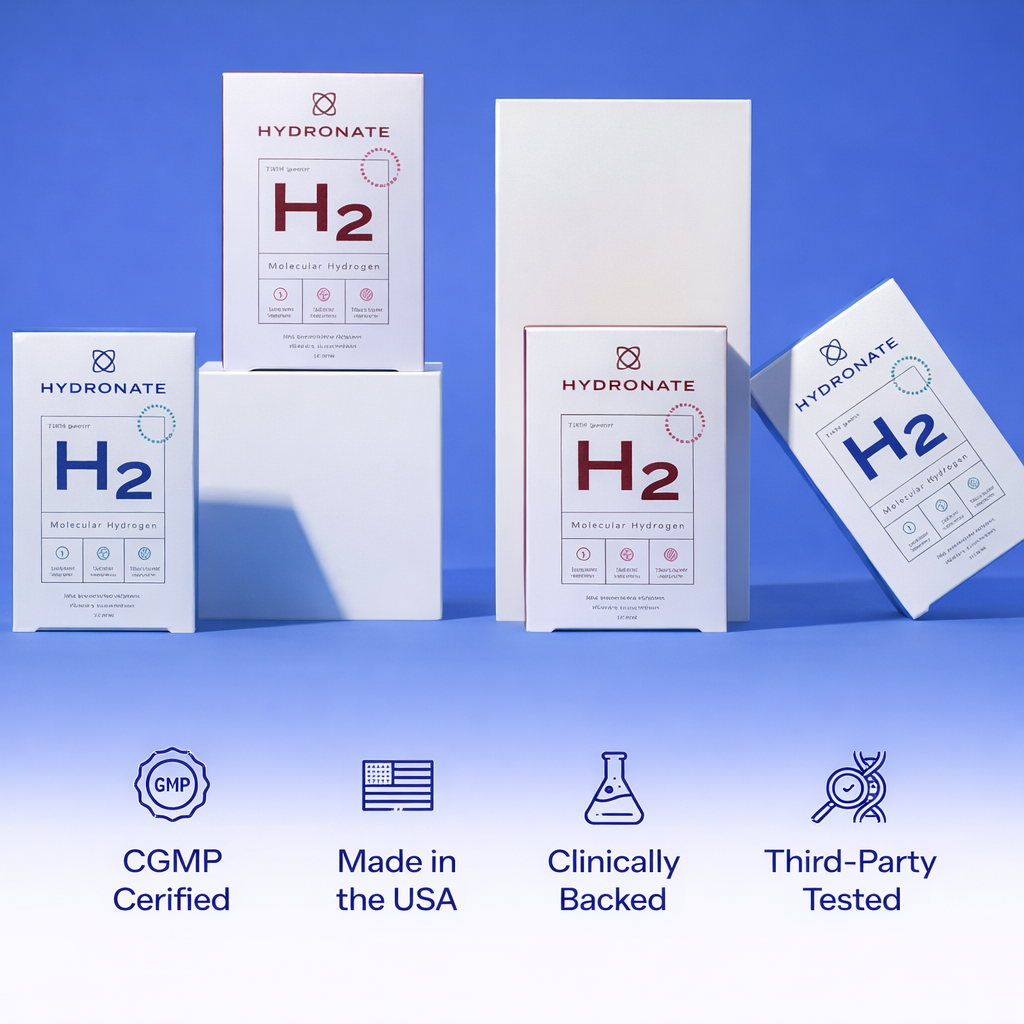
What changed is the delivery. A magnesium-based effervescent tablet, dropped into a glass of water, releases a measured dose at 12+ PPM, third-party tested at the point of consumption, manufactured in a cGMP-certified U.S. facility and separately tested for heavy metals and microbial contamination. Two minutes of fizzing, then you drink it — reasonably promptly, because the gas doesn't wait in an open glass.
It runs about $0.59 a tablet. I started taking it daily, alongside the cardiac monitoring plan my doctor and I had already agreed on. Nothing about my existing care changed.

What to expectYou will not feel this. That is not a flaw in it.
Oxidative load has no sensation attached to it. Anyone promising you a feeling is selling you a feeling rather than a mechanism. What this asks of you instead is a measurement.
The work has started; nothing has surfaced. This is where people stop — and stopping here is the one choice that guarantees you never find out.
Afternoon energy. Fewer flat spells after lunch, less of the mid-week fatigue people had already written off as age. Not the endpoint — just the first thing anyone notices.
Ask for oxidized LDL alongside your standard lipids. That is the number this is aimed at, and it is the only verdict that counts. It is not on the routine panel; you have to request it by name.
Hydronate H2 — Molecular Hydrogen Tablets
"I'm fifty-nine and my panel has been 'fine' for twenty years. Nobody ever told me the number and the artery were two different questions." — reader account, illustrative; results vary.
- 12+ PPM — matches the concentration the Korean and Japanese trials used, not the 2–4 PPM most US products deliver
- 2 daltons — small enough to reach circulating LDL particles directly
- Selective: targets the destructive radicals without flattening normal oxidative signalling
- A tablet, not a device — nothing to charge, leak, or replace
- Third-party tested for dissolved H₂ at the point of consumption
- cGMP-certified U.S. facility · tested for heavy metals and microbial contamination
- About $0.59 a tablet · one glass of water a morning
30-day money-back guarantee · free shipping · cancel anytime

