Save Up To 68% + Free Shipping On Your First Order
Ask A Cardiologist
I'm a Cardiologist. Here Are 15 Questions Patients Ask Me About Cholesterol.
(And the answers a seven-minute appointment doesn't leave room for)
Still watching one number on a lab sheet? Still told your LDL is "great" while something in you says otherwise? Here's what that number doesn't measure — and why lowering it further may not be the thing that protects you.
★★★★★ 2,000+ published studies | 100,000+ customers
Dr. Alex L’Arowe, MD, FACC
Interventional cardiology · 29 years in practice Written from Portland, Oregon · August 2026
15 real questions. The ones patients actually ask me — usually with a hand on the doorframe, on the way out, after the appointment is technically over. Answered in plain language, with the references at the bottom, and with the limits stated wherever the research has them.
The short version, for anyone who doesn't want to read all fifteen
Your LDL number measures how much cholesterol is in your blood. It does not measure what condition it's in. Plaque is built by LDL that has been oxidized — damaged by free radicals on the way through — and nothing in the standard protocol is aimed at that step.
What I use for it is molecular hydrogen: two daltons, the smallest molecule there is, small enough to get inside a cell, and selective enough to neutralise the destructive radicals without flattening the useful ones. One effervescent tablet in a glass of water each morning. The product is Hydronate, at 12+ PPM.
It will not dissolve plaque you already have. Nothing you swallow does — see question seven. Read the rest for why.
Question 01 of 15
My LDL Is Under 100. My Doctor Said "Great." So Why Am I Still Worried?
Because your instinct is picking up something the number can't report.
LDL cholesterol is a measure of how much cargo is moving through your bloodstream. It is not a measure of what condition that cargo is in, and it is not a measure of what is happening inside your artery wall.
I have put stents into people whose LDL was 96 and whose last three lipid panels I would have been happy to sign off on. That is not a rare event in a cath lab. It is a Tuesday.
I'll answer that properly two questions from now. It is not the answer you have been given.
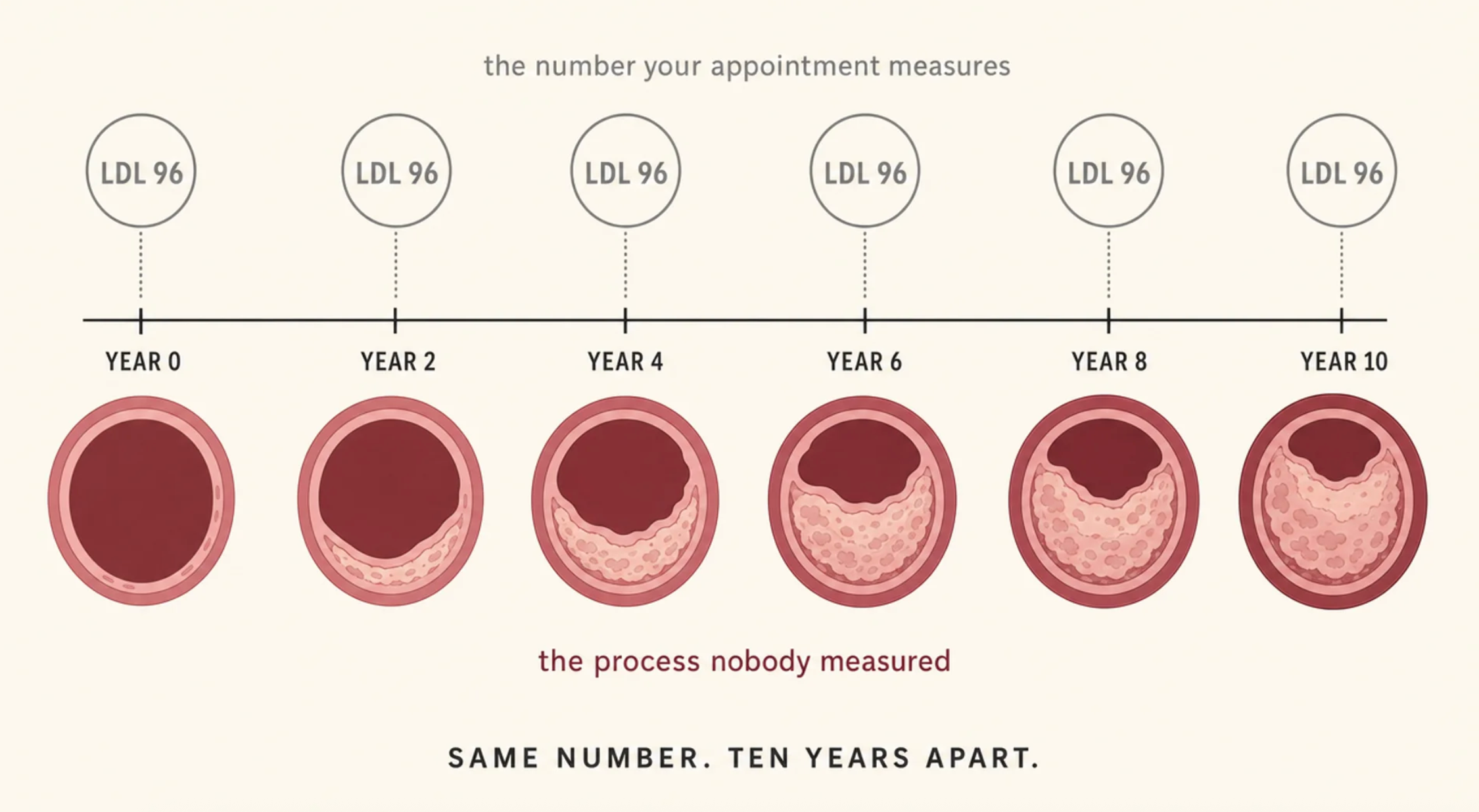
Two men. The same LDL. Two very different arteries. The lipid panel cannot tell them apart — which is precisely the problem.
Question 02 of 15
What Is Oxidized LDL, And Why Has Nobody Tested Me For It?
Ordinary LDL is not inflammatory. Your immune system recognises it and leaves it alone.
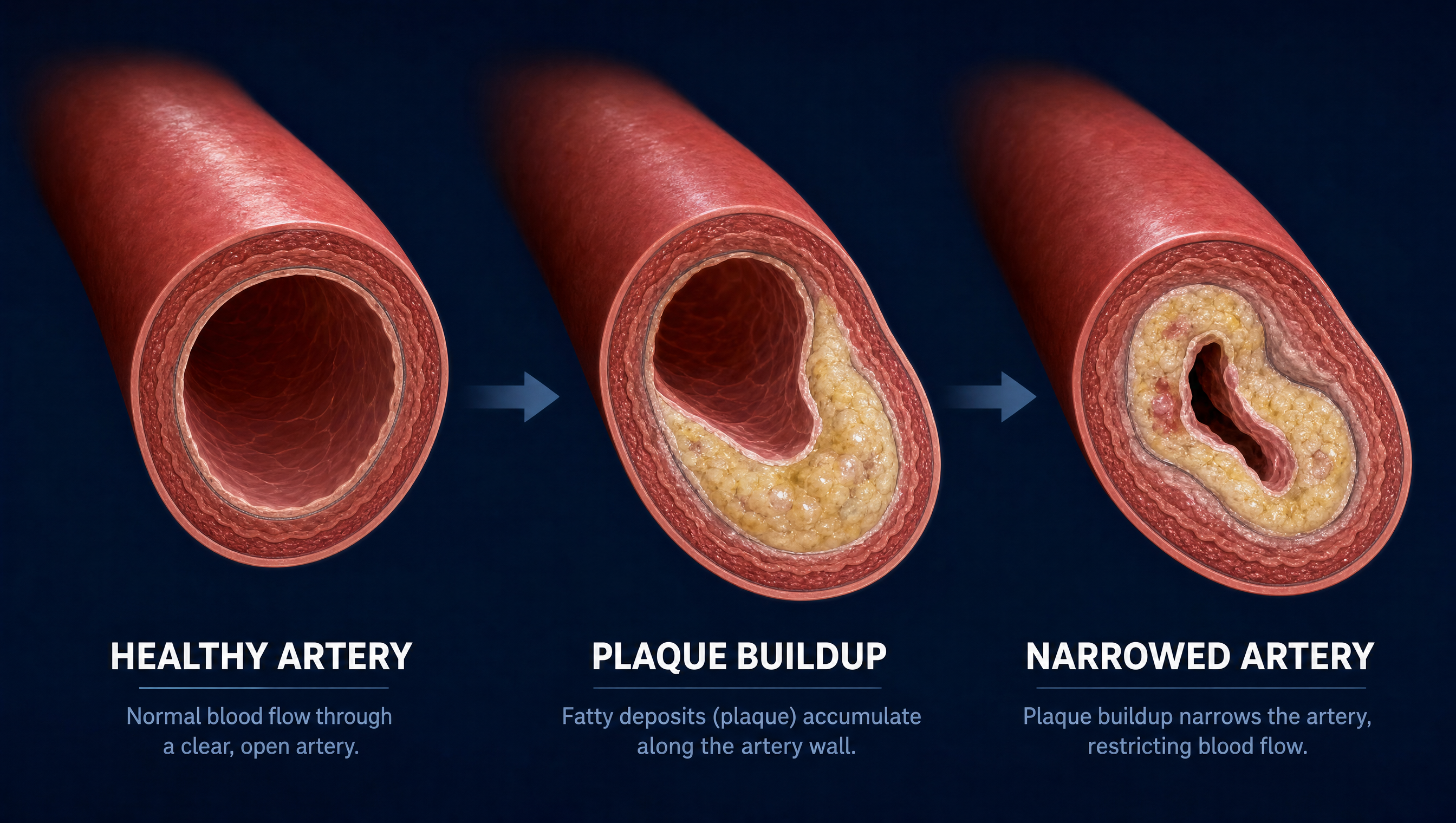
When a free radical damages the outer protein of an LDL particle, that recognition fails. The particle becomes oxidized LDL, and your immune system now reads it as debris. Macrophages engulf it, swell with it, and become foam cells. Foam cells are what plaque is largely made of.
Oxidized LDL can be measured. It is associated with cardiovascular events in the published literature independently of total LDL.[3] And in ordinary American practice, it is almost never ordered — because there is no standard reimbursement pathway for it and no drug marketed against it.
The four stages. Standard care intervenes hard at stage one. Stage two is where the damage is actually done.
Question 03 of 15
So What Is Actually Building The Plaque?
Here is the answer I promised you, and it is one sentence.
It isn't the amount of cholesterol in your blood. It's the amount of oxidative damage being done to it.
Every particle of LDL moving through your bloodstream is exposed to free radicals — the ordinary by-product of running a body. In youth, your own antioxidant systems keep that in balance. With age, with metabolic stress, with inflammation, the balance tips. More damage. Less capacity to repair it.
Under that model, two men with identical LDL of 96 can be in completely different situations. One has 96 units of intact cargo. The other has 96 units of cargo that is being steadily oxidized on the way through. The lab report is identical. The arteries are not.
And this reframes the whole exercise. Lowering LDL reduces how much cargo is exposed. It does nothing about the exposure itself.
That gap is what nobody is measuring, and it is what nothing in the standard protocol is aimed at.
The measurement that almost nobody gets ordered.
The part you can still change
You cannot un-build the plaque you have. You can change what gets added next.
Molecular hydrogen is the smallest molecule that exists — small enough to reach inside the cell, selective enough to leave your useful signalling alone. Hydronate delivers it at 12+ PPM.
12+ PPM · one tablet a day · 30-day money-back guarantee
Question 04 of 15
I'm On A Statin. Doesn't That Handle It — And Can I Take This Alongside It?
This is the first question everyone asks once they understand the oxidation half, so let me be clear before anything else: statins are one of the genuinely great drugs of the last fifty years. I prescribe them. I am not going to tell you to stop taking yours, and nothing on this page is a reason to.
But here is the thing they do, stated precisely: statins reduce how much LDL your liver produces. They lower the quantity of the cargo.
That is one job, and they do it superbly. It is not the only job that needs doing.
Fewer particles in circulation is a good thing. It is not the same thing as protecting the particles that remain.
They address different halves of the same problem, which is exactly why the question comes up so often.
Your statin reduces the quantity of LDL your liver produces. Reducing oxidative load addresses what happens to the particles that remain in circulation. Neither substitutes for the other.
Do not stop a prescription because of an article. Not this one, not any. If you want to change your medication, that is a conversation with the physician who prescribed it, holding your own bloodwork.
Question 05 of 15
I Eat Well And I Exercise. Why Hasn't That Fixed It?
It has probably helped more than you can see. Diet and exercise both reduce the oxidative load your blood vessels are carrying — which, as you have just read, is closer to the actual mechanism than most people realise.
What they can't do is undo decades of accumulated damage on their own, and they can't compensate for the fact that the process driving plaque is happening at a scale nothing in your kitchen can reach.
Patients tell me this with real frustration: I did everything right. Usually they did. The frustration comes from having done everything right against a target that was only ever part of the problem.
Question 06 of 15
Why Does Japan Have Similar Cholesterol Numbers And Far Fewer Heart Attacks?
Careful here, because this gets overstated in both directions. Heart disease is a leading cause of death in Japan too — anyone who tells you otherwise is selling something. What differs is the rate: age-adjusted coronary mortality has run substantially lower there for decades, and the reasons are several, including diet, body composition and how the data are gathered.
But one part of the answer is a genuine difference in how the disease is modelled. A large body of Japanese cardiology research does not treat LDL as the agent that builds plaque. It treats LDL as the cargo, and treats what happens to that cargo in transit as the agent.
Same lipid panel. Different theory of what the panel means.
The comparison that keeps appearing in the literature. It is not explained by cholesterol levels alone.
Question 07 of 15
Can Plaque Actually Be Reversed? Where Does It Supposedly Go?
I want to answer this one bluntly, because it is the question I get most often and it is the one the supplement industry lies about most freely.
Calcified plaque does not dissolve. Nothing you swallow removes it. Not this, not nattokinase, not a cleanse, not anything sold on the internet.
If a product tells you it clears out calcified plaque, stop reading it. That is not a thing that happens outside of a surgical suite.
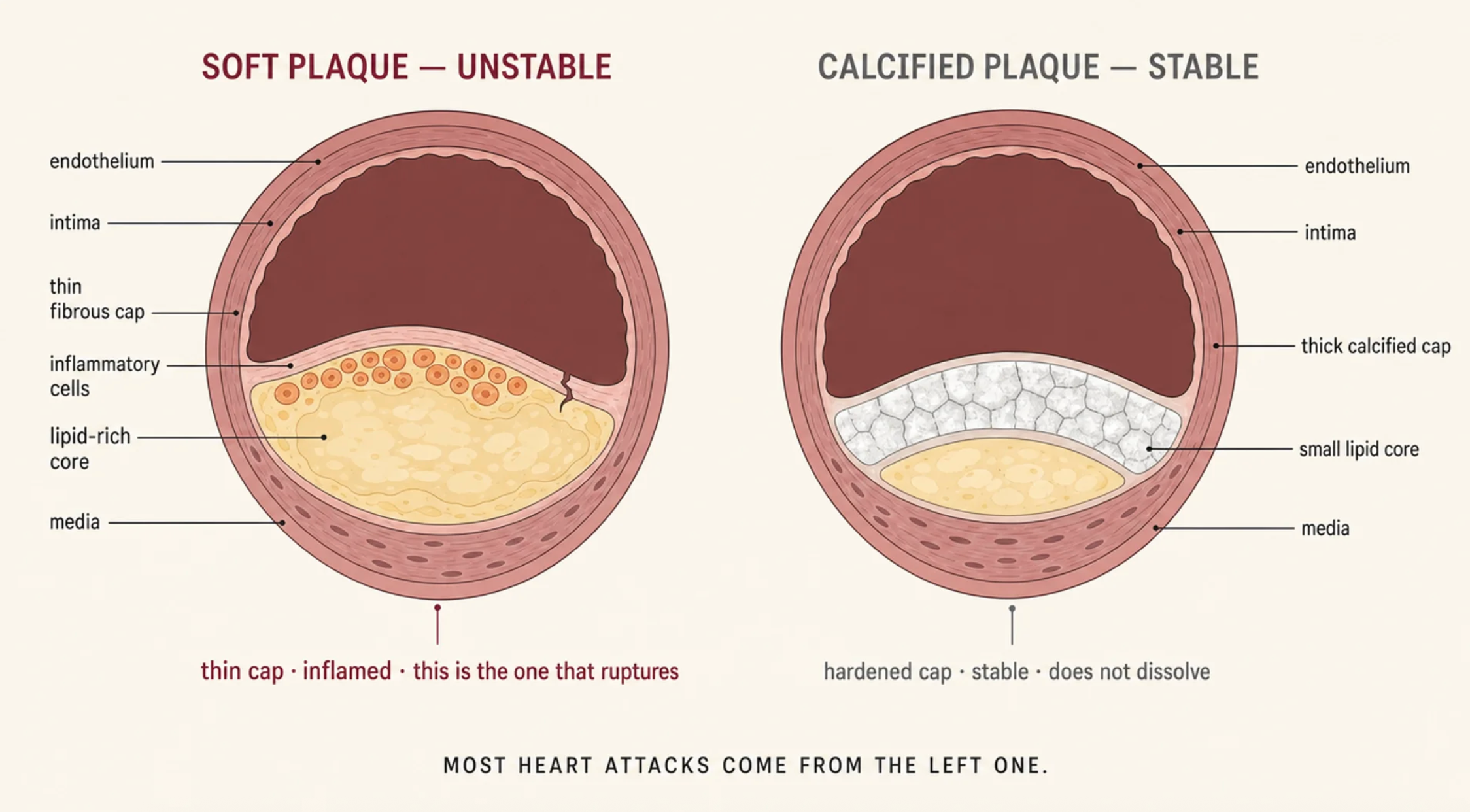
Here is the part that is more interesting, and that almost nobody explains. Calcification is not the enemy you think it is. When your body calcifies a plaque, it is stabilising it — putting a hard cap on something soft and inflamed. A calcified plaque is generally less likely to rupture than a young, soft, inflamed one. The heart attacks I see in the cath lab usually come from the soft ones, not the crusty ones.
So the honest goal is not removal. The honest goal is the rate at which new damage is being added, and how inflamed the plaque you already have is. That process is running today, in you, and it is the only part of this that is still open to influence.
Ask your cardiologist about plaque regression and you will get a careful answer, because a modest degree of soft-plaque regression has been documented under aggressive lipid management. That is a real finding and it is also a slow, partial one. It is not a dissolving.
The soft one is the one that ruptures. The hard one is your body having already stabilised it.
Reducing oxidative load is not about what's already set in your arteries. It is about what gets added over the next ten years.
Question 08 of 15
What If Mine Is Hereditary Rather Than Diet-Related?
Two very different things get called hereditary here, and it matters which one you have.
Familial hypercholesterolaemia is a specific genetic condition — your liver clears LDL poorly, numbers run very high from a young age, and there is often a family history of early cardiac death. If that is you, this is a cardiology-and-medication conversation, full stop. Nothing on this page substitutes for it, and you should be under specialist care.
Family history is the more common version, and it means something different. You inherited a tendency, not a verdict. And notice what you also inherited: the same metabolic patterns, the same oxidative stress load, often the same diet and the same habits.
Genetics largely set how much LDL your liver produces. They do not set how much of it gets damaged in transit. That second half is where the leverage is, and it is where family history stops being destiny.
Question 09 of 15
My Numbers Only Went Up After Menopause. Is That The Same Thing?
It's the same mechanism arriving on a different schedule, and it is the single most under-explained event in women's cardiovascular health.
Before menopause, oestrogen is doing quiet protective work — it supports the lining of your blood vessels and it has a genuine antioxidant effect on circulating LDL. When it falls away, two things happen at once. LDL tends to rise, and the particles lose a layer of protection they had had for thirty years.
Which is why so many women arrive in my clinic bewildered: nothing about their diet or their habits changed, and their panel moved anyway. Nothing they were doing was wrong. The defence was withdrawn.
Heart disease kills more women than every cancer combined, and it is still routinely treated as a men's problem — by patients and by physicians.
Women also tend to present differently when something goes wrong: fatigue, breathlessness, nausea, jaw or back discomfort rather than the crushing chest pain everyone is taught to look for. That is worth knowing regardless of anything else on this page.
Question 10 of 15
If This Is Real, Why Hasn't My Cardiologist Told Me?
Three reasons, and none of them require a villain.
First, there is no drug. No pharmaceutical company owns a molecule aimed at this, so nobody funds the large trials, and nobody sends a representative to educate cardiologists about it.
Second, there is no billing code. Standard of care follows what insurance reimburses, and there is no reimbursable pathway for "reduce oxidative load."
Third, guidelines move slowly, and they should. Most of us trained on a model built decades ago. Guidelines change when large outcome trials force them to, and large outcome trials happen when somebody stands to profit from the result.
That is institutional lag, not conspiracy. But the effect on you is the same: your appointment is built around the number that has a drug attached to it.
Question 11 of 15
What Happens If I Just Keep Doing What I've Been Doing?
Most likely, your LDL stays where your physician wants it, your appointments stay short, and the oxidative process continues at whatever rate it is running at — unmeasured, unaddressed, and entirely invisible on the sheet you're handed.
Plaque does not accumulate on a schedule you can feel. That is the difficult part of this disease. The first symptom is very often the event.
Ten years of a number your physician was happy with, and ten years of a process nobody measured.
Go and be seen
Chest pressure, pain radiating into the jaw or arm, breathlessness on ordinary exertion, or a sudden drop in exercise tolerance are not things to research online. Those are emergency-room symptoms, today.
Question 12 of 15
What's Actually In It — And Does It Cause Side Effects?
People ask about magnesium a lot, so let me explain the chemistry, because it's the part that makes the tablet work.
An effervescent hydrogen tablet is essentially elemental magnesium plus a food acid. Drop it in water and the magnesium reacts, releasing molecular hydrogen into the glass. That is the fizzing you see. The hydrogen is the active part; the magnesium is the mechanism that generates it, and a small amount of it ends up dissolved in the water. Check the label for exact amounts, as you would with anything.
So: yes, magnesium is involved. No, this is not a magnesium supplement dressed up.
On side effects, honestly. Molecular hydrogen has a very good tolerability record in the literature and it leaves the body as water and exhaled gas. But two things do come up in real-world reports and I'd rather you hear them from me.
The first is burping, particularly in the first week — some of the gas comes back up, and some people find it noticeable enough to comment on. The second is occasional headache, usually early and usually transient. Neither is universal and neither is dangerous, but "no side effects whatsoever" is a marketing claim and I'm not going to make it.
Drinking it reasonably promptly, rather than sipping it over an hour, helps with the first one.
Question 13 of 15
So What Actually Reduces Oxidative Load?
Not the antioxidant shelf, and it is worth understanding why, because that failure is instructive.
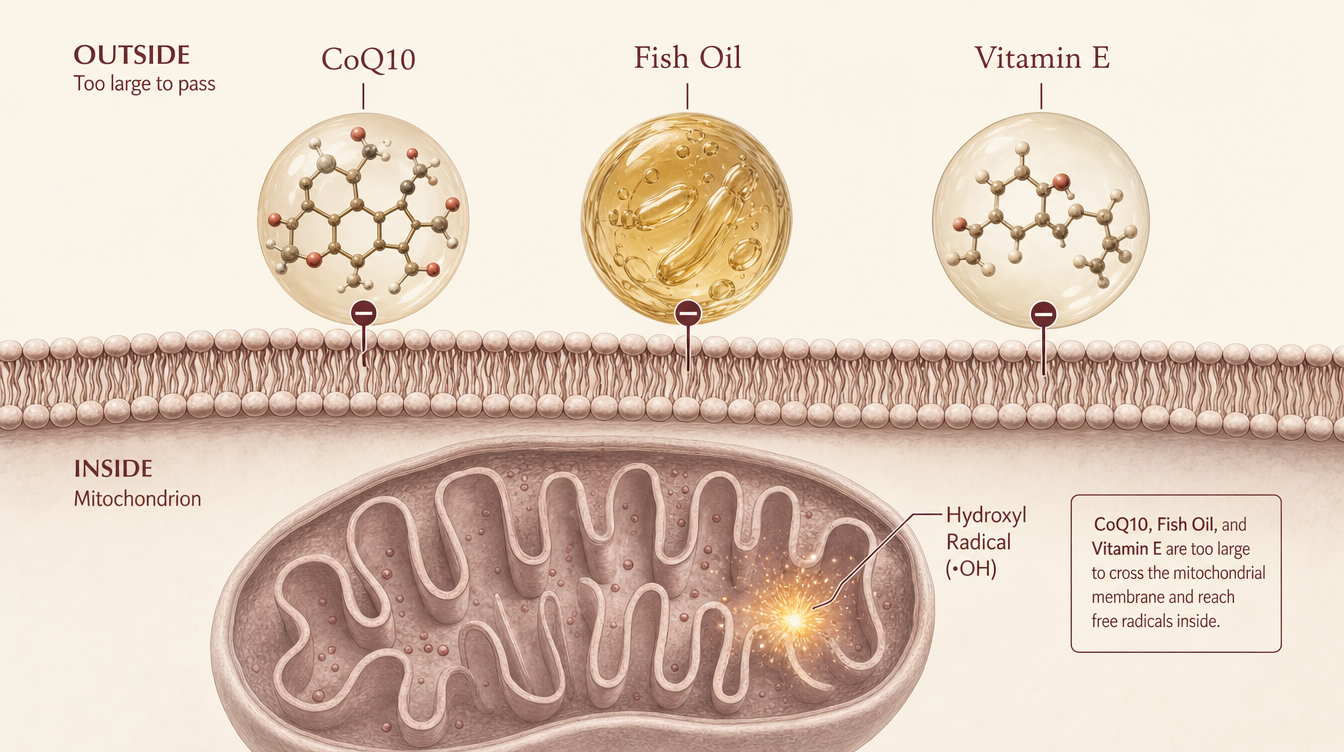
Two problems. Size: most antioxidant compounds are large molecules. Vitamin C is 176 daltons. Curcumin is 368. They circulate; they do not readily cross into the cell interior where the damage originates.
Bluntness: high-dose antioxidants tend to neutralise indiscriminately, including the reactive signalling your body legitimately uses to run itself. Several large trials found no benefit for exactly this reason.
CoQ10, fish oil, vitamin E. All good molecules. All too large to get where the damage is happening.
Molecular hydrogen is a different proposition on both counts. It is 2 daltons — the smallest molecule that exists. Neutral and non-polar, it diffuses straight through cell membranes without a transporter and reaches the mitochondria.
And in the 2007 Nature Medicine paper that opened the field, Ohsawa, Ohta and colleagues showed it is selective: it preferentially neutralises the most destructive radicals — hydroxyl and peroxynitrite — while leaving ordinary signalling radicals alone.[1] That paper has been cited thousands of times and there are now well over two thousand studies on H₂ across medicine.[2]
Ohsawa, Ohta et al., Nature Medicine, 2007. Cited thousands of times. Not in a single American cholesterol guideline.
Question 14 of 15
Why Not Just Buy A $1 Bottle Of Water?
Because plain water contains no dissolved hydrogen. None. Not tap, not spring, not the expensive glass-bottled kind.
The H₂O in water is hydrogen that is already chemically bound to oxygen — locked up, spent, unavailable. Molecular hydrogen is free H₂ gas dissolved into the water, and it has to be put there. That is the entire function of the tablet. The water is the delivery vehicle; the gas is the active ingredient.
Which brings up the version of this question people ask next: what about the $15 hydrogen bottles online? Those do generate hydrogen — at roughly 0.3 to 1.5 parts per million, and the better ones at one to two. Many drugstore tablets land at three to five. At those levels you are drinking mildly interesting water.
There is a second problem nobody mentions: hydrogen is a gas, and it leaves. An open bottle carried around all morning is losing what little it made the whole time.
So the comparison isn't one price against another. It is one to two PPM against twelve — and if the concentration is below what the research used, the price stops being relevant, because you're not running the experiment the studies ran.
The American products sit below the concentration the research used. The Japanese ones don't — and mostly aren't sold here.
Question 15 of 15
How Long Before Anything Changes — And What Do I Use?
Sooner than the panel will show it, and later than you would like. Let me give you the real shape of it.
The change you are actually buying happens quietly, at the level of the particles moving through you right now. It starts the first morning. What takes time is for it to accumulate into something a lab can measure and something you can notice — and the people who see the most are simply the people who kept going.
What people typically reportSelf-reported timelines, not clinical endpoints
1Week
The work has started; nothing has surfaced yet. This is where people quit — and quitting here is the one choice that guarantees you never find out.
2–4Weeks
This is where it usually shows up first: afternoon energy. Fewer flat spells after lunch. Less of the mid-week fatigue people had already written off as age. Patients describe it as feeling less worn through by Thursday.
8–12Weeks
Run the repeat panel. Ask for oxidized LDL alongside the standard lipids — that is the number this is aimed at. This is also the point where people stop thinking of it as something they are trying and start thinking of it as something they do.
The protocol is one effervescent tablet in a glass of plain water, every morning. Two minutes of fizzing, then you drink it — reasonably promptly, because hydrogen is a gas and it leaves an open glass.
I recommend Hydronate for two unglamorous reasons. It is 12+ PPM, several times what any bottle or machine I have tested produces. And it is a tablet and a glass — nothing to charge, nothing to clean, no appliance to abandon in March.
Now the part I say to patients and rarely write down: the oxidation is not waiting for you to decide. It ran this morning while you read this, and it will run tomorrow at exactly the same rate unless something in the equation changes.
You have already spent years managing one half of this problem with real diligence — the diet, the walking, the medication taken on time. That effort was not wasted. It was just aimed at the half that has a drug attached to it.
The other half has never been addressed, in you, on any day of your life. Not because you were careless. Because nobody told you it existed.
Thirty days settles it, and thirty days is a genuinely small ask: two minutes a morning, before the coffee, standing at your own kitchen counter. If you get to the end of it and conclude it did nothing, that is precisely what the guarantee is for — you send it back and you are out the two minutes and nothing else.
Every person I know who is glad they did this describes the same turn: a few weeks in, they stopped watching for it. It had simply become the first thing they do, and the panel caught up later.
What you cannot do is keep watching the one number and call that a plan.
What you're actually getting
✓12+ PPM molecular hydrogenThe concentration used in the research — three to six times what American tablets deliver and up to forty times a cheap bottle.
✓Two daltons, not 176 or 368Small enough to diffuse into the cell and reach the mitochondria, where the oxidation is actually happening.
✓Selective, not bluntNeutralises the destructive radicals and leaves the signalling radicals your body runs on intact — the finding that started the field.
✓Works alongside your statinDifferent half of the problem. Nothing to stop, nothing to swap, no interaction pathway to worry about.
✓Two minutes, one glass, no applianceNothing to charge, clean or replace. The habit survives past March, which is the only reason any of this works.
✓Thirty-day money-back guaranteeIf you get to the end of the bottle and think it did nothing, that's what the guarantee is for.
Thirty-day money-back guarantee. Subscribe & save up to 68%, free shipping, cancel any time.
What Patients Say After The Second Panel
Douglas R. — Sacramento, CA
✓ Verified Customer
★★★★★
LDL 94 for six years and I still had a stent put in at 61. Nobody had ever said the word oxidation to me. I'm four months in, statin unchanged, and my last panel was the first one I've read with any confidence.
Maureen H. — Columbus, OH
✓ Verified Customer
★★★★★
Post-menopause my numbers climbed and nobody could tell me why, only that I should watch them. First two weeks, nothing whatsoever, and I nearly stopped. By week five the two o'clock crash was gone. Not a miracle — a difference.
Sanjay P. — Edison, NJ
✓ Verified Customer
★★★★★
Retired process engineer, so the 2-dalton argument is the only part of this that persuaded me. It isn't marketing, it's the periodic table. Whatever gets inside a cell has to be small enough to diffuse. Ten weeks in.
Curtis W. — Atlanta, GA
✓ Verified Customer
★★★★★
My father died at 63 with cholesterol his doctor was pleased about. That's the whole reason I read this. I asked for the oxidized LDL panel, my doctor had to look up how to order it, and we now have a baseline. That alone was worth it.
P
Paula R. — Boise, ID
✓ Verified Customer
★★★★★
Five months. Energy: better. Sleep: better. Numbers: LDL basically the same, which this page told me to expect, and I appreciated being told rather than sold. I've reordered twice.
You've spent years optimising one number. Every year you spend on it alone is another year the other half runs unopposed.
Two minutes tomorrow morning. One tablet, one glass, 12+ PPM of the smallest molecule there is. Thirty days to decide, and the guarantee covers you either way — so the only thing you're actually risking is the two minutes.
[1] Ohsawa I, Ishikawa M, Takahashi K, et al. Hydrogen acts as a therapeutic antioxidant by selectively reducing cytotoxic oxygen radicals. Nature Medicine. 2007;13(6):688–694.
[2] Ichihara M, Sobue S, Ito M, et al. Beneficial biological effects and the underlying mechanisms of molecular hydrogen. Medical Gas Research. 2015;5:12.
[3] Holvoet P, et al. The metabolic syndrome, circulating oxidized LDL, and risk of myocardial infarction in well-functioning elderly people. JAMA. 2008;299(19):2287–2293.
[4] LeBaron TW, et al. Molecular hydrogen as a therapeutic gas: a review of preclinical and clinical applications. Free Radical Research. 2020;54(3):192–209.
These statements have not been evaluated by the Food and Drug Administration. This product is not intended to diagnose, treat, cure, or prevent any disease.