For anyone who has taken an antidepressant
If you have ever taken an antidepressant and caught yourself thinking I'd rather feel sad than feel nothing at all — that thought is the reason this page exists. The part of you that lights up at a song, a plan, a person you love didn't leave. It went quiet, and the research points at something far more workable than a broken personality: the physical condition of the cells your feelings are made in.
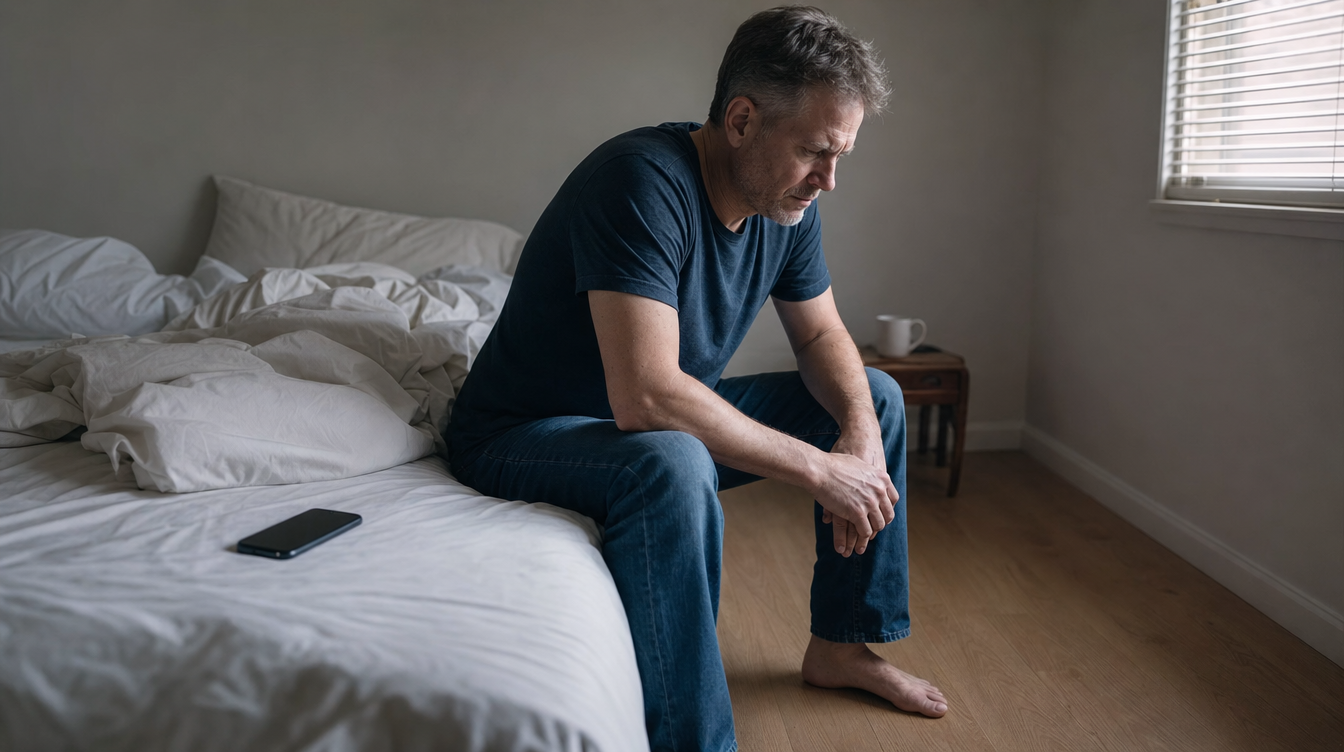
It sounds dramatic. It isn't. The same story comes back over and over, from people who did everything right.
You started the medication hoping to feel better. And maybe, for a while, the crushing weight lifted a little.
Then you noticed something else disappearing too.
The medication didn't just dull the depression. It dulled you.
And here is what almost nobody explains: you were never broken. You were given the wrong explanation for what was actually happening inside your brain.
From $0.59 a tablet · free shipping · 30-day money-back guarantee
The science on this page is published in
The explanation you were given
An entire category of medicine was built on the serotonin deficiency hypothesis — the idea that depression is caused by too little serotonin, and that topping it up is therefore the fix.
In 2022, a systematic umbrella review in Molecular Psychiatry pooled decades of research across every major line of evidence for that hypothesis — serotonin metabolites, receptor binding, depletion studies, gene association. Its conclusion was blunt: there is no consistent evidence that depression is caused by lowered serotonin activity.[1]
Read that again. The explanation you were handed in a ten-minute appointment was a hypothesis, and the umbrella review found the evidence for it doesn't hold together.
So if it isn't a serotonin shortage — what is it?
For a great many people, and especially for those who either didn't respond to an SSRI or who traded depression for a flat, hollowed-out version of themselves, the problem was never the amount of a neurotransmitter.
It was the physical environment those neurotransmitters were trying to operate in.
The root cause
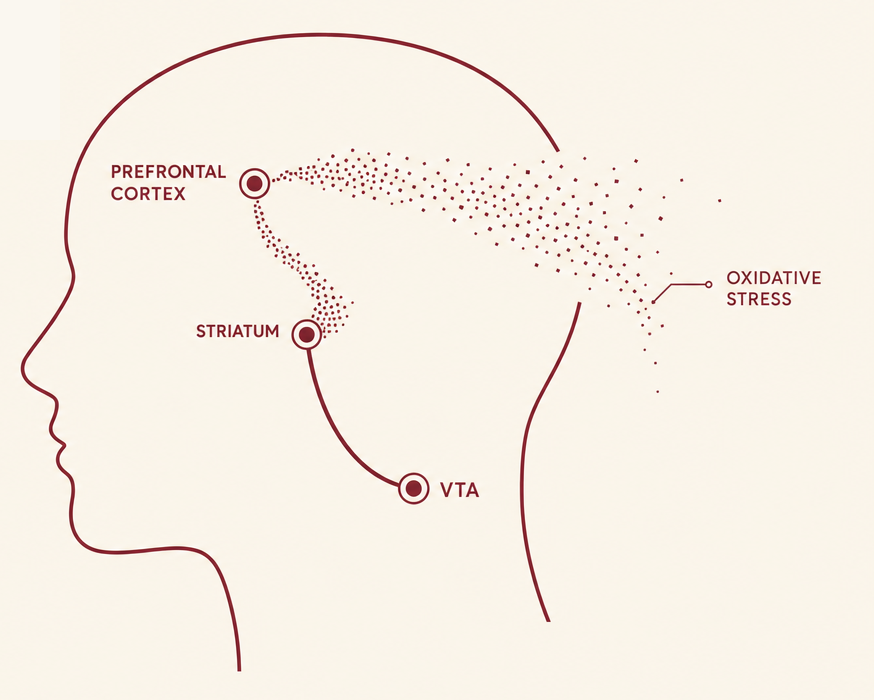
Your brain is about 2% of your body weight and burns roughly 20% of your oxygen. And the neurons that generate reward, anticipation and motivation — the dopamine pathway running from your midbrain up into the striatum and prefrontal cortex — are among the most energy-hungry cells you own.
Neurons can't store fuel. They run their mitochondria continuously, all day, for decades. Every one of those reactions throws off reactive oxygen species: free radicals, molecular exhaust.
In a young, well-buffered brain that exhaust is cleaned up as fast as it's made. With age, chronic stress, broken sleep, inflammation and illness, the balance tips. Production climbs. Buffering capacity falls. Researchers call the tipped state oxidative stress.
And here is the finding that reframes the whole picture: a meta-analysis pooling dozens of studies and thousands of participants found markers of oxidative damage consistently elevated in people with depressive symptoms — and falling again as those symptoms improved.[3]

That is why nothing feels good any more. Not because you lack serotonin. Not because you're ungrateful, or lazy, or not trying hard enough.
Because the neurons responsible for tagging experience as "worth wanting" are working in conditions so oxidatively noisy that the signal can't get through.
Why the medication couldn't reach it
Flooding the system with serotonin does nothing about the oxidative environment inside your reward circuitry. It works at a completely different level — and it works globally.
Serotonin doesn't discriminate. It modulates all emotional processing: joy, grief, anxiety, love, sexual response, connection. You cannot selectively keep the good and remove the bad, because one dial governs the lot.
An SSRI
Acts on neurotransmitter availability, brain-wide. Turns the volume down on the whole signal because one channel was too loud.
The oxidative layer
Is the physical condition of the tissue itself. Clean it up and the existing signalling works better — nothing is suppressed.
It is like turning down the volume on your entire life because one channel was too loud. And the trade-offs compound:
While you were emotionally numb and sexually disconnected, the layer that was actually degrading your reward machinery was completely untouched — because no SSRI was ever designed to reach it.
The requirement is oddly specific
You have probably tried the antioxidant route already. Vitamin C. Vitamin E. Curcumin. Resveratrol. Perhaps six bottles at $80 a month that changed nothing at all.
There are two separate reasons that aisle underdelivered for thirty years, and they're worth separating.
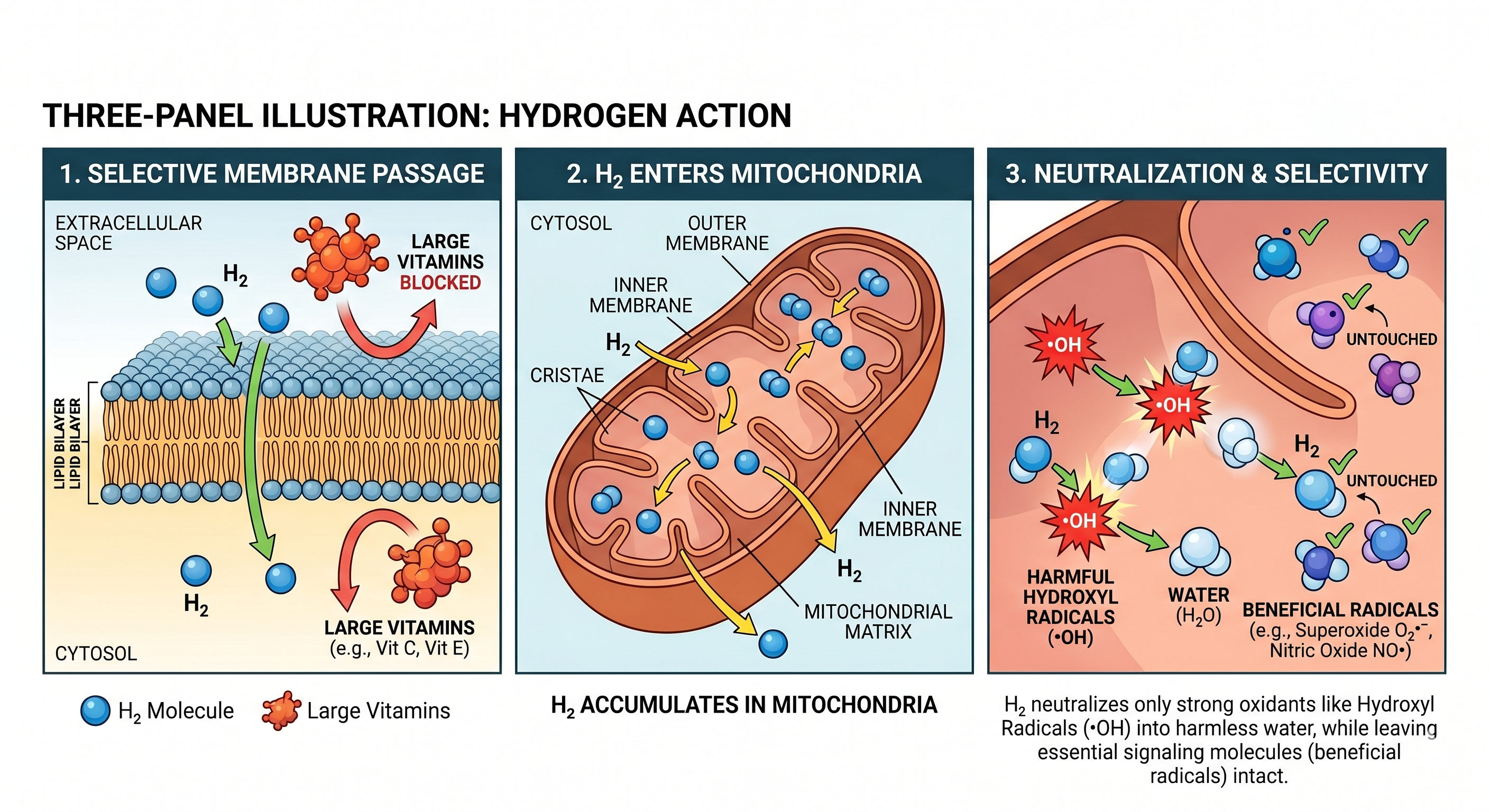
Your brain is guarded by the blood-brain barrier, which exists specifically to keep molecules out. Most compounds need a transporter, a carrier, or a great deal of luck. Curcumin is 368 daltons. Vitamin C is 176.[5] Getting either across the barrier, through a cell membrane, and into the mitochondria where reactive species are actually produced is a genuine engineering problem.
Most of what you swallowed never got anywhere near the neurons that needed it.

Your body uses reactive species. They are signalling molecules — for immune response, for cell housekeeping, for adaptation. Flood the system with a high-dose scavenger and you don't just remove the damage. You remove the signal. That is a large part of why the big antioxidant trials repeatedly disappointed, and occasionally did harm.
Small enough to cross the barrier and the membrane unaided, reach the mitochondria, and then be selective enough to neutralise the destructive radicals while leaving the useful ones alone.
There is exactly one molecule that does all four — and it's the first element on the periodic table.
The molecule
Two. The smallest molecule that exists. It diffuses straight through the blood-brain barrier, through cell membranes, and into the mitochondria — no transporter, no carrier protein, no permission required. It reaches the exact organelle, in the exact neurons, where the oxidative exhaust is generated.
Nothing else in your cabinet can make that claim.
In 2007, a team publishing in Nature Medicine showed that molecular hydrogen acts as a selective antioxidant. It preferentially neutralises the most destructive species — hydroxyl radicals and peroxynitrite — while leaving the ordinary reactive signalling your body depends on completely alone.[2]
That paper is why there are now more than two thousand peer-reviewed papers on molecular hydrogen across medicine — and why the brain became one of the most-studied targets almost immediately.
An SSRI works on a neurotransmitter system, globally. Hydrogen works on the environment — the oxidative conditions inside the neurons — without acting on any neurotransmitter system directly.
| SSRI | Molecular hydrogen | |
|---|---|---|
| What it acts on | Serotonin availability, brain-wide | Oxidative conditions inside the cell |
| Selectivity | Modulates all emotional processing | Targets destructive radicals only |
| Effect on dopamine signalling | Downregulation reported | Not a neurotransmitter agonist |
| Serotonin-receptor activity | Direct, by design | None |
| Discontinuation | Withdrawal effects can persist | Nothing to taper |
| Reaches the mitochondria | Not its mechanism | By simple diffusion |
It clears the static. It doesn't touch the signal.
What people actually describe
Not a dramatic moment. Not an overnight transformation. Weeks in, something shifts — and it's almost always specific rather than sweeping.
★★★★★
"My daughter said something funny in the car. And I laughed. Actually laughed. I pulled over because I was crying — not sad crying. I'd just forgotten what that felt like."
★★★★★
"I noticed I was looking forward to Saturday. I hadn't looked forward to anything in two years. I almost didn't recognise the feeling."
That is what it looks like when the oxidative environment starts to clear. Not global suppression. Not choosing between sadness and nothing. Just the neurons that generate reward getting clean enough conditions to send a signal again.
Individual experiences. Not typical results, and not a substitute for medical care.
Who this is for
If you have been living in that hollow space between depression and numbness, wondering whether a diminished existence is simply the price of not being in crisis — the layer underneath is worth thirty days of your attention.
Not all hydrogen is equal
The clinical research used hydrogen-rich water at meaningful, consistent concentrations, taken daily over weeks. Most of what's sold doesn't meet that bar.

And one thing that isn't in the box: the research pairs hydrogen with movement, daylight and sleep, not instead of them. If you're going to change one thing, change two.
What to expect
Days 1–7
Nothing perceptible. The molecule is diffusing and neutralising, but you won't feel it. This is exactly where most people quit — which is why we're telling you now.
Week 2
The first change usually isn't mood at all. It's the afternoon: the 2 p.m. wall arriving later, or landing softer. That's the broader metabolic shift, not the reward circuit yet.
Weeks 3–4
This is where it gets specific, and where the human trial ran its four weeks.[4] Catching yourself genuinely in a conversation rather than performing one. A song playing and something flickering — not joy yet, just a signal where there was dead air.
Weeks 6–12
The one people write in about: looking forward to something again. Anticipatory reward tends to return before consummatory does, which means you notice you made the plan before you notice you enjoyed it.
That's the point at which people tend to say the same thing: oh — I'm still in here.
Give it thirty days before you judge it. That's the window the guarantee is built around.
Straight answers
Talk to your prescriber first. And to be unambiguous: do not stop or reduce any prescribed medication because of anything on this page. Hydronate is a dietary supplement, not a medicine — it is not a replacement for treatment and is not intended to be used as one.
No, and we won't claim otherwise. There is no large trial of molecular hydrogen for either. What the evidence supports is that oxidative stress is elevated in depressive states, and that H₂ selectively reduces destructive radicals in tissue other antioxidants struggle to reach. That's a mechanism worth understanding, not a cure to buy.
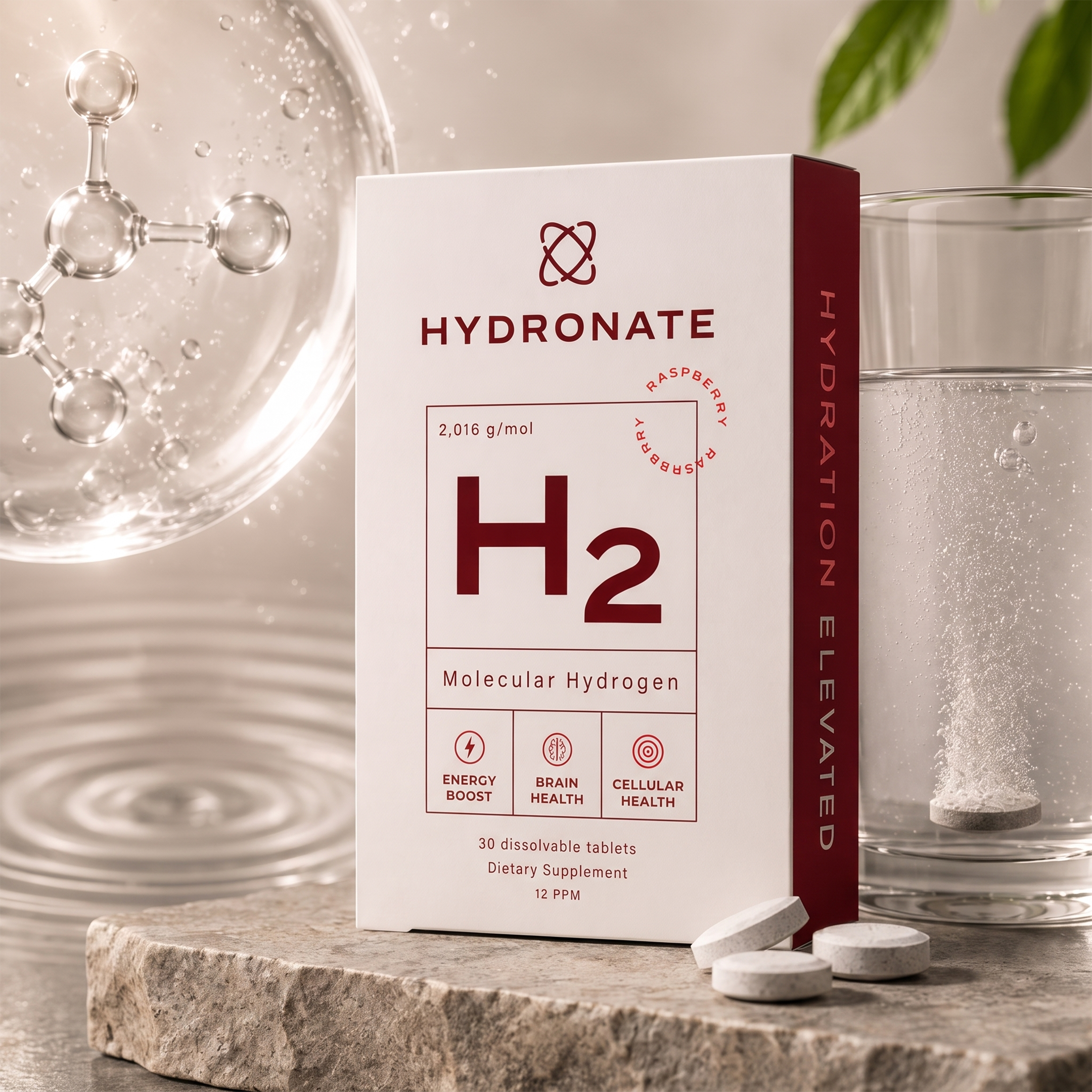
Plain water contains no measurable dissolved hydrogen. The tablet puts H₂ into it, at 12 PPM. The water is the delivery vehicle — hydrogen is the active molecule.
Blunt high-dose antioxidants largely were, and for good reason: they interfere with the reactive signalling your body actually needs. H₂'s documented selectivity is the specific property that makes it behave differently — it's the finding the whole field is built on.
Hydrogen is the first element on the periodic table. Nobody owns it, so nobody can patent it — which means no sales force, no clinic reps, and no budget for the large expensive trials that put something on a treatment guideline. That's an economics story, not an evidence story.
Molecular hydrogen is well tolerated in the published literature, with no serious adverse events reported at the doses used in human studies. If you're pregnant, nursing, taking medication or managing a medical condition, check with your doctor first.
Two paths
Not just the absence of pain.
You can keep living in the hollow space — calling it tiredness, calling it a busy season, deciding that flat is simply what stable feels like now.
Or you can give thirty days to the layer underneath: two minutes a morning, one tablet, one glass of plain water, plus the walk and the sleep the research pairs it with.
If nothing changes, you're covered. The only thing you're actually risking is the two minutes.
From $0.59 a tablet · free shipping · 30-day money-back guarantee
Start here
30-day money-back guarantee · cancel anytime
P.S. The size argument isn't marketing — it's the periodic table. 2 daltons versus 368. That's why one molecule reaches the inside of a brain cell and most of the shelf never gets close.
P.P.S. Don't judge it in week one. The human trial ran four weeks. Give it four weeks.
P.P.P.S. Pair it with a walk and a decent night's sleep. That's how the research was designed, and that's how it should be used.
P.P.P.P.S. Do not stop or reduce any prescribed medication because of anything on this page. Talk to your prescriber. Hydronate is not a replacement for medical treatment and is not intended to be used as one.
[1] Moncrieff J, Cooper RE, Stockmann T, Amendola S, Hengartner MP, Horowitz MA. The serotonin theory of depression: a systematic umbrella review of the evidence. Molecular Psychiatry. 2023;28(8):3243–3256.
[2] Ohsawa I, Ishikawa M, Takahashi K, et al. Hydrogen acts as a therapeutic antioxidant by selectively reducing cytotoxic oxygen radicals. Nature Medicine. 2007;13(6):688–694.
[3] Black CN, Bot M, Scheffer PG, Cuijpers P, Penninx BWJH. Is depression associated with increased oxidative stress? A systematic review and meta-analysis. Psychoneuroendocrinology. 2015;51:164–175.
[4] Mizuno K, Sasaki AT, Ebisu K, et al. Hydrogen-rich water for improvements of mood, anxiety, and autonomic nerve function in daily life. Medical Gas Research. 2017;7(4):247–255.
[5] Molecular weights per PubChem: molecular hydrogen 2.016 g/mol; ascorbic acid 176.12 g/mol; curcumin 368.38 g/mol.