The symptom nobody names

"I'm Not Depressed. I Just Stopped Looking Forward to Things."

There's a word for it — anhedonia — and a growing body of research says one of its quietest drivers isn't in your personality. It's oxidative stress, sitting inside the cells of your brain's reward machinery.

A man in his fifties sitting on the edge of an unmade bed in morning light, phone face-down beside him, looking at the floor.

How many of these do you recognize?

Most people reading that list have somewhere between three and six. It isn't a diagnosis — it's a pattern, and patterns have causes. This one has a name, and it has a mechanism.

See What Hydronate Does >>>

From $0.59 a tablet · free shipping · 30-day money-back guarantee

The science on this page is published in

Nature Medicine2007
Neuropsychopharmacology2009
Psychoneuroendocrinology2015
Medical Gas Research2017
What it actually is

Anhedonia Isn't Low Mood. It's a Reward System That Stopped Reporting In.

Sadness is a feeling. Anhedonia is the absence of one — and that's why it's so hard to describe to anyone, including a doctor.

Clinically it splits in two, and most people have the second one first:

Consummatory

You no longer enjoy the thing while you're doing it. The meal, the film, the holiday — all fine, none of it lands.

Anticipatory

You no longer look forward to it. This one usually comes first, and it's the one that quietly deletes plans from your calendar.

Underneath both sits one circuit: the dopamine pathway running from your midbrain up into the striatum and prefrontal cortex. It's not a "happiness" system — it's a signaling system. Its job is to tag things as worth wanting, then worth doing.

When that signaling gets noisy, the tags stop arriving. Nothing gets marked worth it. You don't feel sad about it. You just... don't go.

And that circuit is one of the most energy-hungry, most oxidatively exposed pieces of tissue in your entire body.

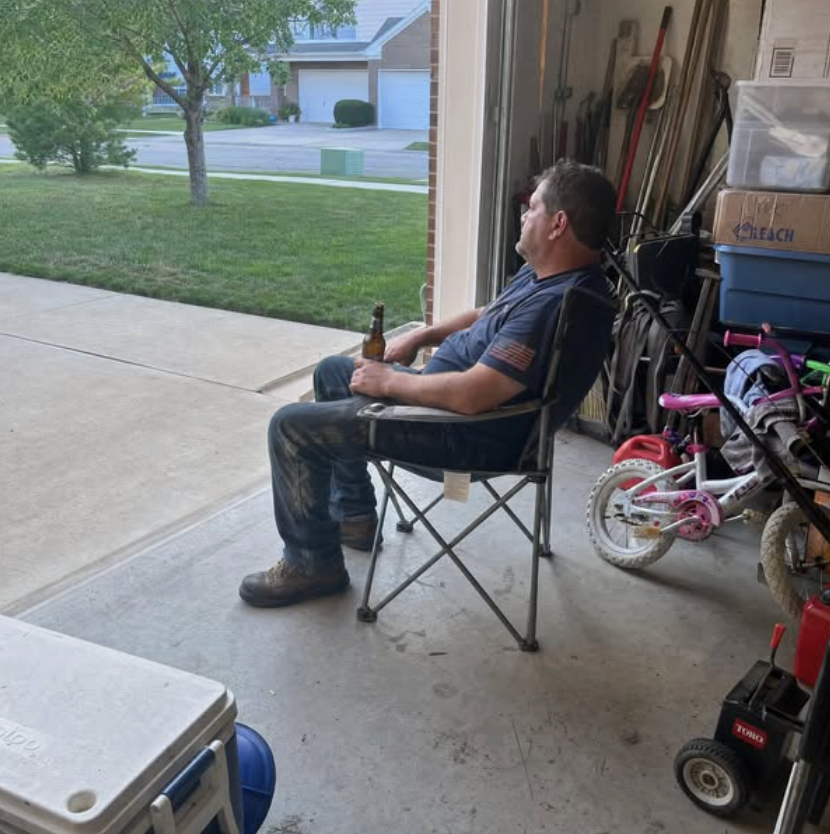
A man sitting alone in a folding chair in his open garage at the end of the day, holding a beer, looking out at the empty street.
Not unhappy. Not in crisis. Just sitting where the day ended, waiting for something to feel worth getting up for.

The root cause

Your Reward Circuit Runs Hot — and Oxidation Is the Exhaust

Your brain is about 2% of your body weight and burns roughly 20% of your oxygen. Neurons can't store fuel. They run their mitochondria continuously, all day, for decades.

Every one of those reactions throws off reactive oxygen species. That's not a defect — it's combustion. In a young, well-buffered brain it's mopped up as fast as it's made.

20% of the oxygen you breathe is consumed by the brain — in tissue that is unusually rich in oxidisable fats and unusually thin on antioxidant reserve

With age, chronic stress, poor sleep, alcohol, illness and inflammation, the balance tips. Production goes up. Buffering capacity goes down. Researchers call the tipped state oxidative stress, and in the brain it isn't an abstraction — it's measurable in blood and urine.

And here's the part that matters for anhedonia specifically: a meta-analysis of dozens of studies found markers of oxidative damage consistently elevated in people with depressive symptoms, and falling again as those symptoms improved.[2]

Oxidative stress isn't the same thing as feeling flat. But it is one of the conditions the cells doing your feeling are being asked to work in.

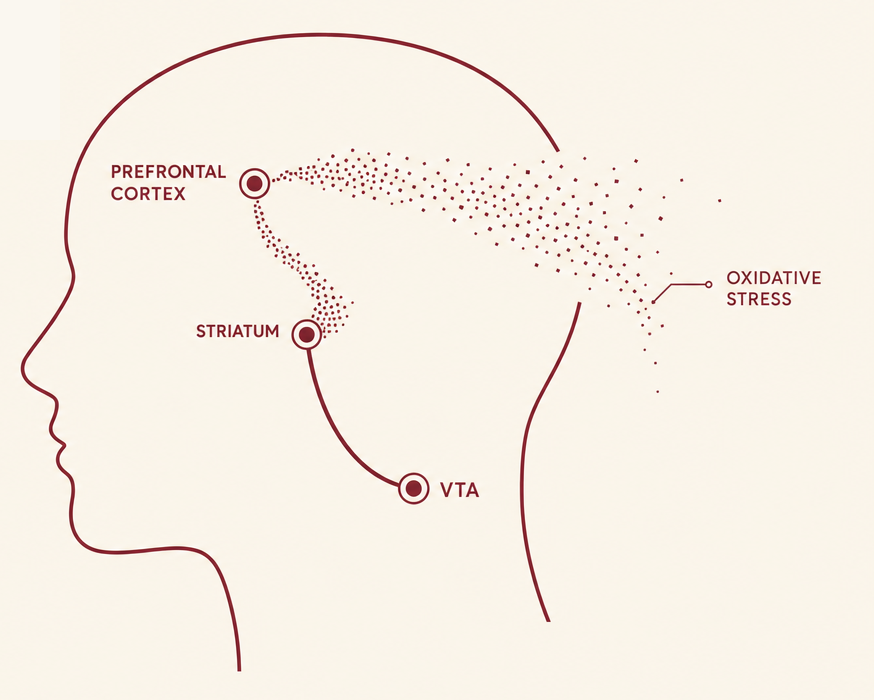
Diagram of the mesolimbic dopamine pathway from VTA to striatum to prefrontal cortex, with oxidative stress scattering the signal.
The mesolimbic dopamine pathway. Dopamine neurons originate in the ventral tegmental area (VTA) and project up into the striatum and prefrontal cortex — the circuit that drives reward, motivation and goal-directed behavior. The pathway doesn't shut off. The signal gets noisy — and noise reads as nothing.

Which raises the obvious question. If oxidation is the environment, why hasn't a shelf full of antioxidants fixed it?

Why the shelf failed you

Almost Everything You've Tried Is Too Big, Too Blunt, or Both

There are two separate reasons the antioxidant aisle has underdelivered for thirty years, and they're worth separating.

Problem one: size and access

Your brain is guarded by the blood-brain barrier, which exists specifically to keep molecules out. Most compounds need a transporter, a carrier, or a great deal of luck. Curcumin is 368 daltons. Vitamin C is 176. Getting either into the interior of a neuron — and then into its mitochondria, where the reactive species are actually produced — is a genuine engineering problem.

Problem two: blunt force

Your body uses reactive species. They're signaling molecules — for immune response, for exercise adaptation, for cell housekeeping. Flood the system with a high-dose scavenger and you don't just remove the damage. You remove the signal. That is a large part of why big antioxidant trials have repeatedly disappointed, and occasionally done harm.

So the requirement is oddly specific

You'd need something small enough to cross the barrier and the membrane without help, reach the mitochondria, and then be selective enough to neutralize the destructive radicals while leaving the useful ones alone.

There is exactly one molecule that does all four.

The molecule

Molecular Hydrogen Weighs 2 Daltons. That Is the Entire Argument.

H₂ is the smallest molecule that exists. Two protons, two electrons, nothing else. Neutral, non-polar, and small enough to diffuse straight through membranes — including the blood-brain barrier — with no transporter and no permission.

2

daltons — molecular hydrogen

368

daltons — curcumin

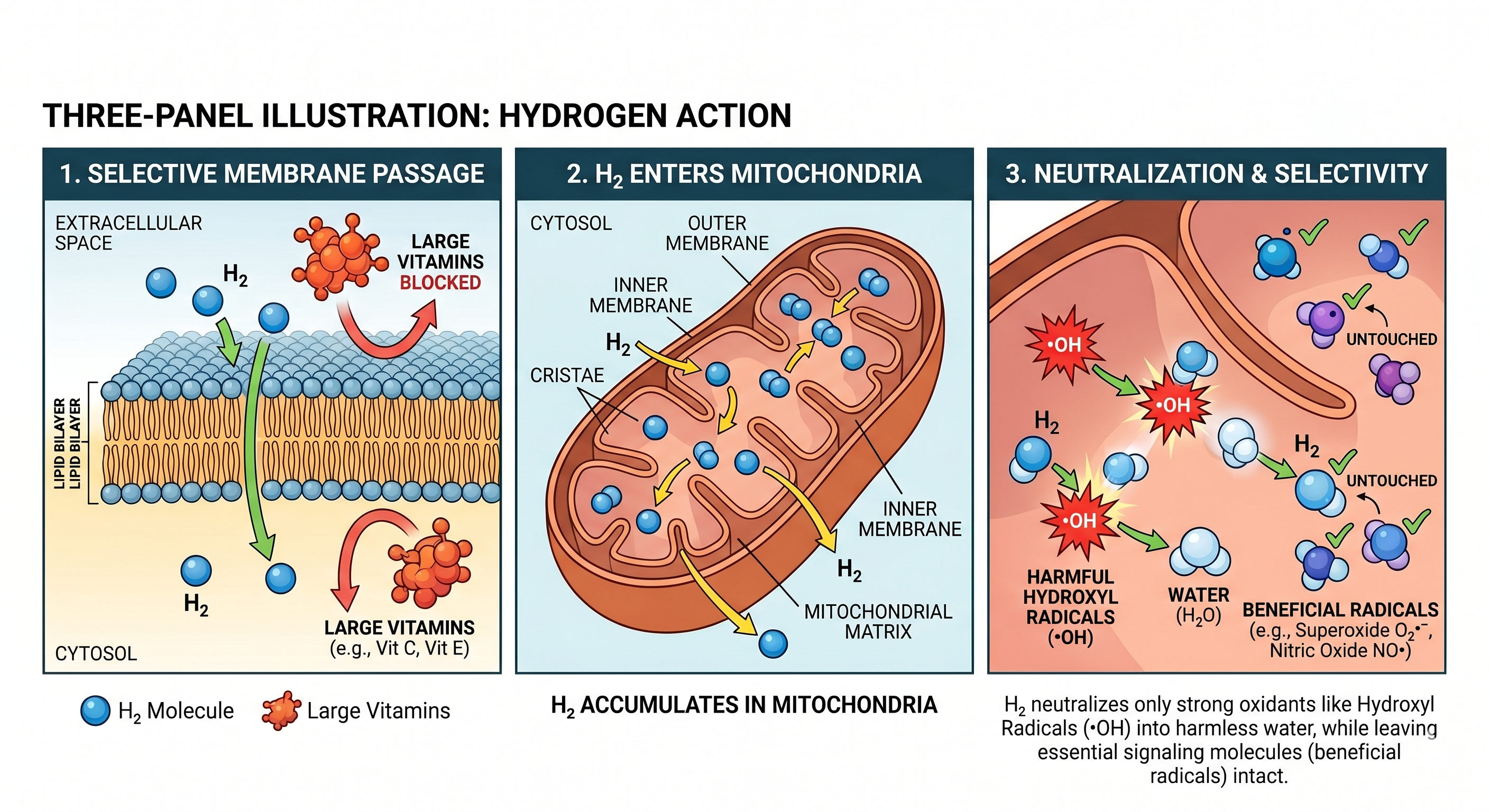
Three-panel illustration: hydrogen passing through the cell membrane, entering the mitochondria, and selectively neutralizing harmful radicals.

Then the second property — the one that started the entire field.

In 2007, a team publishing in Nature Medicine showed that H₂ is a selective antioxidant. It preferentially neutralizes the most destructive species — hydroxyl radicals and peroxynitrite — while leaving the ordinary reactive signaling your body runs on untouched.[1]

Small enough to reach the mitochondria. Selective enough not to flatten the signaling once it gets there.

That paper is why there are now over two thousand peer-reviewed papers on molecular hydrogen across medicine — and why the brain became one of the most-studied targets almost immediately.

The research

Thousands of Participants. Dozens of Studies. One Finding That Keeps Showing Up.

When researchers pooled the oxidative stress data across the depression literature — dozens of separate studies, thousands of participants — the pattern held. Depressive states run with measurably elevated markers of oxidative damage. It is one of the better-replicated findings in the field.[2]

Why that matters for the part of you that stopped looking forward

Your reward circuitry is metabolically expensive. The dopamine neurons that generate anticipation — the flicker before the good thing — run hot, and neurons that run hot generate free radicals as exhaust. When that exhaust outpaces your defences, the machinery doesn't die. It just gets quieter. That is what anhedonia feels like from the inside: nothing is wrong, and nothing is interesting.

And in people

In a randomised, placebo-controlled crossover trial, adults drinking hydrogen-rich water daily for four weeks scored better on mood, anxiety and autonomic nerve function than on placebo water.[3] Twenty-six participants — early-stage, and we'll say so plainly rather than dress it up. The mechanism is well-mapped; the human work is young.

Try Hydronate For 30 Days >>>

From $0.59 a tablet · free shipping · 30-day money-back guarantee

Side by side

Why This Isn't Another Bottle On The Shelf

 Typical antioxidantMolecular hydrogen
Molecular weight176–368 daltons2 daltons
Crosses the blood-brain barrierPoorly, or not at allFreely, no transporter
Reaches the mitochondriaRarelyYes — by diffusion
SelectivityBlunt — scavenges useful signaling tooTargets the destructive species
Time to prepareSwallow a capsuleTwo minutes in a glass

None of that makes hydrogen a miracle. It makes it the only common antioxidant with a plausible route to the place the problem actually is.

The routine

One Tablet. One Glass. Two Minutes, Before Anything Else.

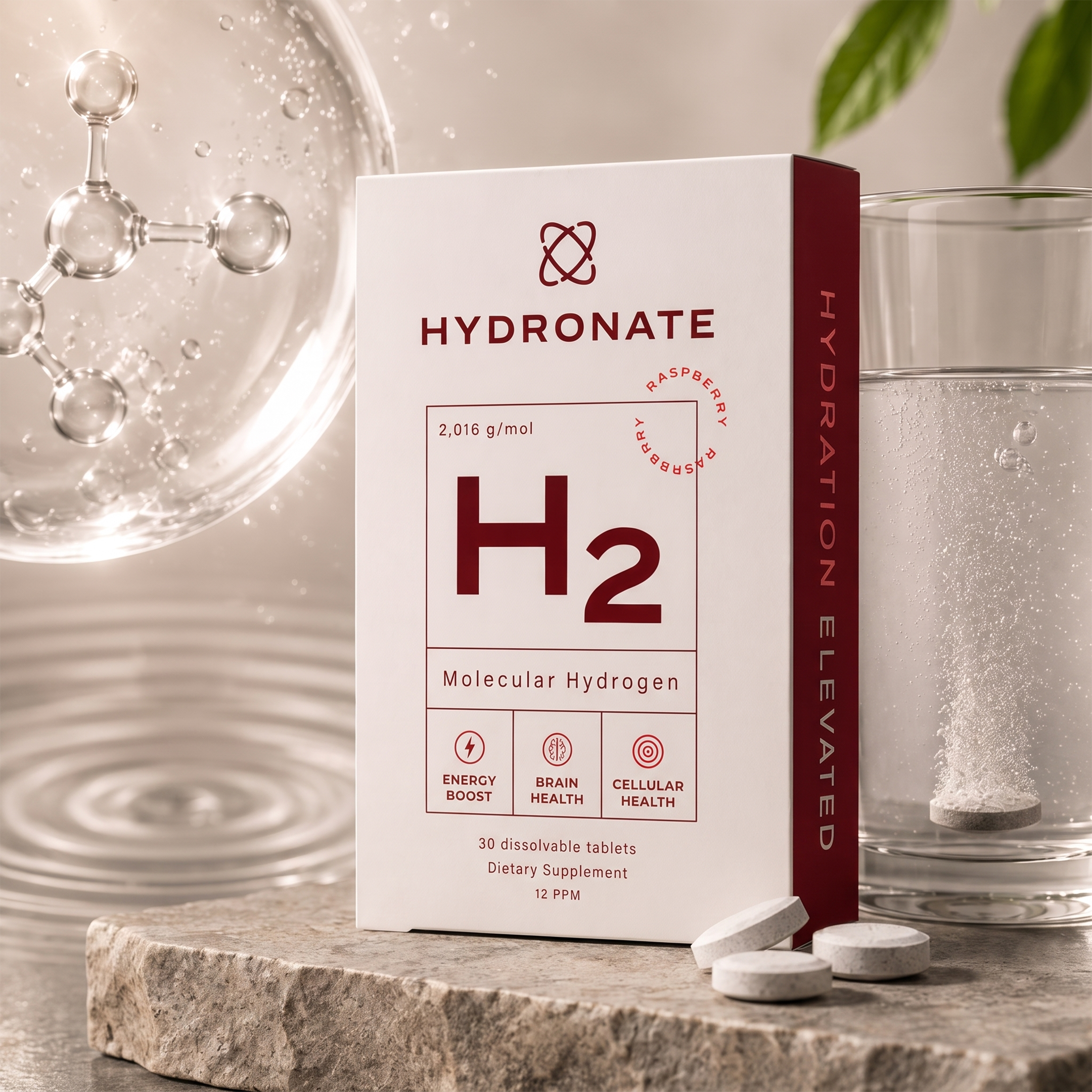
Drop a Hydronate tablet into plain water. It fizzes properly — like an effervescent tablet should — and in about two minutes the water is hydrogen-rich at 12 PPM. Drink it reasonably quickly, because hydrogen is a gas and it doesn't sit in an open glass forever.

That's it. That's the whole protocol.

Hydronate box beside a glass of water with a tablet dissolving.

And one thing that isn't in the box: the research pairs hydrogen with movement, daylight and sleep, not instead of them. If you're going to change one thing, change two.

What to expect

Nothing in Week One. That Is Not a Sales Problem, It's the Timeline.

Give it thirty days before you judge it. That's the window the guarantee is built around.

In their words

What People Tell Us — Unedited

★★★★★

"I kept saying I was tired, because tired is a word people accept. It wasn't tired. I'd sit down to watch something I'd been waiting months for and feel like I was watching a screensaver. Five weeks in I noticed I'd rewound a scene because I actually wanted to hear the line again. Small. But I hadn't done anything like that in two years."

Martin R.
58 · Verified purchase

★★★★★

"Honest review: weeks one and two, nothing. I'd written it off. What changed first was the afternoon slump, not my mood — I stopped needing the 3pm coffee. The rest came later and slower. I'm not going to claim it transformed me. I plan things again. That's what I've got."

Dev P.
44 · Verified purchase

★★★★★

"What sold me was that the page told me what it doesn't do. I've been through enough supplements that promise the moon. I'm on it alongside walking every morning and I'm not going to pretend I know which one is doing what. Both, probably. That's fine by me."

Karen S.
61 · Verified purchase

★★★★☆

"Retired chemist, so the only part of this I found persuasive was the size argument — 2 daltons versus 368 isn't marketing, it's the periodic table. Ten weeks. Sharper in the mornings, definitely. Whether the flatness has genuinely lifted or I'm just less exhausted, I can't tell you. I've reordered twice."

Alan W.
67 · Verified purchase

Individual experiences. Not typical results, and not a substitute for medical care.

Straight answers

The Questions We Get Most

Isn't this just water?

Plain water contains no measurable dissolved hydrogen. The tablet puts H₂ into it, at 12 PPM. The water is the delivery vehicle — hydrogen is the active molecule.

Weren't antioxidants debunked?

Blunt high-dose antioxidants largely were, and for a good reason: they interfere with the reactive signaling your body actually needs. H₂'s documented selectivity is the specific property that makes it behave differently — it's the finding the whole field is built on.

Can I take this with an antidepressant?

Talk to your prescriber. And to be unambiguous: do not stop or reduce any prescribed medication because of anything on this page. Hydronate is not a replacement for treatment and is not intended to be used as one.

Why haven't I heard of it?

Hydrogen is the first element on the periodic table. Nobody owns it, so nobody can patent it — which means there's no sales force, no clinic reps, and no budget for the large expensive trials that put something on a treatment guideline. That's an economics story, not an evidence story.

How long before I know?

Thirty days. Almost nobody reports anything in week one, the small human trial ran four weeks, and the changes people describe tend to be specific rather than dramatic. If thirty days gives you nothing, the guarantee covers it.

Any side effects?

Molecular hydrogen is well tolerated in the published literature, with no serious adverse events reported at the doses used in human studies. It's not a stimulant or a sedative and there's nothing to withdraw from. If you're pregnant, nursing, or managing a medical condition, check with your doctor first.

Two paths

You Can Keep Calling It Tiredness

Keep saying you're busy. Keep declining the thing you'd have said yes to five years ago. Keep waiting for it to lift on its own, because naming it out loud feels worse than living with it.

Or give thirty days to the layer underneath — two minutes a morning, one tablet, one glass of plain water, plus the walk and the sleep that the research pairs it with.

If nothing changes, you're covered. The only thing you're actually risking is the two minutes.

Start My 30 Days >>>

From $0.59 a tablet · free shipping · 30-day money-back guarantee

12PPM high-strength
2k+studies on H₂
Free US shipping
30day guarantee

Start here

Two Minutes Tomorrow Morning

Hydronate molecular hydrogen tablets.
from $0.59per tablet · one a day · free US shipping
Check Availability & Start My 30 Days >>>

30-day money-back guarantee · cancel anytime

P.S. If you take one thing from this page, take the size argument: 2 daltons versus 368. It isn't marketing. It's why one molecule reaches the inside of a brain cell and most of the shelf never gets close.

P.P.S. Don't judge it in week one. Almost nobody feels anything in the first seven days — and that's exactly where most people quit.

P.P.P.S. Pair it with a walk and a decent night's sleep. That's how the research was run, and that's how it should be used.

References

[1] Ohsawa I, Ishikawa M, Takahashi K, et al. Hydrogen acts as a therapeutic antioxidant by selectively reducing cytotoxic oxygen radicals. Nature Medicine. 2007;13(6):688–694.

[2] Black CN, Bot M, Scheffer PG, Cuijpers P, Penninx BWJH. Is depression associated with increased oxidative stress? A systematic review and meta-analysis. Psychoneuroendocrinology. 2015;51:164–175.

[3] Mizuno K, Sasaki AT, Ebisu K, et al. Hydrogen-rich water for improvements of mood, anxiety, and autonomic nerve function in daily life. Medical Gas Research. 2017;7(4):247–255.

[4] Molecular weights per PubChem: molecular hydrogen 2.016 g/mol; ascorbic acid 176.12 g/mol; curcumin 368.38 g/mol.

THIS IS AN ADVERTISEMENT AND NOT AN ACTUAL NEWS ARTICLE, BLOG, OR CONSUMER PROTECTION UPDATE.

These statements have not been evaluated by the Food and Drug Administration. This product is not intended to diagnose, treat, cure, or prevent any disease. The information provided on this page is for informational purposes only and is not a substitute for advice from your physician or other healthcare professional. You should not use this information for diagnosis or treatment of any health problem or for prescription of any medication or other treatment. Consult a healthcare professional before starting any diet, exercise, or supplementation program, before taking any medication, or if you have or suspect you might have a health problem. Testimonials reflect individual experiences and are not typical results.

Contact · Privacy Policy · Terms & Conditions · Refund Policy

Try Hydronate — 30-Day Guarantee >>>